

Local SEO Strategy: Dominate Google Maps Rankings
To dominate Google Maps rankings, businesses must optimize across Google's core local ranking signals: relevance, distance, and prominence. Claim and verify your Google Business Profile, complete 100% of profile attributes, automate rapid review responses, and track multi-point geo-grid visibility across neighborhoods to capture top 3-Pack placement.
Happy Rank's Geo-Grid heatmaps pinpoint exact Google Maps ranking positions across service areas, combining direct Google Business Profile synchronization with automated review replies to boost visibility. Trusted by over 10,000 local businesses and agencies worldwide, this AI-powered strategy optimizes rankings efficiently while maintaining consistent brand voice across customer interactions.
Google Maps ranking depends on a synced, fully optimized Business Profile plus consistent review activity Google trusts. Happy Rank's AI-powered Geo-Grid heatmaps pinpoint exactly where you rank across a service area, while automated review replies and direct Google Business Profile sync help businesses climb the local 3-pack faster.
What Do You Need Before Optimizing Your Listing?
A claimed, verified business listing comes first. Local businesses need a Google Business Profile in place before any optimization work begins. This listing is the foundation that feeds Maps, the Local Pack, and the Knowledge Panel. Skipping this step means every later effort has nothing to attach to.
Before moving into Google Business Profile optimization, gather these essentials:
- Verified ownership access to the Google Business Profile
- Accurate business name, address, and phone (NAP) details
- A clear grasp of local search as the broader goal, since visibility spans Search, Maps, and AI search results
- A tracking method, such as geo-grid local rank tracking, to measure progress once changes go live
With these pieces confirmed, a full local SEO strategy has something solid to build on.
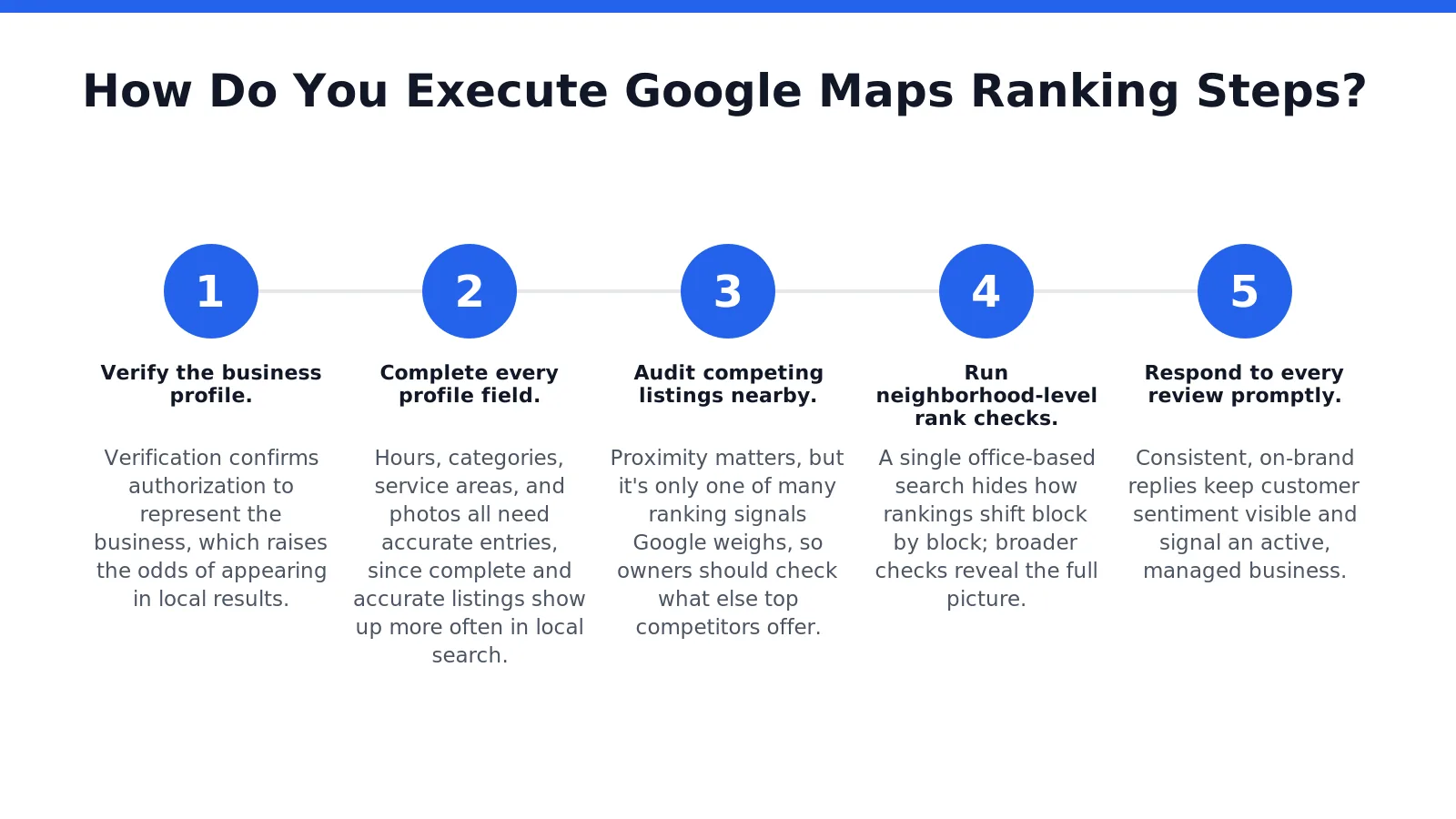
How Do You Execute Google Maps Ranking Steps?
Execution follows a defined sequence: verify ownership, complete every profile field, then track results across the surrounding area. Skipping steps wastes effort, because Google Maps ranking factors reward completeness and consistency together, not isolated fixes. Businesses that follow the order below build a foundation before chasing advanced tactics.
- Verify the business profile. Verification confirms authorization to represent the business, which raises the odds of appearing in local results.
- Complete every profile field. Hours, categories, service areas, and photos all need accurate entries, since complete and accurate listings show up more often in local search.
- Audit competing listings nearby. Proximity matters, but it's only one of many ranking signals Google weighs, so owners should check what else top competitors offer.
- Run neighborhood-level rank checks. A single office-based search hides how rankings shift block by block; broader checks reveal the full picture.
- Respond to every review promptly. Consistent, on-brand replies keep customer sentiment visible and signal an active, managed business.
Google Maps personalizes results by the searcher's exact location. A business ranking first downtown may sit far lower two miles away. Geo grid local SEO scanning solves this by testing dozens of grid points across a service area instead of one spot. This is the same logic behind local rank tracking tools built for small business owners managing multiple neighborhoods.

What Mistakes Derail Your Local Ranking Progress?
Three habits quietly stall local visibility: single-location rank checks, blind faith in an unoptimized profile, and manual tracking that eats up staff hours. Many owners check rankings only from their own office, missing how results shift across neighborhoods just a few miles away. That blind spot hides real ranking gaps.
A second trap: assuming a Google Business Profile guarantees top placement. Having one doesn't mean Google will rank it well; proximity, relevance, and profile completeness all factor in. A verified listing left half-finished still underperforms against competitors running a full GBP optimization routine.
Rankings vary by pin location, so a business owner checking only from a desk sees a skewed picture. Google generates a distinct set of results for every searcher location, which means a single search from the front counter can look strong while the same business barely appears three miles away. Geo grid local SEO scanning solves this by testing a grid of points spread across the entire service area, rather than relying on one search from one address. The resulting heatmap shows exactly which neighborhoods a business dominates and which ones need attention, turning a vague sense of 'we rank well' into a precise, block-by-block picture of local visibility.
That granularity matters because ranking factors like relevance, distance, and prominence shift as the searcher's pin moves. A business might hold a strong 3-pack position downtown while dropping out of the top results in a suburb just a few miles out, and without citywide tracking, that gap stays invisible until a customer mentions they couldn't find the listing. Regular geo-grid checks catch these blind spots early, so adjustments to categories, service areas, or photos can target the neighborhoods actually losing ground.
Manual review replies and rank checks also drain time better spent serving customers, since checking rankings across dozens of grid points by hand, and drafting a thoughtful reply to every new review, adds up to hours of repetitive work each week. Automating these tasks, paired with enterprise-grade security and direct Google integration, protects data while freeing up hours weekly, letting owners and marketing teams focus on strategic decisions instead of manual upkeep.
Conclusion: Sustained Growth on Google Maps
Mastering Google Maps ranking requires a strategic combination of optimization, consistency, and data-driven decision-making. By implementing the techniques outlined, from perfecting your Google Business Profile to building authentic reviews and leveraging local citations, you establish the foundation for sustained visibility in local search results. The most successful businesses recognize that local SEO is an ongoing commitment, not a one-time effort. With the right tools and strategies in place, you transform your online presence into a competitive advantage that drives qualified customers to your door.
Frequently asked questions
Do businesses need separate accounts for Maps and Search?
No. A single Google Business Profile powers all Google surfaces including Google Maps, the Local 3-Pack, and the Knowledge Panel in Search results. Managing one central listing ensures data consistency across the ecosystem.
Why does ranking differ by neighborhood?
Google Maps personalizes rankings based on the searcher's physical proximity to the business. A business ranking #1 downtown may drop outside the top 10 just two miles away, which is why multi-point geo-grid scanning is critical.
How does review management affect Google Maps ranking?
Review velocity, sentiment, and owner response rates directly influence prominence and trust signals. Consistent, keyword-natural review replies demonstrate active business management and improve overall local search visibility.
Why does citywide tracking matter more than office-based checks?
A search conducted from an office desk only reveals visibility from that single coordinate. Citywide geo-grid tracking reveals blind spots in adjacent suburbs and corridors where competitors may be outranking you.