
How Landscapers Can Rank for “Near Me” Searches
Landscapers rank for 'near me' searches by giving Google strong signals of relevance and prominence, not by repeating 'near me'. Complete and verify your Google Business Profile, list every landscaping service, set realistic service areas, add real project photos, build a page for each service, earn genuine reviews and local links, and track Maps rankings across neighborhoods.
When homeowners need lawn maintenance, garden design, or a complete outdoor makeover, they often search Google for a landscaper near me. If your business does not appear in local search results, you could be missing out on potential customers who are ready to hire. That is where local SEO for landscapers comes in. By optimizing your Google Business Profile, targeting relevant local keywords, and building a strong online reputation, you can improve your chances of appearing when nearby customers search for landscaping services.
However, ranking for “near me” searches takes more than adding those words to your website. You need to understand how Google evaluates local businesses and where your competitors are gaining visibility. Tools like [Happy Rank](/) can help you track Google Maps rankings, monitor local search visibility, and identify opportunities to strengthen your presence in nearby service areas.
With the right local SEO strategy, you can make it easier for homeowners in your service area to find and choose your landscaping business.
Understand How “Near Me” Searches Work for Landscapers
When someone searches for a landscaper near me, they usually want a business that can provide services in their area without a long wait or complicated arrangements. They might need regular lawn maintenance, garden renovation, tree and shrub care, or a complete landscape redesign. For landscaping companies, appearing in these searches creates an opportunity to connect with homeowners who are actively looking for professional help.
Understanding how local search works is the first step toward improving your visibility and attracting more relevant leads.
Why “Near Me” Searches Matter for Landscaping Businesses
Near me searches often indicate strong local intent. People are not simply researching landscaping ideas. Many are comparing nearby providers, checking reviews, and deciding whom to contact for an estimate.
For example, a homeowner searching for “lawn care near me” may be looking for recurring maintenance, while someone searching for “landscape design near me” may have a larger project in mind. Targeting these different needs helps your business reach the right audience.
Here are a few reasons these searches matter:
- Higher purchase intent: Searchers may already be looking for a landscaping company to hire.
- Local customer reach: You can connect with homeowners in the neighborhoods and communities you actually serve.
- More qualified leads: Relevant local visibility can bring in inquiries for services your business offers.
- Better brand awareness: Appearing in local results can help homeowners recognize your business when they compare providers.
How Google Determines Local Search Rankings
Google primarily considers three factors when ranking businesses in local results: relevance, distance, and prominence. Understanding these factors helps you make better decisions about your local SEO strategy.
- Relevance: How closely your business profile and website match the search. Accurate service categories and detailed descriptions help Google understand what you offer.
- Distance: How far your business is from the searcher or the location specified in the query. You cannot control where a customer searches from, so focus on serving your actual service area.
- Prominence: How well-known your business appears to be. Reviews, links from other websites, and information about your business across the web can contribute to prominence.
You cannot guarantee a top position by optimizing just one factor. Instead, build a complete local presence that accurately represents your business.
Find the Right Local Keywords for Your Services
Start by identifying the terms potential customers use when looking for your services. Combine your main offerings with relevant locations and customer needs.
Examples include:
- Landscaping company near me
- Lawn maintenance in Dallas
- Garden design near me
- Landscape installation in New York
- Commercial landscaping services near me
Use these local landscaping keywords naturally in relevant service pages, headings, and business descriptions. Avoid repeating “near me” unnaturally throughout your content. Google can use location signals and other context to understand local intent, so helpful content and accurate business information are more valuable than keyword stuffing.
Optimize Your Google Business Profile for Local Searches
Your Google Business Profile is one of the most important tools for improving your landscaping company's visibility in local search results. It helps potential customers discover your business on Google Search and Google Maps, learn about your services, read reviews, and contact you. If you want to rank for landscapers near me, start by making sure your profile accurately represents your business and the areas you serve.
Complete Your Business Information and Categories
Begin by claiming and verifying your profile. Add accurate business information, including your business name, phone number, website, operating hours, and primary business category. Choose the category that best describes your main service, then add relevant secondary categories when they accurately represent your business.
A complete profile helps Google understand your business and gives potential customers the information they need to make a decision.
Add Landscaping Services and Genuine Project Photos
Your profile should explain exactly what customers can hire you to do. Add relevant services such as lawn mowing, garden maintenance, landscape design, planting, mulching, and hardscaping if you offer them.
Include genuine landscaping project photos to show the quality of your work. Before-and-after images can be particularly useful because they demonstrate the difference your services make.
Consider uploading photos of:
- Recently maintained lawns and gardens
- Landscape design and installation projects
- Patios, walkways, and other outdoor features
- Seasonal garden improvements
- Completed residential or commercial projects
Set Up Your Service Areas Accurately
Many landscaping companies travel directly to customers instead of serving them from a storefront. If this applies to your business, configure your Google Business Profile service areas to reflect the cities, towns, and communities you genuinely serve.
For example, a landscaping company based in one city might serve several nearby communities for lawn maintenance and garden installation. Adding distant locations does not guarantee better rankings, so keep your service areas realistic and accurate.
Keep Your Profile Updated
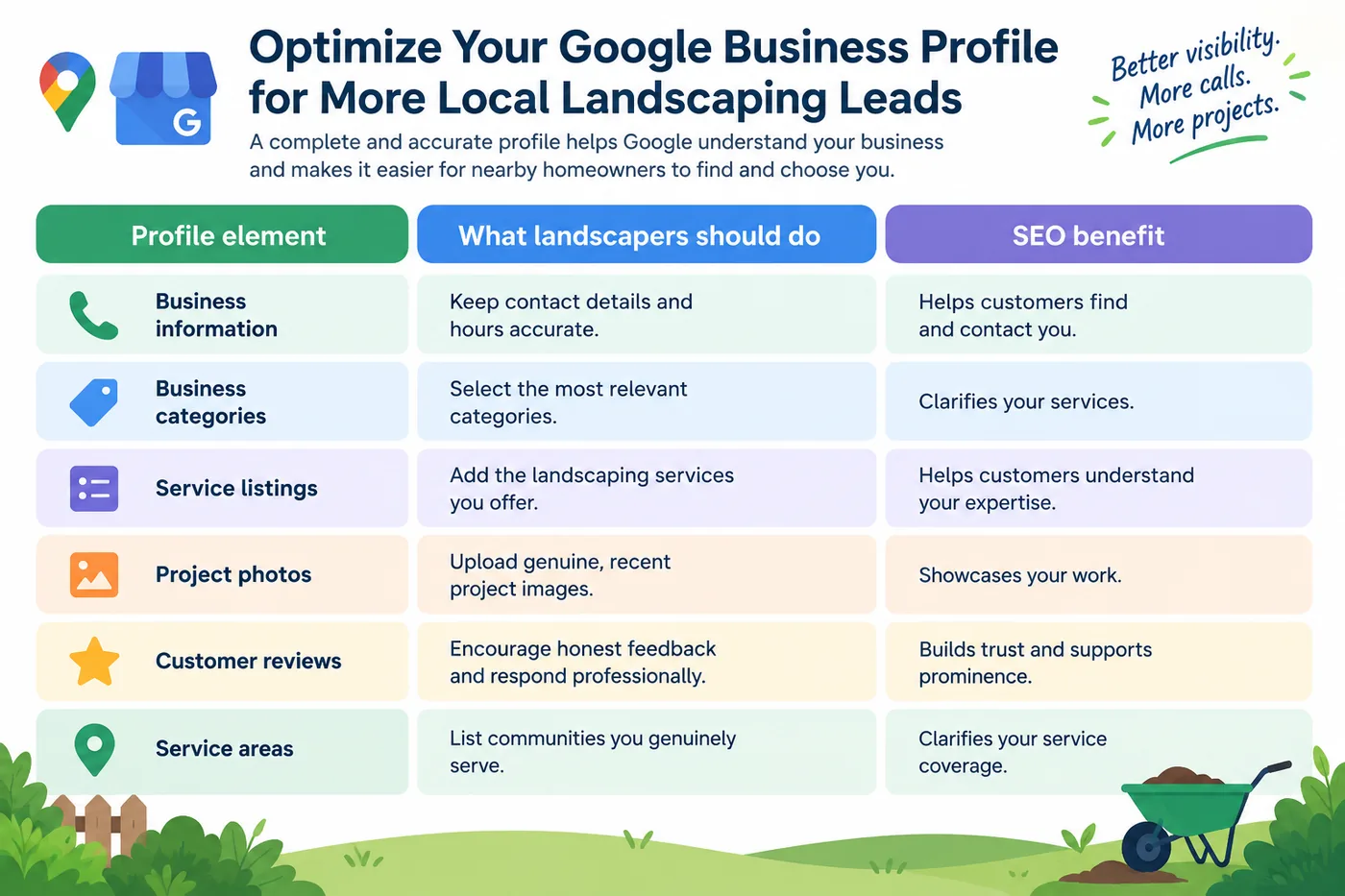
Maintaining your profile is an ongoing task, not a one-time setup. Use the following checklist to identify the areas that need attention.
A well-optimized Google Business Profile helps landscaping businesses improve their local search visibility and make it easier for nearby customers to find their services. Keep your business information accurate, choose relevant categories, list your landscaping services, and upload genuine project photos. Encourage honest customer reviews and specify the service areas you actually cover. These small but consistent improvements can strengthen customer trust and help potential clients choose your business when searching for a landscaper near me.
Review your profile regularly, update seasonal service information when needed, and share useful project updates when appropriate.
You can also use Happy Rank to monitor Google Maps rankings across different locations and identify areas where your landscaping business may need stronger local visibility.
A complete, accurate, and well-maintained profile supports your broader local SEO strategy and makes it easier for nearby homeowners to evaluate your landscaping services.
Improve Your Website and Local Keyword Targeting
Your Google Business Profile helps customers discover your landscaping company, but your website gives them more reasons to choose you. A well-optimized website helps search engines understand your services, locations, and expertise. To improve your chances of appearing for landscaping near me searches, focus on useful content, relevant local keywords, and a website that makes contacting your business easy.
Optimize Service Pages for Landscaping Keywords
Create dedicated pages for the main services you offer instead of squeezing everything onto one page. For example, lawn care, landscape design, garden maintenance, and patio installation can each have their own service page.
Include relevant local landscaping keywords in page titles, headings, descriptions, and body content naturally. Explain what each service involves, who it benefits, and which areas you serve.
Here are some examples:
| Page type | Example keyword | Content to include |
|---|---|---|
| Lawn care | Lawn care services in Dallas | Mowing, edging, fertilization, and maintenance plans |
| Landscape design | Landscape design in LA | Design process, project photos, and consultation details |
| Garden maintenance | Garden maintenance near me | Seasonal care, pruning, and planting services |
| Patio installation | Patio installation in New York | Material options, project examples, and installation details |
These pages help potential customers find information relevant to their needs while helping search engines understand your service offerings.
Create Useful Location Pages
If your landscaping company serves multiple communities, create dedicated location landing pages for the areas that matter most to your business. Include relevant services, local project examples, customer testimonials, and clear contact information.
Avoid publishing dozens of nearly identical pages with only the city name changed. Each page should offer genuinely useful information about serving that location.
Make Your Website Mobile-Friendly
Many homeowners search for local services on their phones. If your website loads slowly or makes contact details difficult to find, potential customers may leave before requesting an estimate.
Improve the experience by focusing on:
- Mobile-friendly design: Make text readable and navigation simple on smaller screens.
- Page speed: Compress large images and remove unnecessary elements that slow loading.
- Clear calls to action: Add visible buttons such as “Request an Estimate” or “Call for Landscaping Services.”
- Local business details: Display accurate contact information and explain your service coverage.
Publish Content That Answers Local Questions
Helpful blog posts about lawn care schedules, landscaping costs, seasonal planting, and garden improvements can attract relevant visitors. Use local SEO content to answer the questions homeowners actually ask, rather than repeating keywords unnecessarily.
Happy Rank can complement these efforts by helping you monitor local search rankings and identify opportunities to improve visibility for relevant landscaping keywords. Combine ranking data with website inquiries and estimate requests to understand which improvements are delivering meaningful results.
Strengthen Reviews and Local Authority
When homeowners search for a landscaping company near me, they want more than a nearby provider. They also want to know whether the business is reliable, experienced, and capable of delivering quality work. Building a strong online reputation through customer reviews, local citations, and relevant backlinks can help your landscaping business earn trust and support its local SEO efforts.
Encourage Genuine Customer Reviews
Customer reviews give potential clients an idea of what it is like to work with your business. Positive feedback about lawn maintenance, garden transformations, or professional service can help homeowners feel more confident about requesting an estimate.
Make it easy for satisfied customers to leave honest feedback by sharing your Google review link after completing a project. Avoid offering incentives for reviews or pressuring customers to leave positive ratings.
Focus on earning reviews that reflect genuine customer experiences. You can also respond professionally to feedback, thank customers for their time, and address concerns constructively.
Maintain Consistent Local Business Citations
Local citations are online mentions of your business details, such as its name, phone number, address where applicable, and website. These details may appear in business directories, landscaping associations, and local community websites.
Keep your information accurate and consistent across relevant platforms. Incorrect phone numbers or outdated business details can confuse potential customers and make it harder for them to contact you.
| Citation source | What to prioritize |
|---|---|
| Local business directories | Accurate business details and website |
| Landscaping associations | Relevant membership and service information |
| Local chambers of commerce | Correct business listings |
| Industry directories | Appropriate landscaping categories |
| Community websites | Genuine local business mentions |
Choose trustworthy, relevant directories rather than submitting your business to every website you find.
Earn Relevant Local Backlinks
Local backlinks are links from other websites in your community or industry that point to your website. Relevant links can help search engines discover your content and provide additional context about your business.
Consider building relationships with local nurseries, garden centers, property managers, home improvement businesses, and community organizations. You could collaborate on a gardening project, contribute expert advice to a local publication, or sponsor a community event.
Prioritize genuine relationships and useful contributions over buying links or participating in manipulative link schemes.
Showcase Local Projects and Customer Results
Your completed work can become a valuable source of trust and local relevance. Publish landscaping project case studies featuring garden renovations, lawn improvements, or outdoor installations in communities you serve.
Include details such as the customer's needs, the services provided, and the finished result. Add authentic photos and obtain permission before sharing customer information or project images.
Happy Rank can help you monitor local search visibility and compare your rankings across nearby areas. Combine this data with reviews, citations, and project content to identify opportunities to strengthen your reputation and attract more qualified landscaping leads.
Track Local Rankings and Improve Your Visibility
Improving your landscaping company's local SEO is not a one-time task. You need to understand where your business appears in search results, which services attract attention, and whether your efforts generate genuine inquiries. By monitoring local search rankings and reviewing performance data, you can identify weaknesses and make informed decisions about your next steps.
Monitor Google Maps Rankings Across Neighborhoods
A landscaping business may rank well in one neighborhood but appear much lower in another. This happens because Google Maps rankings can vary depending on the searcher's location and other local ranking factors.
Instead of checking your position from a single location, monitor visibility across the communities you serve. Geo-grid rank tracking helps you visualize rankings across multiple geographic points, making it easier to identify areas where your business performs well and locations that may need more attention.
Happy Rank offers geo-grid rank tracking to help local businesses understand how their Google Maps visibility varies across an area. Use these insights to prioritize realistic opportunities rather than expecting your business to rank first everywhere.
Analyze Competitors and Identify Ranking Gaps
Checking competing landscaping companies can reveal useful opportunities. Look at businesses that appear prominently for searches such as lawn care near me, landscape design in your city, or garden maintenance nearby.
Pay attention to factors such as:
- Google Business Profile optimization: Are competitors providing detailed and accurate business information?
- Customer reviews: How frequently do they receive feedback, and how do they respond?
- Website content: Do they have dedicated pages for specific landscaping services?
- Local authority: Are they mentioned by relevant directories or community websites?
Use these observations to identify practical improvements for your own business. Avoid copying competitors' content or assuming that one ranking factor explains their entire performance.
Measure Calls, Website Visits, and Estimate Requests
Rankings matter, but they are only part of the picture. Your ultimate goal is to attract customers who need landscaping services.
Track meaningful local SEO performance metrics to understand whether improved visibility leads to business opportunities.
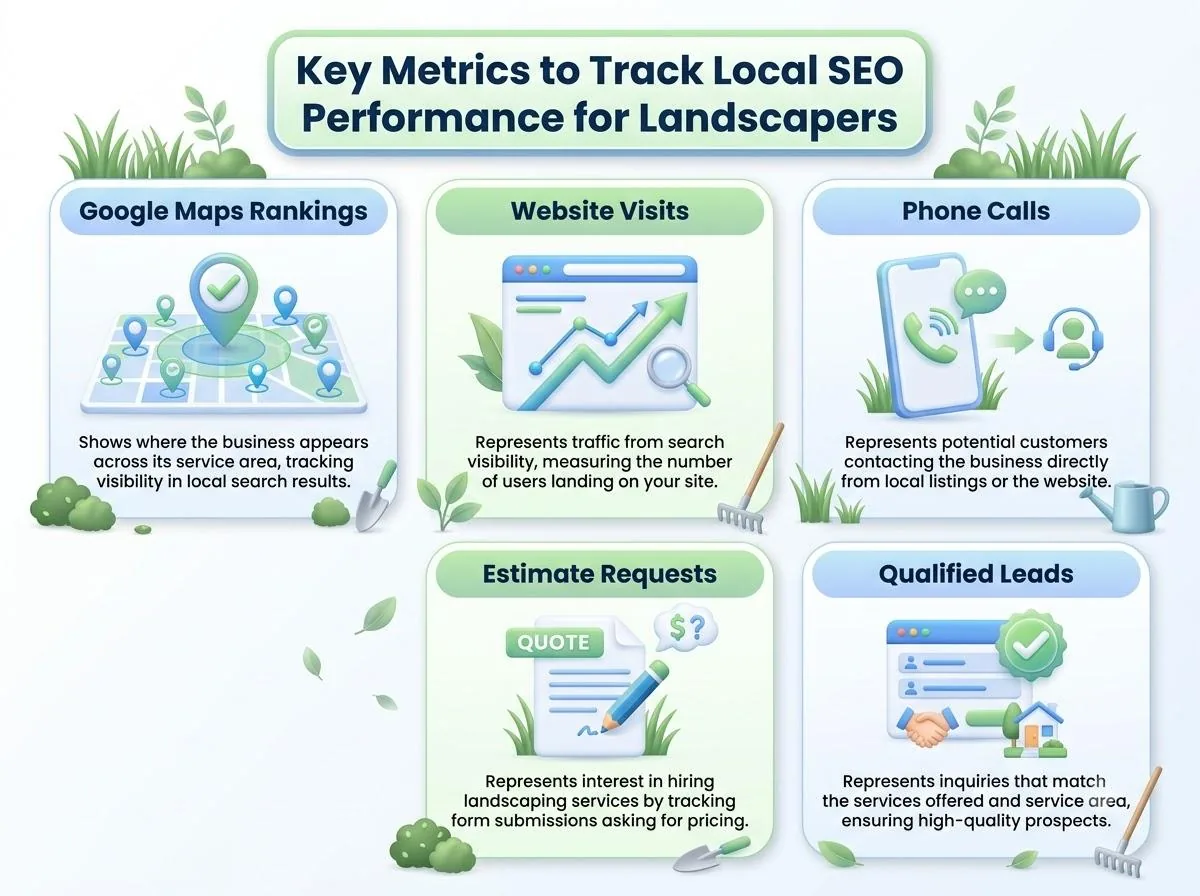
Tracking these local SEO metrics helps landscapers understand whether their optimization efforts are generating real business opportunities. Monitor Google Maps rankings across your service areas, review website traffic, and track phone calls, estimate requests, and qualified leads. These insights can reveal which strategies attract potential customers and where improvements are needed. Review your results regularly and use the data to refine your local SEO strategy and attract more landscaping customers.
Refine Your Local SEO Strategy
Review your performance regularly and focus on the biggest gaps first. If rankings are weak in an important area, review your business profile, service pages, reviews, and local competitors. If traffic increases but estimate requests remain low, improve your website's service information and calls to action.
Consistent local rank tracking helps you evaluate progress, adjust your strategy, and focus your time on improvements that can attract more relevant landscaping leads.
Conclusion
Ranking for “near me” searches takes consistent effort, but the results can make a real difference to your landscaping business. By optimizing your Google Business Profile, targeting relevant local landscaping keywords, building genuine customer reviews, and creating useful service area pages, you can improve your chances of reaching homeowners who are actively looking for landscaping services.
Remember, ranking higher is only part of the goal. You also want to turn that visibility into phone calls, estimate requests, and long-term customers. Monitoring Google Maps rankings and tracking performance across your service areas can help you identify opportunities and refine your local SEO strategy over time.
Tools like [Happy Rank](/) can help you track local search visibility, compare rankings across different locations, and understand where your business may need improvement. Start with the areas that matter most, measure your progress, and keep improving your online presence. The more accessible and trustworthy your business appears to local homeowners, the better positioned you will be to earn their attention and win more landscaping projects.
Frequently asked questions
Should landscapers add 'near me' to their website content?
No, not repeatedly. Google uses location signals and context to understand local intent, so accurate business information and helpful service pages matter more than repeating 'near me'.
How does Google rank landscapers in local search?
By relevance (how well your profile and site match the search), distance (how far you are from the searcher) and prominence (how well known you are, based on reviews, links and information across the web).
How should landscapers set service areas on Google Business Profile?
If you travel to customers, list the cities, towns and communities you genuinely serve. Adding distant locations doesn't guarantee better rankings, so keep the areas realistic.
What pages should a landscaping website have?
A dedicated page for each main service, such as lawn care, landscape design, garden maintenance and patio installation, plus location pages for key areas that include local projects and testimonials rather than only a swapped city name.
How can landscapers earn local backlinks?
Build relationships with nurseries, garden centers, property managers, home improvement businesses and community groups. Collaborate on projects, contribute expert advice to local publications or sponsor community events instead of buying links.
Why does my landscaping business rank in one neighborhood but not another?
Google Maps rankings change with the searcher's location. Geo-grid rank tracking shows your visibility across many points in your service area so you can see where to focus.