
Local SEO Software vs Manual SEO Management for Growing Businesses
Manual local SEO works for a single location with a manageable workload: it's low-cost and gives you full control, but checking rankings, reviews, competitors and reports by hand takes time. Local SEO software suits growing or multi-location businesses by centralizing rank tracking, profile and review monitoring and reporting. Human judgment is still needed for strategy either way.
As your business grows, getting noticed in local search becomes more challenging. You may need to monitor rankings across multiple service areas, keep your Google Business Profile updated, respond to customer reviews, and track competitors while managing everyday operations. Handling these tasks manually can work when you have a single location and a manageable workload. However, as your business expands, keeping everything organized becomes increasingly time-consuming.
This is where the choice between local SEO software and manual SEO management matters. Manual methods give you direct control over individual tasks, while local SEO tools can simplify local ranking tracking, Google Business Profile management, local competitor analysis, and SEO reporting through a centralized workflow. Platforms like [Happy Rank](/) can help businesses organize these activities and monitor local search performance more efficiently.
So, which approach makes more sense for a growing business? The answer depends on your team's capacity, budget, and goals. Let's compare both approaches to help you choose a practical, scalable local SEO strategy.
What Is Manual SEO Management?
Manual SEO management means handling your local search optimization tasks yourself or through a team without relying on dedicated software to centralize the entire process. You might use spreadsheets, search engines, your Google Business Profile dashboard, and separate reporting tools to monitor performance. This approach gives you direct control over each task, but it requires consistent time and attention.
Here are the main activities involved in manual SEO management:
- Google Business Profile management: Update business hours, contact details, service information, and business posts to keep your profile accurate.
- Local ranking tracking: Search Google and Google Maps to check where your business appears for relevant local keywords.
- Online review monitoring: Check customer feedback, respond to reviews, and identify recurring concerns that may affect your online reputation.
- Local keyword research: Find the search terms potential customers use when looking for your products or services.
- Local competitor analysis: Review competing businesses, their profiles, customer reviews, and local search visibility.
- SEO performance reporting: Collect ranking data, record changes, and organize results using spreadsheets or separate tools.
Each task contributes to a stronger local SEO strategy, but managing them individually can become challenging as your business expands.
What Does Manual Local SEO Management Look Like?
Manual local SEO management involves completing each optimization task separately and keeping track of the results yourself. For example, you might check your Google Maps rankings, update your Google Business Profile, respond to customer reviews, and record competitor activity in a spreadsheet. Each task is manageable on its own, but the workload increases as you target more local keywords or expand into additional service areas. You also need to review your records regularly to identify ranking changes, spot opportunities, and measure progress. Without a consistent process, important updates can easily be overlooked. This approach can work for smaller businesses.
| SEO activity | How you manage it manually | Main challenge |
|---|---|---|
| Google Business Profile | Update details and publish posts through the dashboard | Keeping information consistent |
| Local rankings | Search target keywords on Google and Google Maps | Rankings vary by search location |
| Customer reviews | Check reviews and respond individually | Regular monitoring takes time |
| Competitor research | Review competing businesses and their profiles | Comparing multiple competitors is labor-intensive |
| Reporting | Record metrics in spreadsheets | Gathering and updating data repeatedly |
Manual SEO management can work well for businesses with one location, a manageable workload, and enough time to maintain a consistent routine. It also gives owners direct involvement in their local search optimization efforts.
However, as your business grows, repetitive tasks can take time away from customer service and business development. If you need to track several locations or review performance regularly, local SEO software. A practical way to manage these tasks is to establish a routine and decide how often each activity needs attention. You do not need to check every metric daily, but you should review important changes consistently to maintain your local search visibility and identify opportunities for improvement.
For example, a growing local business might follow this schedule:
- Google Business Profile management: Weekly, check business details, posts, and services.
- Local ranking tracking: Weekly or biweekly, review keyword rankings across target areas.
- Online review monitoring: Several times a week, check new reviews and customer feedback.
- Local competitor analysis: Monthly, review competitors’ profiles, reviews, and visibility.
- SEO performance reporting: Monthly, assess ranking trends, website traffic, and customer actions.
To make manual SEO management more effective, focus on a few practical habits:
- Prioritize relevant local keywords: Track search terms that reflect your services and the locations you want to reach.
- Keep business information consistent: Check your name, address, phone number, opening hours, and service details across important online directories.
- Record changes regularly: Maintain a spreadsheet to document ranking movements, profile updates, and review trends.
- Measure meaningful outcomes: Look beyond rankings to evaluate website visits, phone calls, direction requests, and other customer actions.
- Review your workload: Identify repetitive tasks that take too much time or become difficult to manage as your business expands.
These practices create a reliable foundation for local SEO management. However, spreadsheets and manual checks can become difficult to maintain when you manage multiple locations or need frequent performance updates. Advantages and Limitations of Manual SEO Management
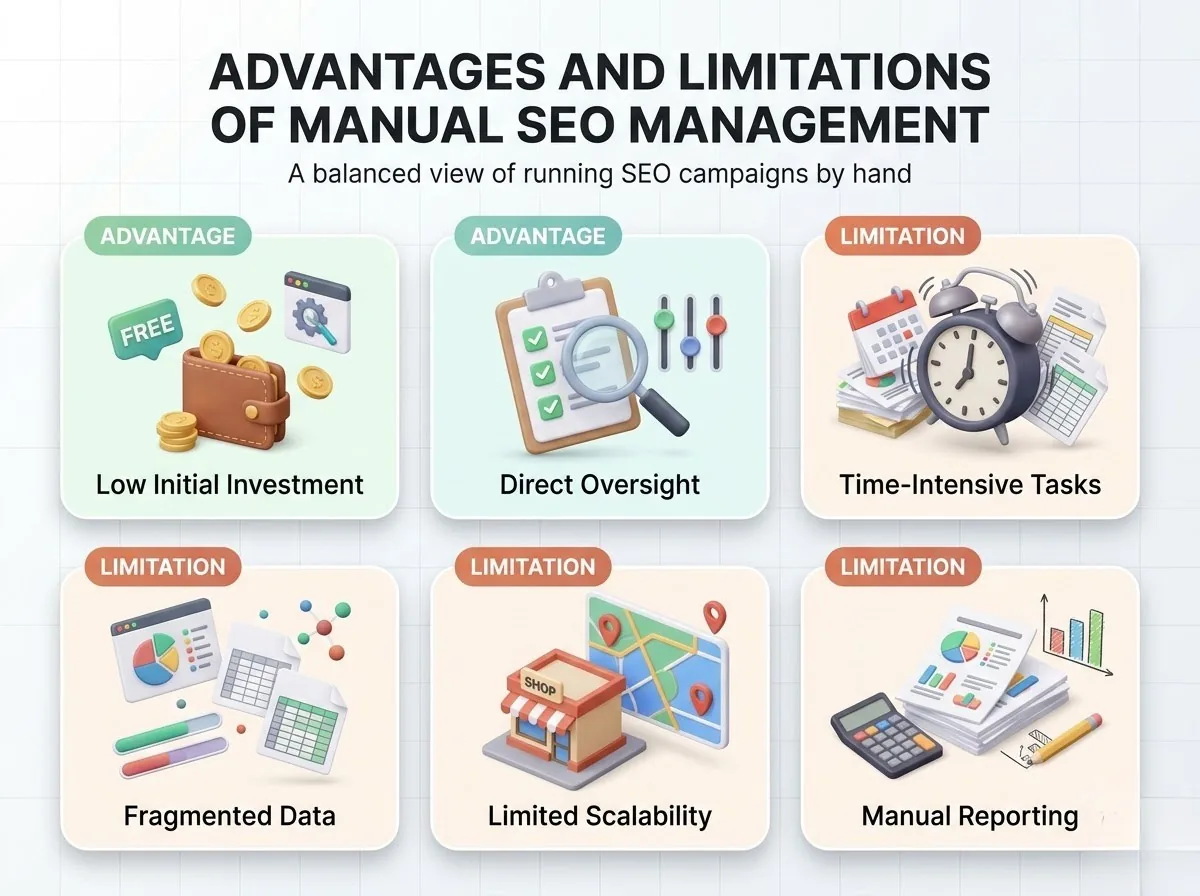
Manual SEO management gives growing businesses direct control over their optimization efforts. You can decide which local SEO strategies to prioritize, make changes when needed, and focus on the search terms most relevant to your customers. However, this approach also comes with limitations that become more noticeable as your workload increases.
Key advantages of manual SEO management include:
- Greater control: You can review every update and make decisions based on your business priorities.
- Lower initial costs: You can start with free resources such as Google Business Profile, Google Search Console, and spreadsheets.
- Flexible workflows: You can adjust your local search optimization activities without learning a new platform.
- Direct insights: Personally reviewing competitors and customer reviews can help you understand local market needs.
The main challenge is the time required to maintain these activities consistently. As your business grows, collecting data, checking rankings, and preparing reports can take attention away from other important responsibilities.
The right approach depends on your current resources and goals. If you operate one location and have time to monitor your Google Maps rankings, customer reviews, and local competitors, manual management may be sufficient. If you need to coordinate several locations or track performance more frequently, local SEO software can help organize recurring tasks and make reporting more manageable.
The key is to identify where manual work still delivers value and where a more structured workflow could improve efficiency without sacrificing human judgment.
What Is Local SEO Software?
Local SEO software is a digital tool that helps businesses manage, monitor, and improve their visibility in local search results. Instead of checking every metric separately, you can use a dedicated platform to organize important activities such as local ranking tracking, Google Business Profile management, competitor analysis, and SEO performance reporting.
For growing businesses, the biggest advantage is having a more organized view of local search performance. You can spend less time collecting information from different sources and more time deciding what needs improvement.
Depending on the platform and subscription, local SEO software may offer features such as:
- Local rank tracking: Monitor keyword rankings across specific locations and service areas.
- Google Business Profile monitoring: Review profile information and manage supported activities from a centralized dashboard.
- Review management: Monitor customer feedback and organize review-related workflows.
- Local competitor analysis: Compare your search visibility with competing businesses.
- Automated reporting: Generate reports that help you understand ranking trends and overall performance.
- Local SEO analytics: Review available performance data to identify opportunities for improvement.
How Local SEO Software Supports Growing Businesses
As your business expands, you may need to monitor more keywords, locations, and competitors. Local SEO software can help you organize this information without relying entirely on manually maintained spreadsheets.
| Software feature | How it helps |
|---|---|
| Geo-grid rank tracking | Shows how rankings vary across different points within a service area |
| Google Business Profile tools | Helps organize profile management and monitoring activities |
| Review monitoring | Makes customer feedback easier to track |
| Competitor tracking | Helps identify differences in local search visibility |
| Performance reports | Simplifies the process of reviewing progress over time |
For example, a plumbing company serving several nearby cities may struggle to understand its visibility by checking Google Maps manually. A platform with local rank tracking and geo-grid reports can provide a clearer picture of where the business performs well and where additional optimization may be needed.
Advantages and Limitations of Local SEO Software
Local SEO software can make it easier to manage growing optimization workloads, especially when you need to monitor several locations, track ranking changes, and prepare regular reports. Instead of gathering every metric manually, your team can use centralized dashboards and supported automation features to organize recurring tasks.
However, choosing software does not automatically improve your search rankings. The value depends on whether the platform addresses your actual needs and whether your team uses the information to make meaningful improvements.
Key advantages of local SEO software include:
- Improved efficiency: Reduce time spent on repetitive tasks such as collecting ranking data and compiling reports.
- Centralized performance tracking: Review important local SEO metrics in one place instead of switching between multiple tools.
- Location-level insights: Use geo-grid rank tracking to understand how your visibility varies across different areas.
- Consistent reporting: Monitor performance trends and share findings with your team more easily.
- Scalable workflows: Organize recurring SEO activities as you add locations, services, or team members.
There are also limitations worth considering before investing in a platform.
- Time management: Simplifies recurring tasks, but setup and learning take time.
- Ranking analysis: Organizes local ranking data, but results need interpretation.
- Reporting: Streamlines performance reviews, but available metrics vary by platform.
- Automation: Reduces repetitive work, but cannot automate every SEO task.
- Scalability: Supports multi-location management, but costs may increase as needs grow.
- Decision-making: Highlights optimization opportunities, but human judgment remains essential.
For example, a growing HVAC company may use local SEO software to identify neighborhoods where its Google Maps visibility is weak. The team can then investigate possible causes, improve relevant service pages, and review its Google Business Profile information.
Ultimately, the goal is not to automate everything. It is to build a more efficient local SEO workflow that gives your team reliable information while leaving strategy and important decisions in human hands.
Local SEO Software vs Manual SEO Management: Key Differences
Both approaches aim to improve your business's visibility in local search results, but they differ in how you manage everyday tasks. Manual SEO management relies on hands-on research, separate tools, and personal tracking, while local SEO software helps centralize data and streamline supported activities. The right choice depends on your workload, team capacity, and growth plans.
Let's compare the main differences that matter when choosing a local SEO strategy for your business.
Time and Operational Efficiency
Manual SEO requires you to check rankings, review customer feedback, update business information, and compile reports individually. This can work for a business with one location, but the workload increases as you expand.
With local SEO automation, you can reduce time spent on supported repetitive tasks and organize important information in a centralized dashboard. This gives your team more time to focus on optimization decisions and customer experience.
Local Ranking Accuracy and Visibility Tracking
Checking Google Maps rankings manually provides a basic understanding of your visibility, but results can vary by search location and other factors. Occasional searches may not reveal how consistently your business appears across its service area.
Dedicated local rank tracking software can monitor selected keywords across multiple geographic points. For example, a cleaning company can use geo-grid rank tracking to identify neighborhoods where its visibility is strong and areas that may need more attention.
Google Business Profile and Review Management
Manual Google Business Profile management involves checking profile details, monitoring reviews, and making updates individually. As customer interactions increase, maintaining a consistent routine becomes more demanding.
Depending on the platform, local SEO software can centralize profile monitoring and review-related workflows. However, you should confirm which actions are supported before choosing a tool.
Competitor Analysis and Reporting
Manual local competitor analysis often involves visiting competing profiles, checking search results, and recording observations in spreadsheets. Preparing reports also requires gathering data from different sources.
Local SEO software can organize competitor insights and available performance metrics, making it easier to identify trends and communicate results.
| Comparison factor | Manual SEO management | Local SEO software |
|---|---|---|
| Time investment | More hands-on work | Streamlines supported recurring tasks |
| Ranking monitoring | Individual searches and records | Structured tracking across selected locations |
| Reporting | Manually maintained spreadsheets | Centralized dashboards and available reports |
| Competitor research | Separate research activities | Organized competitor insights |
| Scalability | Workload grows with business needs | Helps coordinate larger workloads |
| Human oversight | Required for all decisions | Still essential for strategy and interpretation |
For growing businesses, software can offer a more organized way to manage increasing workloads.
Cost, Resources, and Scalability
Cost is another important factor when comparing local SEO software vs manual SEO management. Manual management may seem more affordable because you can start with free tools and handle tasks internally. However, the time your team spends collecting data, checking rankings, and preparing reports also has a cost.
Local SEO software typically involves a subscription, and pricing may depend on the features, number of locations, or tracking capacity you need. The investment can make sense when it reduces repetitive work and helps your team manage local search performance more consistently.
Before choosing an approach, consider these practical factors:
- Number of business locations: A single location may require less coordination than a company serving several cities. As your business expands, manual monitoring can become more demanding.
- Reporting requirements: If you need frequent performance updates, collecting data manually can consume valuable time. Software may simplify local SEO reporting through centralized dashboards and automated reports.
- Team capacity: Consider whether your employees can manage rankings, customer reviews, competitor research, and profile updates alongside their other responsibilities.
- Time spent on repetitive tasks: Identify activities such as local rank tracking and data collection that could be streamlined with dedicated tools.
- Budget and potential return: Compare subscription costs with potential time savings and the value of making better-informed SEO decisions.
For example, a local electrician operating from one location may find manual tracking sufficient at first. However, a growing electrical services company with several branches may benefit from centralized local SEO management, multi-location rank tracking, and more consistent reporting.
The best decision is not necessarily to choose the cheapest option. It is to establish a sustainable local SEO strategy that fits your budget, reduces unnecessary work, and supports your business as it expands.
When Should Growing Businesses Switch to Local SEO Software?
Manual SEO management can be effective when your business has a limited number of local SEO tasks and enough time to handle them consistently. However, as your customer base grows and you expand into new service areas, keeping track of every activity becomes more challenging. Recognizing when your current process is no longer efficient can help you choose the right time to invest in local SEO software.
Here are some signs that your business may benefit from a more organized approach.
You Are Managing Multiple Business Locations
If your business operates across several cities or neighborhoods, monitoring each location's search visibility manually can become difficult. You may need to check separate Google Business Profiles, track different keyword sets, and compare performance across service areas.
Local SEO software with multi-location tracking can help centralize this information and make it easier to identify areas that need attention.
Manual Reporting Takes Too Much Time
If your team spends hours collecting ranking data, updating spreadsheets, and preparing monthly reports, those tasks may be limiting the time available for actual optimization.
Tools that support automated SEO reporting can simplify data collection and make performance trends easier to review. This allows your team to focus more on interpreting results and planning improvements.
You Struggle to Track Local Ranking Changes
Checking search results occasionally does not always provide a complete picture of your visibility. Rankings can differ across geographic areas, so you may miss important local patterns.
Using local rank tracking software with geo-grid capabilities can help you understand how your business appears across different points within a target service area.
Competitor Research Has Become Difficult
As your market becomes more competitive, regularly reviewing other businesses, their profiles, and their search visibility requires additional effort.
Dedicated local competitor analysis tools can help organize available competitor data and highlight potential opportunities for improving your own local search presence.
Your Team Needs a More Consistent Workflow
When several people manage local SEO, tasks can become scattered across spreadsheets, email threads, and separate dashboards. This makes it harder to maintain consistent processes and review progress.
Signs It Is Time to Consider Local SEO Software
As your business grows, managing local SEO manually can become increasingly difficult. Tracking multiple locations, preparing reports, monitoring rankings, and researching competitors all require consistent effort. Local SEO software can help simplify these tasks by organizing important data and making performance easier to monitor. The following comparison highlights common challenges growing businesses face and how software can support a more efficient local SEO workflow.
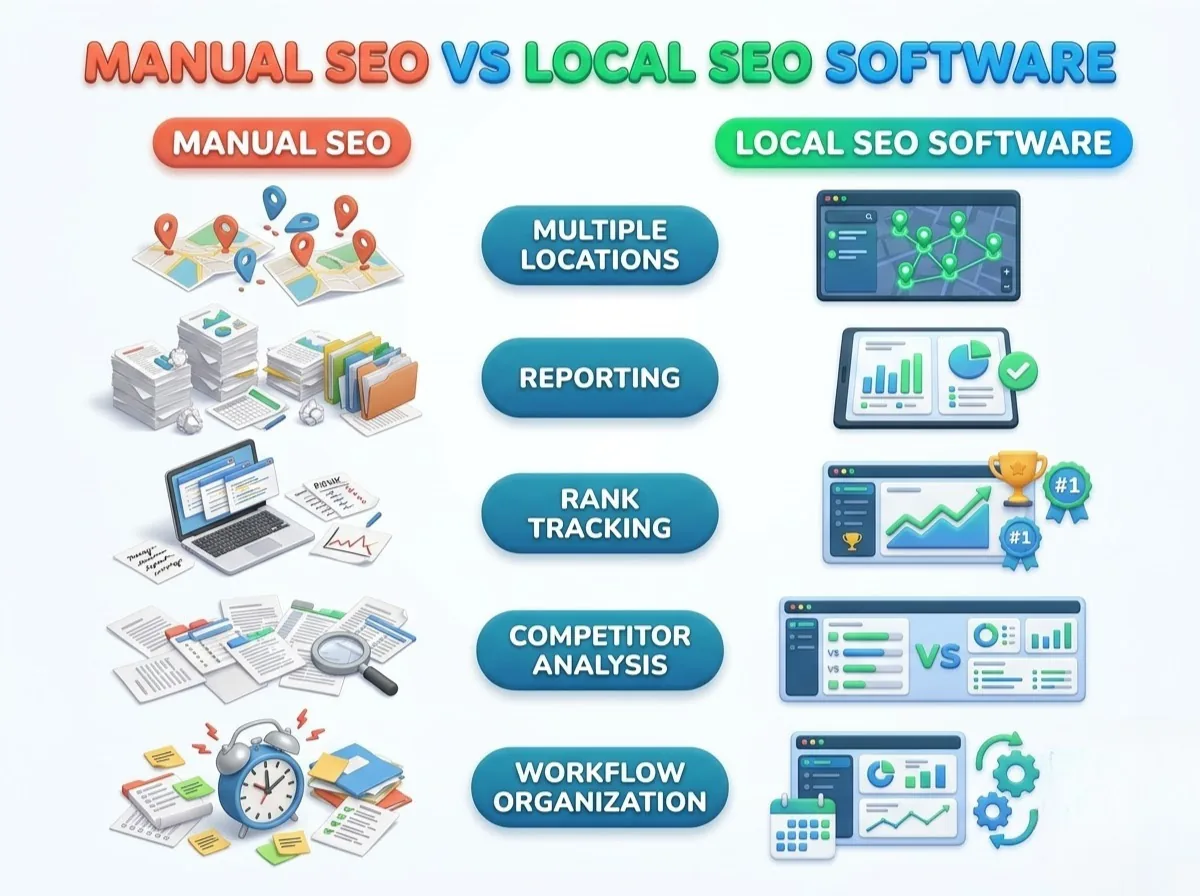
Ultimately, switching to local SEO software makes sense when the time and coordination required by manual management start outweighing its simplicity. You do not need to automate every activity. Start with the tasks that consume the most time, then choose tools that address those specific needs.
How to Choose the Right Local SEO Approach for Your Business
Choosing between local SEO software and manual SEO management depends on your business size, available resources, and long-term goals. Instead of switching approaches simply because your competitors use software, evaluate your current workload and identify where you need better efficiency.
Start by reviewing your existing local SEO strategy. Consider how much time your team spends checking rankings, updating business profiles, monitoring customer reviews, and preparing reports. If these activities are manageable, manual methods may still meet your needs. If they regularly delay other responsibilities, dedicated software could be worth considering.
Before making a decision, focus on these factors:
- Business size and locations: Businesses operating across several service areas may benefit from centralized tracking and reporting.
- Budget and resources: Compare subscription costs with the time your team spends on repetitive tasks.
- Essential features: Look for useful capabilities such as local rank tracking, Google Business Profile management, and competitor monitoring.
- Ease of use: Choose a solution your team can adopt without adding unnecessary complexity.
- Reporting requirements: Make sure you can monitor meaningful metrics and evaluate progress consistently.
You should also remember that software cannot replace sound SEO decisions. Your team still needs to improve website content, maintain accurate business information, respond thoughtfully to customer feedback, and act on performance insights.
Ultimately, the right approach is the one that supports consistent local search optimization while allowing your team to focus on customers and sustainable business growth.
Conclusion
Choosing between local SEO software and manual SEO management comes down to how your business operates today and where you plan to grow. Manual methods can work well for businesses with one location, manageable workloads, and enough time to monitor rankings, update business information, and review customer feedback. However, as your business expands, keeping every task organized can become increasingly time-consuming.
Local SEO software offers a more structured way to monitor rankings, analyze competitors, and review performance across different service areas. It can reduce repetitive work and help your team make informed decisions without spending excessive time collecting data. Still, successful local SEO management requires human judgment, relevant content, accurate business information, and consistent optimization.
If you want to simplify your workflow, [Happy Rank](/) provides tools for tracking local rankings, monitoring competitors, managing Google Business Profile activities, and reviewing local search performance. Explore its available features to determine whether they align with your business needs and growth plans.
Ultimately, you do not have to choose between complete manual control and full automation. Combining the flexibility of manual SEO with the efficiency of suitable software can help you build a sustainable local SEO strategy that supports long-term visibility and business growth.
Frequently asked questions
What is manual local SEO management?
Handling local SEO tasks yourself with free tools and spreadsheets: updating your Google Business Profile, searching Google and Maps to check rankings, monitoring reviews, researching keywords and competitors, and compiling reports by hand.
What are the advantages of managing local SEO manually?
Full control over every update, low starting costs using free tools like Google Business Profile, Search Console and spreadsheets, flexible workflows, and first-hand insight from reviewing competitors and customer feedback yourself.
When should a business switch to local SEO software?
When you manage multiple locations, manual reporting takes hours, you can't see how rankings change across your service area, competitor research has become difficult, or several people need a consistent shared workflow.
Does local SEO software improve rankings automatically?
No. It organizes data and highlights opportunities, but your team still needs to interpret results, improve content, keep business information accurate and act on the insights.
How often should I do local SEO tasks manually?
A practical schedule is weekly profile checks, weekly or biweekly ranking checks, review monitoring several times a week, and monthly competitor analysis and performance reporting.
Is local SEO software worth the cost?
Compare the subscription price with the time your team spends collecting rankings, reviews and report data by hand. It tends to pay off as locations, keywords and reporting needs grow.