
How Plumbers Can Stand Out From Local Competitors
Plumbers stand out from local competitors by showcasing verified credentials, highlighting fast response guarantees, displaying before-and-after project photos, maintaining higher review ratings with descriptive client stories, and leveraging geo-grid tracking to target underserved neighborhoods where competitors are weak.
Local plumbing is more crowded than ever.A homeowner with a burst pipe rarely calls the first company they see, and most will compare a few plumbing companies before booking anyone. Price matters, but it is rarely the deciding factor. Homeowners look for trust signals such as reviews, licensing, and clear communication, along with proof of plumbing expertise and consistent service quality.Online visibility now shapes that first impression, since many customers find a plumber through aGoogle Mapssearch before they ever speak to one.
Standing out takes a deliberate plan. The sections that follow cover how to build a distinct business identity, improve the customer experience, strengthen your website and reviews, study nearby competitors, and track your local search rankings. Tools such as[Happy Rank](/)can help you monitor visibility across neighborhoods and spot gaps your competitors have left open, but the strategy matters more than any single tool.
Build a Distinct Identity for Your Plumbing Business
This section lays the groundwork for everything else you do. Before touching your website or ads, you need a clear answer to two questions: what you do best and why homeowners should choose you. The steps below show how to answer both consistently across every channel.
Identify Your Most Valuable Plumbing Services
Start by knowing which plumbing services you perform better than most. Review your last year of jobs. Which calls produced the highest margins, the most repeat business, or the strongest reviews? Those patterns point to your core offerings.
Services that combine steady demand with specialized skill tend to set businesses apart most effectively. Common examples include:
- Drain cleaningwith camera inspection, which goes beyond simple snaking
- Pipe repair and repiping, especially for older homes with galvanized or cast iron lines
- Water heater installation and replacement, including tankless systems
- Emergency plumbing, where a fast response time becomes a selling point
Once you have a shortlist, choose two or three to lead with. A business known for water heater replacement and emergency plumbing is easier to remember than one that claims to handle everything equally well.
Define What Makes Your Business Different
Homeowners rarely choose a plumber based on truck logos. They weigh credibility, and that comes from specific, verifiable details. Focus on the factors you can prove:
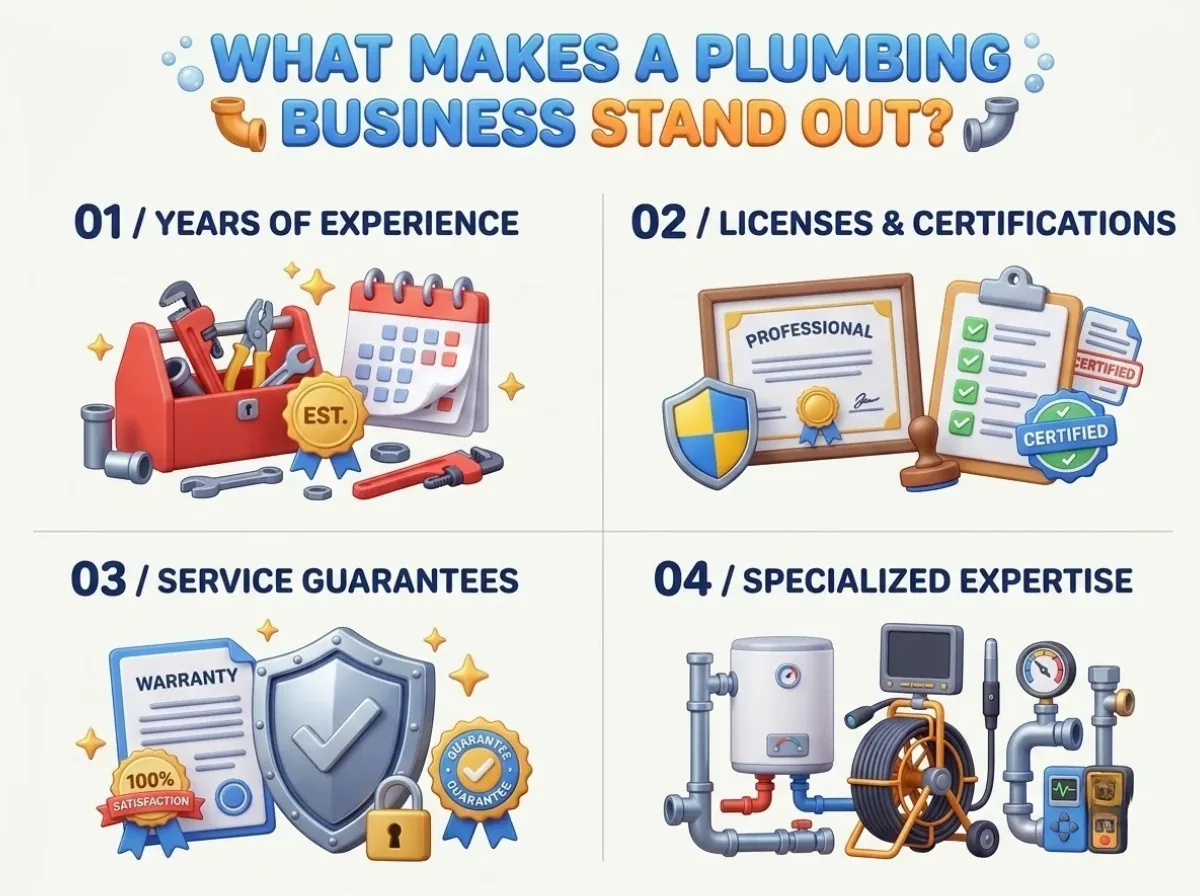
A value proposition pulls these details into one clear statement. Avoid vague claims such as "quality service at great prices." Instead, state something concrete, such as "Licensed plumbers with 15 years of experience in older homes, backed by a one-year labor guarantee on every repair."
Communicate Your Strengths Across Marketing Channels
An identity only works if it appears consistently. A homeowner might check your van, website, Google Business Profile, and social media within a single afternoon. If the business name, service area, or core message shifts from one channel to the next, the signal weakens.
Keep your core details identical everywhere: business name, phone number, service areas, and license information. Then tailor the message to each channel:
- Website: Detailed service pages that reinforce your specialties
- Google Business Profile: Current hours, accurate service categories, and recent posts about completed work
- Social media: Short updates showing real jobs, seasonal reminders, and team introductions
Make Customer Experience Your Strongest Competitive Advantage
Most plumbing jobs are judged less on the repair itself than on how the process felt. A homeowner usually remembers whether the call was returned, whether the price was a surprise, and whether anyone followed up at all. The points below cover the three moments that shape those memories most closely.
Simplify Appointment Scheduling and Communication
Convenience starts with the booking process. Give customers several ways to schedule, including online forms, text messages, and phone calls, and respond quickly to every inquiry. A missed call during a weekend leak can send a customer straight to a competitor before you ever know they called.
Once a job is booked, keep the customer informed at each stage. Useful appointment updates include:
- A confirmation with the arrival window and the technician's name
- An arrival notice when the technician is on the way
- A short message as soon as the schedule changes
Clear communication prevents the most common complaint about home service work: waiting around all day without knowing why. A few well-timed messages cost little and make a visit feel organized rather than unpredictable.
Offer Transparent Pricing and Service Expectations
Homeowners tolerate high prices more easily than uncertainty. Explain what each part of the bill covers, including the service call charge,inspection fees, parts, and labor. Then describe when costs might change, such as when a hidden problem appears behind a wall.
| **Charge** | **What to Explain Upfront** |
|---|---|
| Service or dispatch fee | Whether it applies to the visit or is credited toward the job |
| Inspection or diagnostic fee | What the inspection includes and whether it is waived if you do the work |
| Parts and materials | How they are priced and whether they carry a warranty |
| Labor | Hourly or flat rate, and how additional time is billed |
Provide a written estimate before starting work, and get approval before any charge that goes beyond it. A customer who sees the cost in writing and agrees to it is far less likely to dispute the invoice later.
Build Long-Term Relationships Through Reliable Service
A completed job is an opportunity to earn the next one. Follow up within a few days to confirm the repair is holding and to answer any questions. A short, specific message is more useful than a generic review request sent weeks later.
Maintenance reminders also keep your business in front of customers. Annual water heater flushing, drain cleaning before the holidays, and sump pump checks before the rainy season give homeowners a reason to call before a problem starts. Include brief, practical advice in these reminders, since helpful guidance builds goodwill that a discount rarely can.
Create a More Convincing Online Presence Than Competitors
A plumber's website often gets the first look from a homeowner who is stressed about a problem. It needs to answer questions quickly and clearly, show proof of past work, and make the next step obvious. The three elements below do that most effectively, beginning with your core service pages.
Develop Website Pages That Address Customer Needs
Create a dedicated page for each major service rather than one long list. A visitor searching for sewer line repair wants to know what the problem looks like, how you fix it, and what it typically costs. A single generic services page rarely answers those questions well.
Each service page should include:
- A plain-language description of the problem and its common symptoms
- The repair process, from inspection through cleanup
- Typical timelines and whether pricing ranges are available
- A clear contact option, such as a phone button or booking form
Pricing ranges can build trust, but only if they are accurate and properly qualified. Explaining that costs depend on access, pipe material, and permit requirements is more honest than publishing a single number that rarely fits.
Use Project Photos and Customer Experiences to Build Trust
Proof works better than promises.Before-and-after photos of completed work show the quality of your installations in a way no description can match. A clear photo taken in daylight is usually enough. Get the homeowner's permission before posting, especially when the property is recognizable.
Customer testimonials carry the same weight when they are specific. "Fixed our water heater in two hours and explained the warranty clearly" tells a reader more than "Great service!" Respond publicly to reviews, including critical ones, since how you handle a complaint often matters as much as the complaint itself.
Publish Helpful Content That Answers Local Plumbing Questions
Homeowners search for answers long before they search for a plumber. Articles on frozen pipe prevention,low water pressure causes, and signs of a failing sewer line capture those early searches and position your business as a knowledgeable resource.
Seasonal content works well here. Guidance on preparing outdoor faucets for winter or checking for leaks after heavy rain speaks directly to local conditions. Write from direct experience, mention the problems you actually see in your service area, and link each article to the relevant service page so visitors can take the next step. This also gives your team a ready reference when homeowners call with the same questions.
Analyze Local Competitors to Find Missed Opportunities
Your competitors have already done much of the market research for you, though most plumbers never examine them closely enough. Their listings, reviews, and service areas show where demand is strong and where attention is thin. The steps below turn that visible information into a practical, prioritized list of openings.
Identify Which Plumbing Businesses Compete for Local Customers
Start with the search itself. Run the terms a homeowner would use, such as "emergency plumber" or "water heater repair," and note which companies appear in Google Maps results for each neighborhood you serve. Results shift by location, so search from several points across your service area rather than only from your office.
Record each competitor's service categories, review count, and listed services in a simple spreadsheet. Patterns emerge quickly. You may find that three businesses dominate the same postcode, or that a competitor with a strong reputation offers little beyond basic repairs.
Evaluate Competitor Strengths and Weaknesses
Look past star ratings. Read the most recent reviews to see whether service quality is holding up, and note recurring complaints such as missed appointments or unclear invoices. A competitor with thousands of reviews may still respond poorly to complaints, which is a gap you can fill.
Use the table below to structure your review of each competitor:
| **Area** | **What to Look For** | **Possible Opening** |
|---|---|---|
| Service coverage | Services they omit or mention only briefly | Specialized work, such as trenchless sewer repair |
| Online reputation | Response rate and tone toward negative reviews | Faster, more transparent replies |
| Content quality | Thin or outdated service pages | Detailed, locally specific pages |
| Customer engagement | Posts, photos, and updates on their profile | Regular, practical updates |
Each weakness should lead to a specific action. Note the gap, decide whether it matters to your target customers, and rank it against your existing strengths.
Discover Underserved Neighborhoods and Search Opportunities
Some areas have limited competition because they sit on a boundary or lack a dominant local business. Look for neighborhoods where map results show few plumbers, or where competitors have sparse reviews and outdated profiles. Those areas can deliver quick visibility gains.
Search opportunities follow the same logic. Identify plumbing queries that competitors ignore, such as slab leak detection in a region with older foundations or backflow testing for commercial clients. Target searches that match your capabilities and that customers in your area actually make. Start with one or two neighborhoods, measure the results, and expand from there.
Track Local Performance and Improve Your Competitive Position
Visibility is not a one-time achievement. Search results shift with seasons, competitor activity, and changes to your own listings, so a ranking that looks strong today can slip within just a few weeks. Consistent tracking tells you what is working, what needs attention, and where to focus your effort next.
Monitor Google Maps Rankings Across Service Areas
Ranking tracking works best when it reflects where customers actually are. Check your position for your core terms in each neighborhood you serve, and record the results on a consistent schedule, such as every two weeks. A single search from your office tells you little about how visible you are to a homeowner across town. Note any neighborhood where your rank drops, since that often signals a new competitor or weak local signals.
geo-grid tracking takes this further by placing a grid of search points over your service area and measuring your rank at each one. The resulting map shows where you rank strongly, where you fade, and how visibility changes from one block to the next. Those variations point directly to the neighborhoods that need more attention.
Measure the Customer Actions That Matter
Rankings only matter if they produce calls and bookings. Track the actions that signal real intent:
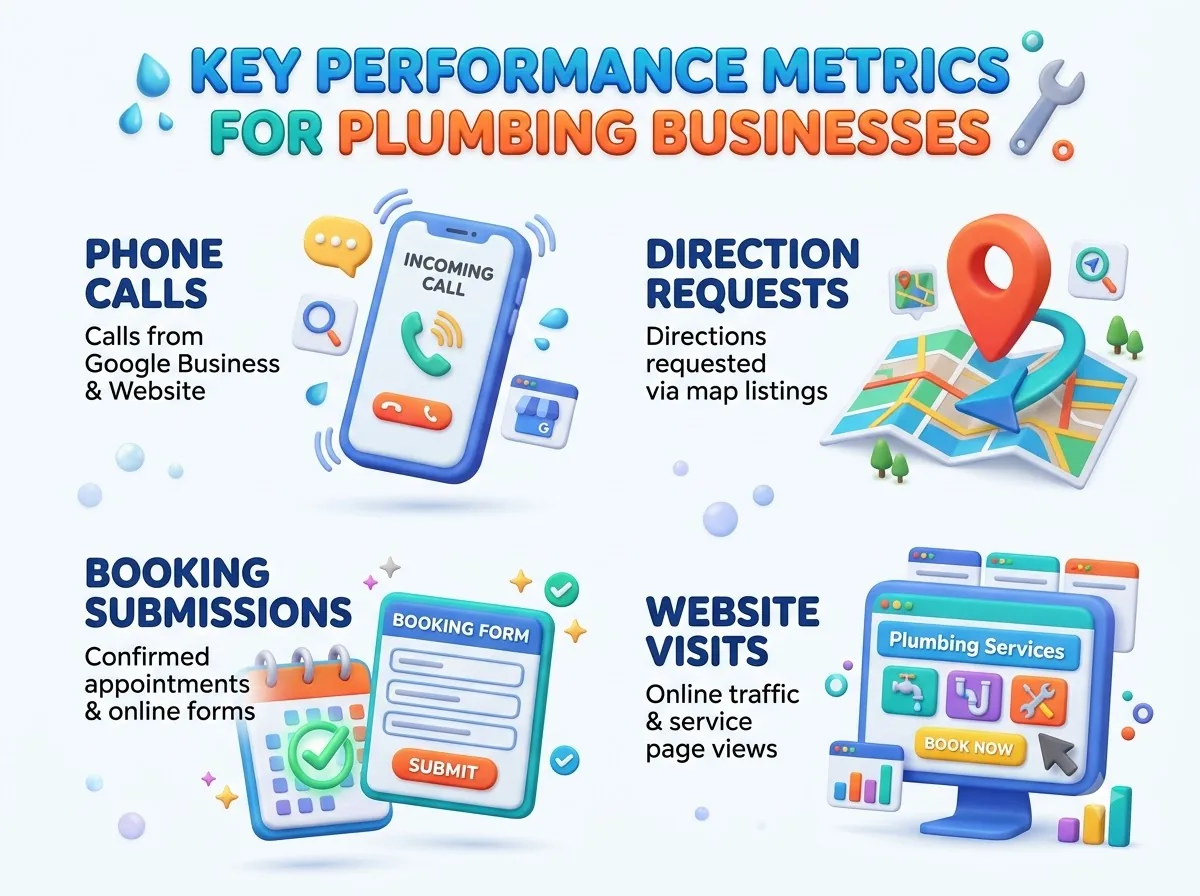
Connect these actions to specific campaigns and content. If a new water heater page drives few calls, the problem may be the content, the offer, or the visibility. Knowing which one helps you decide whether to rewrite the page or improve its local signals. Attribute each job to its source where your booking system allows it, and review these numbers monthly so trends stand out.
Use Local SEO Insights to Refine Your Strategy
Review ranking changes and competitor movements on a regular schedule rather than reacting to every fluctuation. When a competitor suddenly climbs, check what changed: new reviews, updated service pages, or fresh profile activity. Then decide whether your own pages, listings, or business information need an update. Document each change in a simple log so you can connect ranking shifts to specific actions over time.
Monitoring software can make this review faster. [Happy Rank](/), for example, tracks local rankings, compares competitors, and highlights where your visibility is weakest. Use these reports to prioritize fixes, such as updating outdated service pages or correcting inconsistent business information across directories.
Conclusion
Standing out in a crowded local market comes down to a few connected habits. A clear identity tells homeowners what you do best, while a strong customer experience turns a single repair into repeat business. Your online presence then confirms those claims with proof, and competitor research reveals the openings others have missed.
Competing successfully requires more than lower prices or heavier promotion. Discounts can win an initial call, but they rarely build the reputation that keeps customers returning. Visibility earned through consistent reviews, accurate listings, and useful content tends to last far longer than a short-term campaign.
Results depend on steady monitoring. Rankings shift, and competitors adjust. Tools such as[Happy Rank](/)can make that work easier by tracking local search visibility across neighborhoods and highlighting where your position is weakest. Used alongside regular reviews of your performance, it helps you spot problems early and act while the opportunity still exists.
Local search visibility plays an important role in helping HVAC contractors connect with homeowners looking for heating, cooling, and repair services. However, having a website and a Google Business Profile does not guarantee strong local rankings or consistent service inquiries. Many contractors unknowingly make local SEO mistakes that limit their Google Maps visibility, weaken their local search rankings, and make it harder for potential customers to find their businesses.
Problems such as targeting irrelevant keywords, maintaining duplicate listings, overlooking technical SEO issues, and failing to monitor local search performance can gradually affect online visibility. Recognizing these problems is the first step toward building a more effective strategy.
With a platform like[Happy Rank](/), HVAC contractors can monitor local rankings, evaluate competitors, and identify opportunities to improve their online presence. Understanding which mistakes to avoid can help contractors make informed decisions and build a stronger foundation for long-term local search success.
Targeting the Wrong Local Searches and Customer Intent
Choosing the wrong keywords is a common mistake that can prevent HVAC contractors from reaching homeowners who need their services. Many businesses focus on broad search terms without considering what potential customers actually want when searching online. For example, ranking for a general phrase such as "HVAC company" may bring visitors who are researching heating and cooling systems rather than looking for immediate repairs. An effective local SEO strategy for HVAC contractors should focus on relevant searches that connect services, customer needs, and specific locations.
Focusing on Broad HVAC Keywords Instead of Service-Specific Searches
Using generic keywords without targeting specific services can attract irrelevant website traffic. Homeowners searching for AC repair, furnace replacement, or emergency heating assistance usually have different requirements and expectations. When contractors overlook these differences, their websites may struggle to attract qualified visitors.
Instead of relying entirely on broad phrases, businesses should identify service-specific keywords that reflect their actual offerings. Consider these examples:
- AC repair near me:Targets homeowners looking for immediate air conditioning repairs.
- Furnace installation in [city]:Reaches customers planning a new heating system installation.
- Emergency HVAC repair:Connects contractors with people experiencing urgent heating or cooling problems.
- HVAC maintenance services:Attracts homeowners interested in routine system inspections and preventive maintenance.
Matching keywords with customer needs helps businesses improve local search relevance and attract more meaningful inquiries.
Ignoring Seasonal Changes in HVAC Search Behavior
HVAC search demand changes throughout the year. Homeowners are more likely to search for AC repair and cooling services during warmer months, while furnace maintenance and heating repairs become more relevant during colder periods. Contractors who use the same keyword strategy throughout the year may miss opportunities to reach customers with immediate seasonal requirements.
Businesses should review seasonal search trends and adjust their content priorities accordingly. For example, they can emphasize air conditioning maintenance before summer and furnace inspections before winter. Updating relevant website content and promotional messaging helps keep the business aligned with changing customer demand.
Targeting Locations Outside the Actual Service Area
Another common HVAC SEO mistake is targeting cities and neighborhoods that the business does not genuinely serve. Creating location-focused content for distant areas may attract visitors who cannot become customers. It can also make the website less relevant to the company's actual operations.
HVAC contractors should:
- Prioritize cities and neighborhoods within their operational service area.
- Create useful location-specific content based on genuine local experience.
- Keep website location information consistent with their business coverage.
- Avoid creating multiple pages that only replace one city name with another.
A focused local keyword strategy helps contractors reach homeowners in the areas where they can realistically provide services. This makes search visibility more relevant and supports better opportunities for qualified service inquiries.
Making Google Business Profile Errors That Reduce Local Visibility
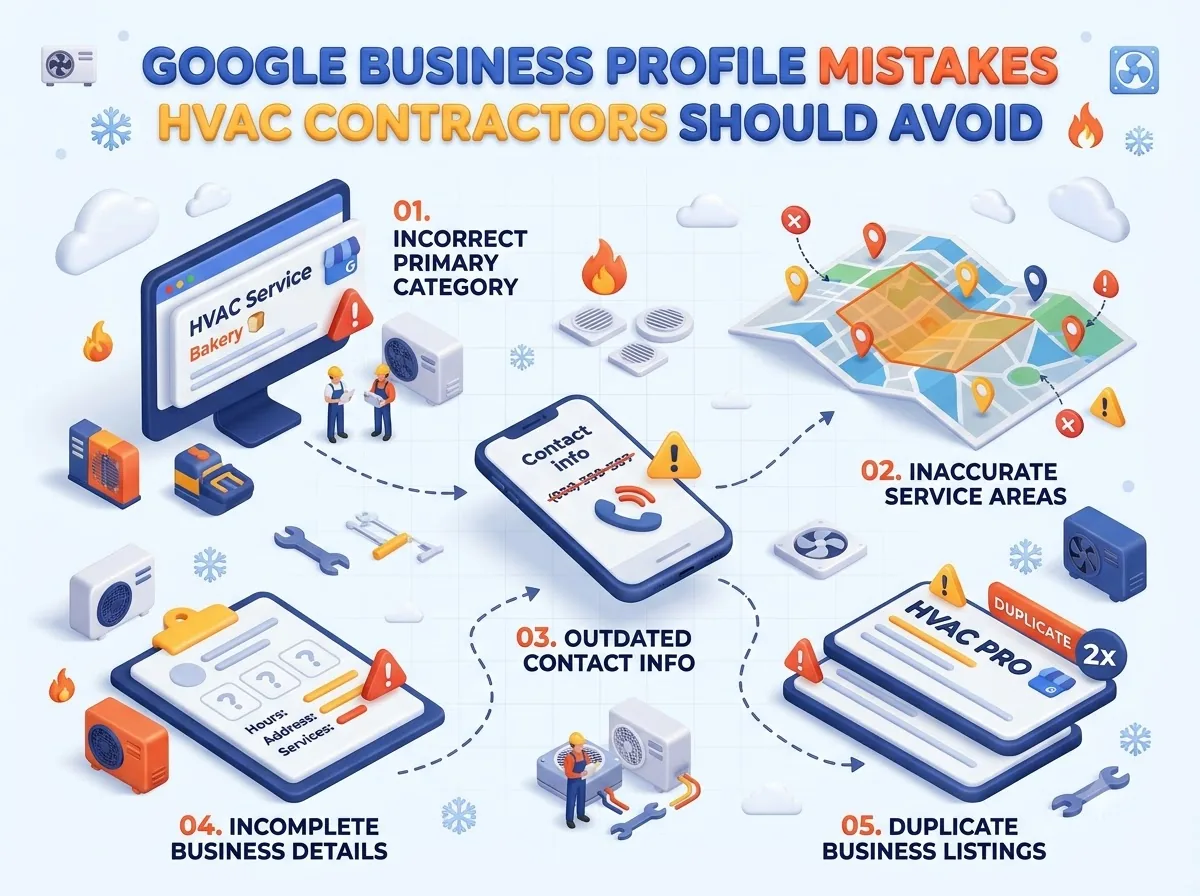
A well-maintained Google Business Profile helps HVAC contractors appear in relevant local searches and gives homeowners essential information about their services. However, small profile management mistakes can create confusion and weaken a business's local search visibility. Incorrect categories, inaccurate service areas, outdated contact details, and duplicate listings can make it harder for potential customers to find and trust a company. These Google Business Profile mistakes can also affect how effectively contractors connect with homeowners searching for nearby heating and cooling services.
The following table highlights common profile errors and their potential consequences:
Choosing an Inaccurate Primary Business Category
Selecting an unsuitable primary business category is a common mistake that can affect how Google understands an HVAC company's services. For example, choosing a general contractor category instead of a more relevant HVAC contractor category may reduce the business's relevance for specific heating and cooling searches.
Contractors should select the most accurate primary category that represents their main business activity. They can also add relevant secondary categories when they genuinely offer those services. This helps establish clearer business relevance for local searches without adding unrelated categories simply to attract more traffic.
Using an Incorrect Address or Service Area
HVAC companies often serve multiple neighborhoods and surrounding communities. However, displaying an inaccurate business address or selecting locations outside their actual coverage area can create problems for customers and search engines. Contractors who operate as service-area businesses should follow Google's address and service-area guidelines instead of displaying an address where customers are not served.
To maintain accurate local business information, contractors should:
- Set service areas based on the locations they genuinely cover.
- Keep their business address accurate and follow Google's eligibility requirements.
- Avoid adding distant cities simply to increase potential search exposure.
- Update service areas when business operations or coverage changes.
Leaving Out Important Business Information
Outdated or incomplete profile details can cause homeowners to lose confidence in an HVAC company. Imagine someone searching for emergency AC repair but finding incorrect operating hours or an outdated phone number. They may contact another contractor instead.
Businesses should regularly review their Google Business Profile information, including:
- Operating hours:Keep regular and holiday schedules updated.
- Contact details:Verify that phone numbers and website links work correctly.
- Business description:Clearly explain the company's heating and cooling services.
- Service information:Include relevant services that customers can actually book.
- Business photos:Use genuine, recent images of the team, equipment, and completed projects.
Ignoring Duplicate or Unmanaged Business Listings
Duplicate profiles can confuse homeowners who encounter different phone numbers, addresses, or business details for the same company. They can also make it difficult to maintain consistent business information across online platforms.
Contractors should check for existing listings before creating new profiles and follow Google's procedures for reporting or resolving duplicates. Regularly reviewing business listings helps prevent conflicting details and provides homeowners with a more reliable source of company information.
Addressing these profile management mistakes helps HVAC contractors maintain accurate business details, improve customer confidence, and build a more consistent local search presence.
Creating Website Problems That Weaken HVAC Search Performance
An HVAC company's website should make it easy for homeowners to find relevant services, understand what the business offers, and request assistance. However, certain website mistakes can weaken local search performance and make important service pages harder to discover. Issues such as duplicate location content, excessive keyword usage, technical errors, and poor internal linking can affect the user experience and prevent search engines from understanding the website properly. Identifying these HVAC website SEO problems helps contractors maintain a website that supports local visibility and customer inquiries.
Publishing Similar or Repetitive Location Pages
Creating separate pages for every city may seem like an effective way to expand local reach. However, publishing multiple pages with nearly identical content and changing only the city name provides little additional value to visitors. This can create repetitive website content and make it harder for search engines to identify the most useful page for a particular search.
HVAC contractors should develop genuinely useful location-specific landing pages that include relevant service information, actual coverage areas, local project examples, and customer concerns. Each page should offer distinct information rather than repeating the same paragraphs across different locations.
Overloading Service Pages With Keywords
Another common mistake is adding too many keywords to service pages in an attempt to improve HVAC search rankings. Repeating phrases such as "AC repair in [city]" throughout headings, paragraphs, and image descriptions can make content sound unnatural.
Instead, contractors should use keywords naturally and prioritize clear explanations of their services. For example, an AC repair page can discuss common cooling problems, repair options, warning signs, and service availability. This approach supports search intent optimization while making the content more helpful to homeowners.
Ignoring Technical SEO Problems
Even useful website content can struggle to perform when technical issues prevent search engines and visitors from accessing pages properly. Broken links, slow loading times, mobile usability problems, and indexing errors can weaken the overall website experience.
HVAC contractors should regularly check for these common problems:
- Broken links:Repair links that lead to missing or unavailable pages.
- Page speed issues:Optimize images and reduce unnecessary website elements.
- Mobile usability errors:Ensure service pages work properly on smartphones.
- Indexing problems:Check whether important service pages can be discovered and indexed.
- Redirect errors:Fix incorrect redirects that send visitors to unrelated pages.
Failing to Connect Related HVAC Service Content
Poor internal linking can make it difficult for visitors to explore related services. For example, an AC repair page could link to relevant air conditioning maintenance and replacement pages. Without these connections, homeowners may struggle to find additional information.
| **Website issue** | **Recommended correction** |
|---|---|
| Duplicate location pages | Publish unique, locally relevant content |
| Keyword stuffing | Use natural, service-focused language |
| Slow-loading pages | Optimize images and website performance |
| Broken internal links | Regularly check and repair website links |
| Poor mobile experience | Improve responsive design and usability |
A technically sound website with useful content and clear navigation creates a stronger foundation for HVAC local SEO. Regular website audits help contractors identify problems before they affect customer experience and organic search performance.
Overlooking Trust Signals and Local Reputation Problems
Homeowners often compare multiple HVAC contractors before choosing someone to handle their heating or cooling problems. They may check customer reviews, business information, service descriptions, and feedback from previous clients before making contact. Contractors who overlook these trust signals can struggle to establish credibility, even when their services are reliable. Weak online reputation management, inconsistent business information, and generic website content can affect customer confidence and reduce opportunities to attract local customers. Avoiding these local SEO mistakes helps HVAC businesses build stronger relationships with potential customers.
Neglecting Negative Customer Reviews
Ignoring negative reviews can make an HVAC company appear unresponsive to customer concerns. For example, a homeowner who leaves feedback about a delayed AC repair appointment may lose confidence if the business never responds. Other potential customers may also consider these unanswered complaints when comparing contractors.
HVAC businesses should monitor their Google customer reviews and respond professionally to both positive and negative feedback. Helpful responses should acknowledge concerns, provide clarification when appropriate, and offer a suitable way to resolve service-related issues. This demonstrates accountability and supports a more positive customer experience.
Trying to Gain Reviews Without a Consistent Process
Some contractors collect customer feedback only when they receive a particularly positive response. This creates an inconsistent review collection process and limits opportunities to understand customer experiences across different services.
Businesses should establish a simple and consistent approach to requesting honest feedback. They can:
- Send review requests after completing service appointments.
- Make it easy for customers to access the review platform.
- Request feedback from customers without pressuring them.
- Avoid offering discounts or incentives in exchange for positive reviews.
- Monitor review activity to understand recurring customer concerns.
A consistent customer feedback strategy helps contractors maintain an authentic online reputation while identifying areas that need improvement.
Using Generic Content That Does Not Demonstrate Local Experience
Publishing generic HVAC content that could belong to any contractor makes it difficult for homeowners to understand what distinguishes one business from another. Repetitive service descriptions and vague claims do little to demonstrate experience.
Contractors should include useful details that reflect their real services and local knowledge, such as completed projects, common HVAC problems in their service areas, and practical maintenance advice. This creates more meaningful,locally relevant content and gives potential customers better reasons to trust the business.
Failing to Keep Business Information Consistent Across Directories
Inconsistent business details across online directories can confuse customers and make it harder to verify company information. Differences in business names, phone numbers, addresses, and website links may create uncertainty when homeowners search for local HVAC services.
| **Reputation mistake** | **Recommended action** |
|---|---|
| Unanswered negative reviews | Respond professionally and address concerns |
| Irregular review collection | Establish a consistent feedback process |
| Generic website content | Include genuine projects and local service information |
| Conflicting directory details | Maintain accurate business name, address, and phone number |
| Outdated business listings | Review and update important directory information |
Maintaining strong local business credibility requires more than collecting positive reviews. HVAC contractors should provide accurate information, demonstrate genuine service experience, and manage customer feedback consistently to build trust and support long-term local search visibility.
Tracking the Wrong Metrics and Failing to Correct SEO Problems
Improving local search visibility requires more than publishing website content and maintaining business listings. HVAC contractors also need to understand whether their SEO efforts are producing meaningful results. However, many businesses focus on surface-level numbers, such as overall website traffic or rankings for a single keyword, without evaluating customer actions. These local SEO tracking mistakes can make it difficult to identify weaknesses, measure progress, and improve marketing decisions. Monitoring the right local SEO performance metrics helps contractors understand how customers discover their businesses and which areas need attention.
Checking Rankings From Only One Location
Checking Google Maps rankings from the business address provides only a limited view of local search performance. A contractor may appear prominently near their office but have much lower visibility in surrounding neighborhoods. This happens because local search results can vary depending on the searcher's location and other factors.
HVAC businesses should monitor Google Maps rankings across different locations within their actual service areas. This helps them identify neighborhoods where visibility is strong and areas that may need further attention. Location-based ranking reports also provide a clearer picture of local search competition.
Measuring Traffic Without Evaluating Actual Inquiries
High website traffic does not necessarily mean an HVAC company is generating more business. Visitors may browse service pages without calling, requesting an appointment, or contacting the contractor. Focusing only on traffic numbers can hide problems with lead generation and conversion performance.
Contractors should track meaningful customer actions, including:
- Phone calls:Calls generated through the website and Google Business Profile.
- Direction requests:Customers looking for directions to the business location.
- Booking submissions:Appointment requests received through website forms.
- Service inquiries:Questions about AC repair, furnace installation, and maintenance.
- Website visits:Traffic generated through local organic search.
These indicators help businesses understand whether their local search traffic is attracting potential customers.
Ignoring Competitor Changes and Ranking Declines
Local search competition can change as other HVAC companies update their websites, improve their profiles, or receive new customer reviews. Contractors who monitor only their own rankings may overlook these changes and miss opportunities to improve their visibility.
Regular competitor monitoring helps businesses identify differences in service coverage, content quality, review activity, and local search performance.
Making SEO Changes Without Reviewing Performance
Making frequent website or profile changes without measuring their impact can create confusion about which improvements are actually working. Contractors should establish a baseline, review performance regularly, and prioritize corrections based on reliable data.
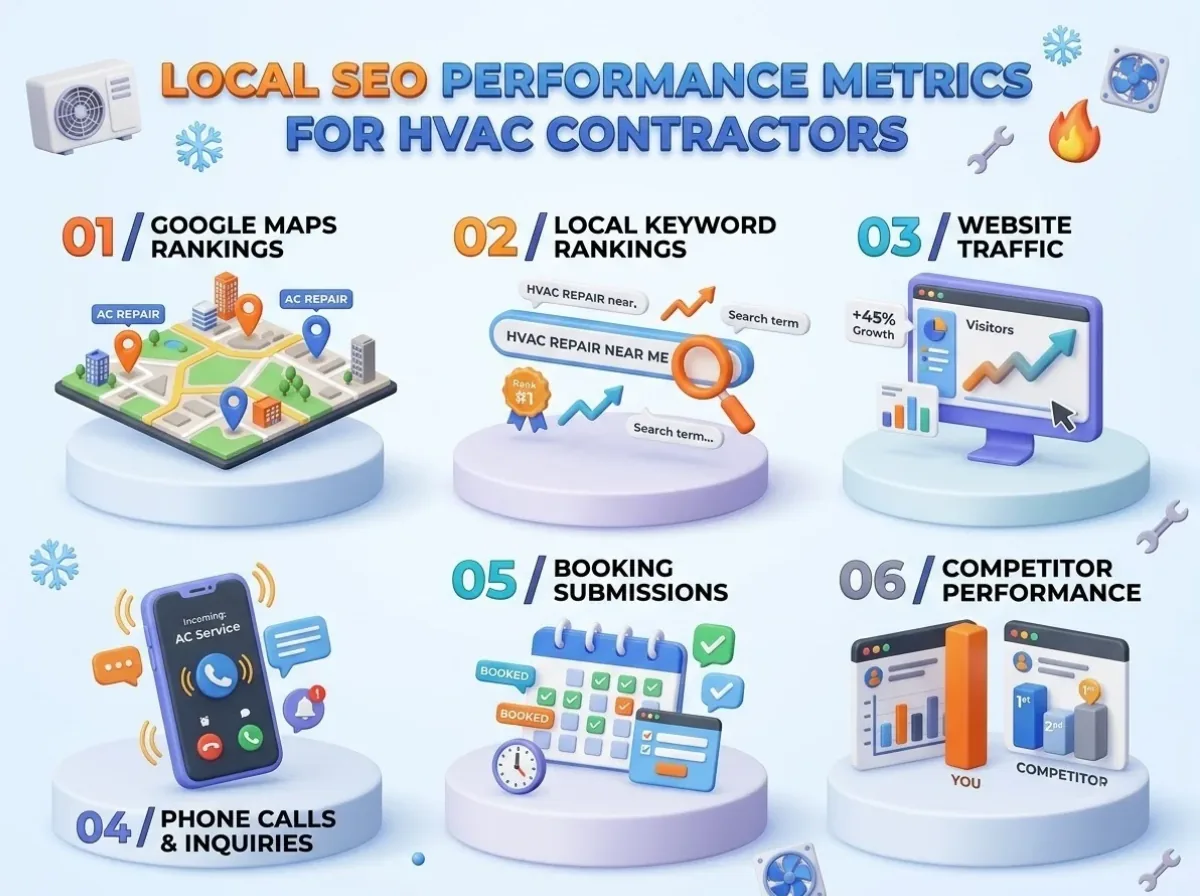
Using a consistent SEO performance monitoring process helps contractors identify ranking changes, evaluate customer engagement, and make informed adjustments. Rather than relying on assumptions, businesses can use measurable results to strengthen their local search strategy and improve opportunities for attracting qualified HVAC customers.
Conclusion
Avoiding common local SEO mistakes is essential for HVAC contractors who want to improve search visibility and connect with more homeowners in their service areas. From targeting irrelevant keywords and making Google Business Profile errors to overlooking website issues, customer reviews, and performance tracking, small mistakes can gradually weaken an online presence. Regularly reviewing these areas helps businesses identify problems, make informed improvements, and build a more effective local SEO strategy.
Managing these activities becomes easier with the right tools.[Happy Rank](/)helps HVAC contractors monitor Google Maps rankings, track local competitors, evaluate search visibility, and identify opportunities for improvement. By combining consistent optimization with ongoing performance monitoring, contractors can make better marketing decisions and strengthen their local presence. Rather than waiting for rankings or inquiries to decline, businesses should address potential SEO problems early and focus on building sustainable visibility in the communities they serve.
Residential landscaping businesses depend on local homeowners to generate consistent projects and long-term growth. However, reaching potential customers requires more than offering quality lawn care or attractive garden designs. Homeowners often search online for nearby professionals who understand their property's needs, local climate, and outdoor improvement goals. This makes local SEO for landscaping businesses essential for building visibility in relevant service areas.
By targeting location-based keywords, creating useful residential landscaping content, and optimizing their Google Business Profile, landscaping companies can connect with homeowners actively searching for professional services. Showcasing completed projects, earning genuine customer reviews, and developing service-specific website pages can further strengthen local credibility.
A well-planned local search strategy helps businesses attract qualified visitors, generate estimate requests, and compete more effectively in their communities.[Happy Rank](/)can help landscaping businesses monitor local visibility and identify opportunities to improve their Google Maps rankings.
Understand How Homeowners Search for Residential Landscaping Services
Residential landscaping businesses need to understand what homeowners are looking for before deciding which keywords to target. Not every potential customer searches for a general term such as "landscaping company near me." Some homeowners need help maintaining an existing lawn, while others want to redesign their gardens, improve drainage, or create attractive outdoor living spaces. Understanding these differences helps businesses develop a more focused local SEO strategy that connects their services with relevant customer searches.
Identify Searches Based on Specific Landscaping Problems
Homeowners often begin their search when they encounter a particular outdoor maintenance problem or want to improve their property's appearance. For example, someone dealing with an overgrown lawn may search for lawn maintenance services, while another homeowner might look for professionals who can redesign an outdated garden. These searches reveal specific needs that landscaping businesses can address through targeted website content.
Identify common problems that homeowners in your service areas experience and use them to guide your keyword research. Consider search phrases such as lawn care services near me, garden cleanup services, residential drainage solutions, and landscape renovation contractors. Creating relevant content around these requirements helps your website appear for more specific local landscaping searches instead of competing only for broad industry terms.
Separate Landscaping Searches by Service Intent
Residential landscaping includes several services, and homeowners often search for each one independently. Someone looking for regular lawn maintenance has different requirements from someone planning a complete landscape installation. Targeting all these searches through one general landscaping page can make it difficult for visitors to find the information they need.
Organize your landscaping keywords according to the services your business provides. For example:
- Lawn care:Lawn mowing, fertilization, weed control, and seasonal maintenance.
- Landscape design:Garden planning, plant selection, and residential landscape design.
- Hardscaping:Patio installation, retaining walls, walkways, and outdoor features.
- Garden maintenance:Pruning, mulching, planting, and garden cleanup.
- Landscape installation:New lawns, flower beds, shrubs, and outdoor improvements.
Develop dedicated service pages that explain each offering, its benefits, and the type of property it suits. This approach makes your website more relevant to different residential landscaping searches and helps potential customers find services that match their projects.
Discover Neighborhood-Level Search Opportunities
Homeowners frequently prefer landscaping professionals who serve their immediate area because local contractors are easier to contact and may have greater familiarity with neighborhood properties. This creates opportunities to target searches containing city names, neighborhoods, suburbs, and nearby communities.
Start by identifying the locations where your business regularly completes residential projects. Research phrases such as "landscaping services in [city]," "residential landscapers in [neighborhood]," and "lawn maintenance near [area]." Use these location-based terms naturally in relevant website content rather than inserting multiple location names into every paragraph.
You can also create useful location pages for important service areas. Include the services available, examples of nearby projects, and information about local landscaping requirements. Make sure every page offers genuinely useful information instead of simply replacing one city name with another. This helps strengthen local search relevance while giving homeowners a clearer understanding of your service coverage.
Map Keywords to the Homeowner's Decision Stage
Not every homeowner searching for landscaping information is ready to hire a contractor immediately. Some are researching ways to improve their gardens, while others are comparing service providers or requesting project estimates. Understanding these different stages helps businesses create content that supports the entire customer journey.
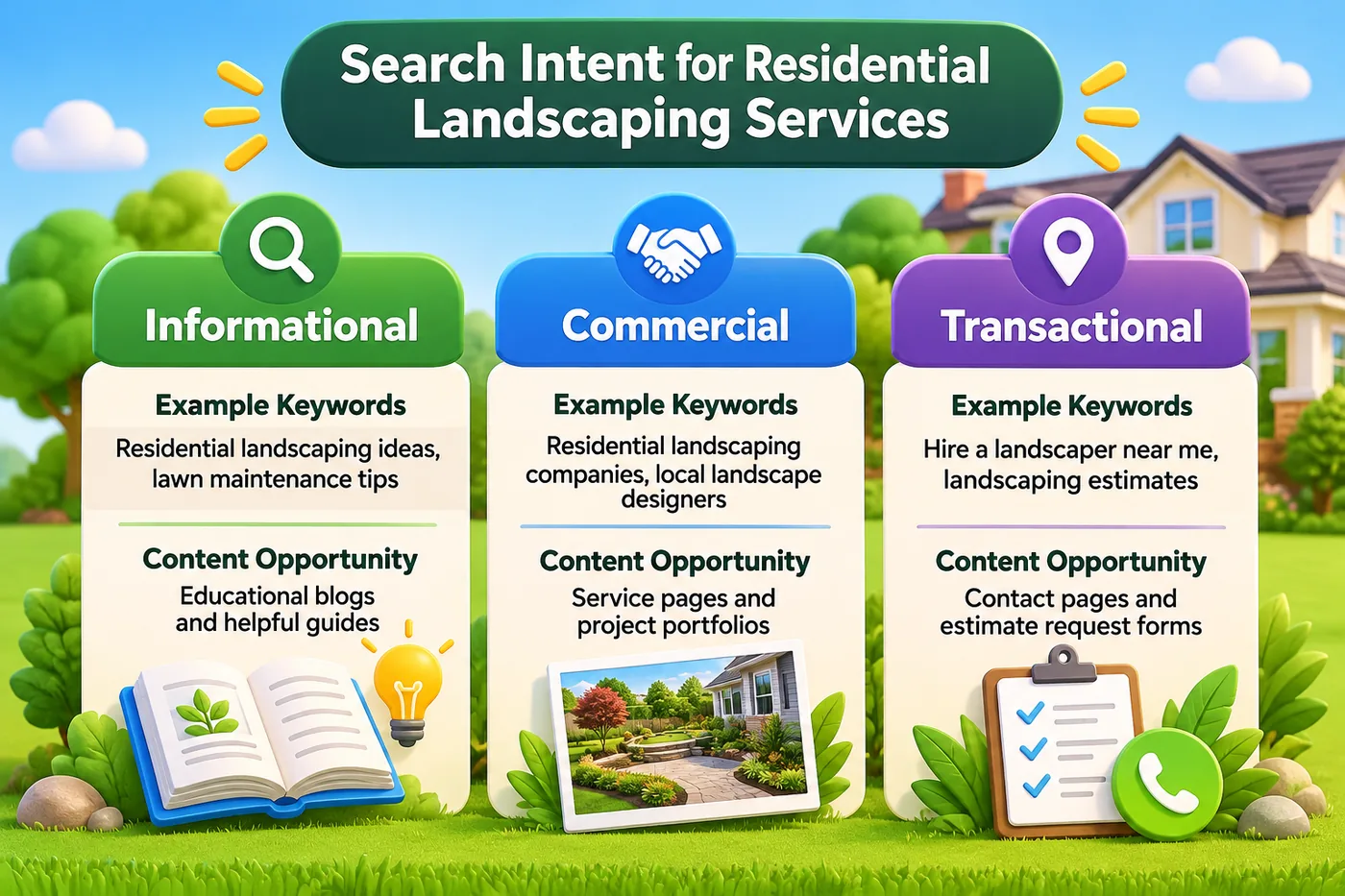
Consider organizing keywords into three categories:
Use informational content to introduce homeowners to your expertise, commercial pages to demonstrate your services, and transactional pages to encourage inquiries. Aligning content with homeowner search intent helps attract visitors at different decision stages and creates more opportunities to turn local website traffic into qualified landscaping leads.
Turn Completed Landscaping Projects Into Local SEO Assets
Residential landscaping businesses often have valuable marketing material that goes underused: their completed projects. Every lawn transformation, garden installation, patio improvement, or outdoor renovation demonstrates practical experience that potential customers can evaluate. Instead of relying only on general service descriptions, businesses can use these projects to create useful website content that highlights their work and local expertise. Incorporating residential landscaping projects into a website also creates opportunities to target location-specific searches and attract homeowners looking for similar improvements.
Create Location-Specific Project Pages
Turn notable residential landscaping projects into individual website pages that explain the work completed and the property's requirements. For example, if your company redesigned a backyard in a particular neighborhood, create a project page describing the original challenges, services provided, materials used, and final results.
Include relevant local landscaping keywords naturally in the page title, headings, and descriptions. Mention the service area when it adds useful context, but avoid repeating location names unnecessarily. These pages help demonstrate your experience while giving search engines more context about the services and communities your business serves.
Use Before-and-After Photos to Demonstrate Local Expertise
Visual evidence can help homeowners understand the quality and scope of your landscaping work. Before-and-after photographs show how your team addresses common outdoor problems and transforms residential properties. They also make project pages more informative and engaging.
Use original photographs of completed work, including lawn improvements, garden installations, planting arrangements, and patio designs. Follow basic image SEO practices:
- Use descriptive filenames that explain the project.
- Add relevantimage alt textto describe what each photograph shows.
- Compress images to support faster website loading.
- Include captions explaining the landscaping work and its results.
These practices improve image accessibility and help search engines understand your visual content.
Build Content Around Different Residential Property Types
Landscaping requirements vary depending on property size, layout, and homeowner preferences. A small suburban yard may need space-efficient garden planning, while a large residential property may require extensive lawn installation and outdoor living features.
Create useful content around different property types and their landscaping challenges. For example, publish articles about small backyard landscaping ideas, low-maintenance gardens, landscaping for newly built homes, and curb appeal improvements. Connect these topics with relevant services and project examples to demonstrate how your business handles different residential requirements.
Connect Project Content With Relevant Service Pages
Your project portfolio should guide visitors toward the services they may need. Link each completed project to relevant service pages so homeowners can explore similar solutions.
For example, a backyard transformation featuring a new patio can link to your hardscaping page, while a lawn renovation project can direct visitors to your lawn installation service. This creates a useful internal linking structure, improves website navigation, and connects local landscaping content with relevant service offerings.
Make Your Google Business Profile Reflect Your Actual Landscaping Expertise
A well-maintained Google Business Profile (GBP)helps residential landscaping businesses present their services to homeowners searching for nearby professionals. However, simply adding a business name, phone number, and address is not enough to communicate what makes your company relevant to local customers. Your profile should accurately represent your landscaping expertise, service offerings, completed work, and customer experience. Keeping these details updated can strengthen your local online presence and help potential customers evaluate your business before making contact.
Organize Services Around Real Homeowner Needs
Use your Google Business Profile to highlight the specific landscaping services your company provides. Instead of relying on a general description such as residential landscaping, list individual offerings like lawn installation, garden maintenance, landscape design, mulching, planting, and patio installation where applicable.
Write clear service descriptions that explain what each offering involves and how it helps homeowners. For example, a lawn installation description can mention site preparation, grass selection, and installation. This gives visitors a better understanding of your expertise and makes your Google Business Profile optimization more useful to potential customers.
Build a Consistent Visual Portfolio Through Profile Updates
Homeowners often want to see examples of a landscaper's previous work before requesting an estimate. Regularly adding original photographs to your business profile provides visual evidence of your services and workmanship.
Share images of completed lawn transformations, garden designs, planting projects, and outdoor improvements. You can also publish relevant business updates about seasonal services, recently completed projects, and available landscaping offerings. Keep photographs authentic and descriptions informative. A consistent visual portfolio helps communicate your company's capabilities and gives potential customers more confidence when evaluating local landscaping providers.
Turn Customer Reviews Into Local Trust Signals
Customer reviews provide useful insights into how your business handles residential landscaping projects. Encourage satisfied homeowners to share honest feedback about their experience, including communication, project management, workmanship, and service quality.
Respond to reviews professionally and acknowledge specific feedback where appropriate. Address negative comments constructively and explain how concerns can be resolved. Avoid offering incentives in exchange for reviews. Authentic Google reviews for landscaping businesses can help prospective customers assess your reliability and understand what working with your team may involve.
Keep Business Information Accurate Across Local Platforms
Inconsistent business information can create confusion for homeowners trying to contact your company. Check that your business name, address, phone number, website, and operating hours match across your website, Google Business Profile, and relevant online directories.
Update these details whenever your business information or service coverage changes. Also, review important local listings periodically to identify outdated contact information. Maintaining accurate local business citations supports a consistent online presence and makes it easier for homeowners to find and contact your landscaping company.
Build Seasonal and Property-Specific Content to Capture Local Demand
Residential landscaping requirements change throughout the year, creating new opportunities for businesses to attract homeowners through relevant website content. Seasonal weather, plant growth, lawn conditions, and outdoor improvement plans influence the services people search for. Instead of publishing general landscaping articles, create content that addresses these changing needs and reflects the conditions in your service areas. A well-planned seasonal local SEO strategy helps your business target relevant searches throughout the year while demonstrating knowledge of residential landscaping requirements.
Plan Content Around Seasonal Landscaping Requirements
Develop blog posts and service-related content based on the landscaping tasks homeowners commonly consider during different seasons. For example, spring content can cover lawn preparation, garden cleanup, and new planting, while summer topics can address irrigation planning and lawn maintenance. Fall articles can focus on leaf removal, pruning, and soil preparation, whereas winter content can discuss landscape planning and upcoming outdoor improvements.
Publish these resources before seasonal demand reaches its peak. Include relevant seasonal landscaping keywords and connect educational articles with the services your business provides.
Create Local Guides for Common Residential Landscaping Challenges
Different locations have different landscaping conditions. Soil quality, rainfall, temperature, drainage, and suitable plant varieties can influence how homeowners maintain their outdoor spaces. Use this local knowledge to create practical guides that address common property-related challenges.
For example, a landscaping company serving areas with heavy rainfall could publish content about residential yard drainage and water management. Businesses operating in warmer regions might create guides about drought-tolerant plants and lawn care during hot weather. Incorporating location-specific landscaping content makes your website more useful to local homeowners and helps establish your business as a knowledgeable service provider.
Develop Content for Different Property Improvement Goals
Homeowners have different reasons for investing in landscaping services. Some want to improve curb appeal, while others need a low-maintenance garden or a functional outdoor living area. Creating content around these goals allows your business to connect with homeowners who have specific improvement plans.
Consider publishing articles about low-maintenance landscaping ideas, small backyard transformations, family-friendly garden designs, and outdoor entertainment spaces. Include relevant project photographs, practical recommendations, and links to your service pages. This approach attracts visitors with different landscaping interests while introducing them to the solutions your company offers.
Use Seasonal Search Trends to Prioritize Content
Not every landscaping topic attracts the same level of interest throughout the year. Review keyword research tools, website traffic, and previous search performance to identify topics that generate relevant attention during particular seasons.
Prioritize content based on local homeowner demand, service availability, and business goals. Monitor which articles attract organic visitors and generate inquiries, then update or expand successful topics. Using local keyword research and seasonal performance insights helps landscaping businesses create more relevant content and allocate their SEO efforts effectively.
Convert Local Search Visibility Into Qualified Landscaping Inquiries
Appearing in local search results is only one part of a successful SEO strategy. Residential landscaping businesses also need to turn website visitors into potential customers. Homeowners searching for landscaping professionals want clear service information, evidence of previous work, and an easy way to request estimates. A conversion-focused website should address these expectations while making it simple for visitors to take the next step. Combining local SEO optimization, useful website content, and clear calls to action can help landscaping companies generate more qualified inquiries from their target service areas.
Create Service Pages That Answer Homeowner Questions
Your service pages should explain what homeowners can expect before contacting your business. Avoid using generic descriptions that provide little information about the actual work involved.
Include the following details on relevant residential landscaping service pages:
- Service descriptions:Explain what each landscaping service includes.
- Project requirements:Describe property preparation, materials, and other important considerations.
- Estimated timelines:Provide general information about how long different projects may take.
- Maintenance information:Explain ongoing care requirements where relevant.
- Project examples:Add photographs and descriptions of similar completed work.
Addressing these details makes your website more informative and helps homeowners evaluate whether your services match their requirements.
Make It Easy for Homeowners to Request Estimates
Once visitors understand your services, provide clear ways to contact your business. Place visible calls to action throughout your website, particularly on service pages, location pages, and project galleries.
Consider including:
- Clickable phone numbers for mobile visitors.
- Simplelandscaping estimate request forms.
- Clear contact information and business hours.
- Dedicated inquiry options for larger landscaping projects.
- Links to relevant services near project descriptions.
Keep forms short and request essential details such as the homeowner's location, required service, and preferred contact method. A straightforward inquiry process reduces unnecessary steps and encourages interested visitors to get in touch.
Establish Trust Before the First Customer Interaction
Homeowners are more likely to contact a landscaping company when they can evaluate its experience and reliability. Use your website to demonstrate genuine expertise rather than relying entirely on promotional claims.
Strengthen your online reputation by highlighting:
- Authentic customer testimonials andGoogle reviews.
- Before-and-after photographs of residential projects.
- Relevant professional qualifications and experience.
- Clear information about service areas and project capabilities.
- Consistent business details across online platforms.
These trust signals help potential customers make informed decisions before requesting an estimate.
Measure Which Local SEO Activities Generate Actual Leads
Track performance regularly to understand which SEO activities attract visitors and generate business inquiries. Focus on meaningful performance indicators rather than rankings alone.
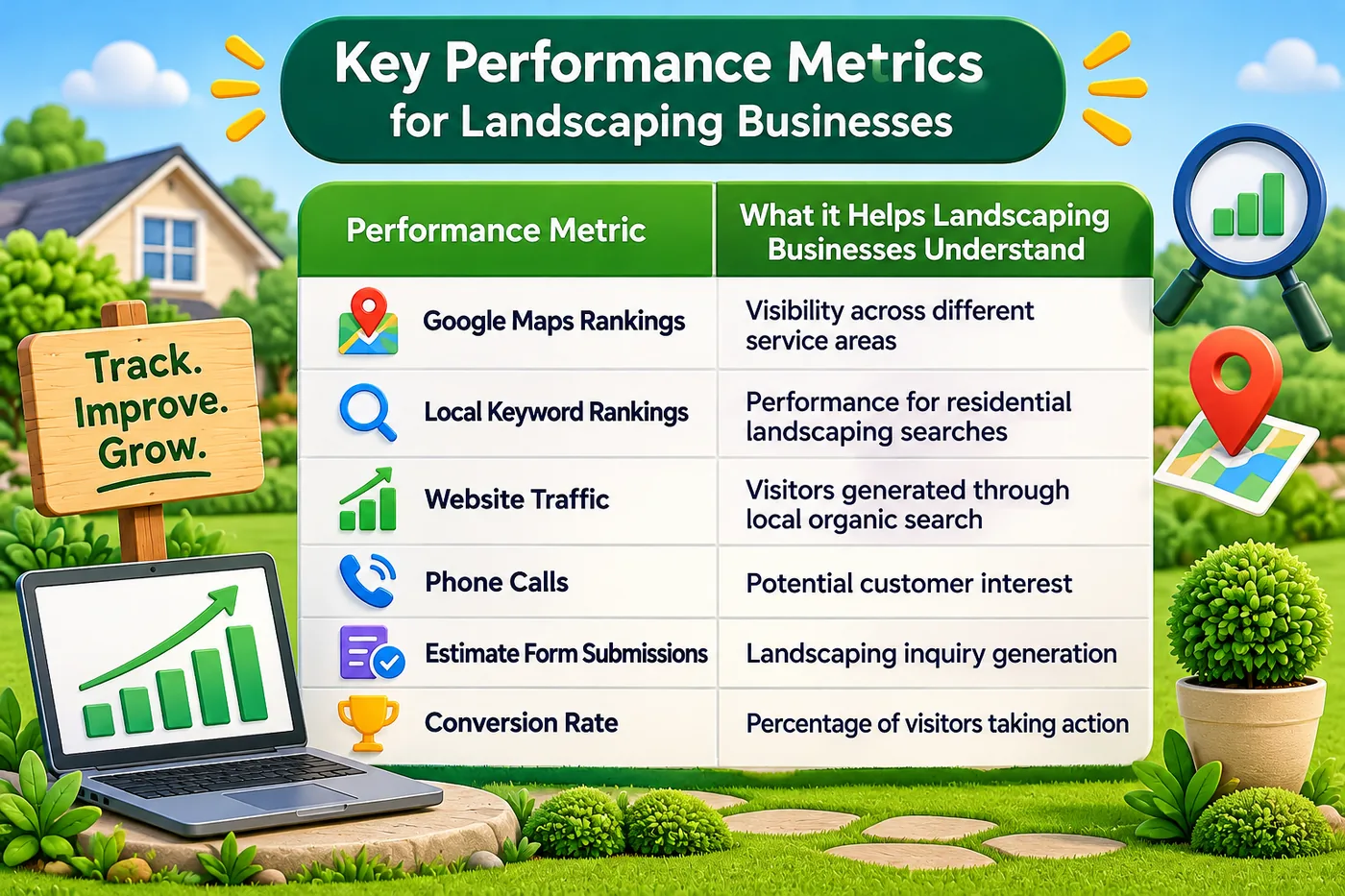
Use these insights to improve underperforming service pages, identify valuable local search opportunities, and strengthen your lead generation strategy. Regular monitoring helps connect search visibility with measurable business results.
Conclusion
Building a strong local online presence requires residential landscaping businesses to understand homeowner search behavior and demonstrate their expertise through relevant website content. From targeting location-based keywords and showcasing completed projects to optimizing Google Business Profile and publishing seasonal guides, every effort should help potential customers find services that match their needs.
Businesses should also focus on creating informative service pages, maintaining authentic customer reviews, and making estimate requests easy. Consistently monitoring local search rankings, website traffic, and customer inquiries helps identify opportunities for improvement.
[Happy Rank](/)can support these efforts by helping landscaping businesses monitor Google Maps visibility, track local rankings, and understand their performance across different service areas. With a consistent local SEO strategy, residential landscapers can strengthen their online presence, reach more nearby homeowners, and generate valuable opportunities for business growth.
Frequently asked questions
How can a plumbing contractor differentiate from established local competitors?
Focus on customer experience proof: showcase upfront pricing guarantees, clean-cut uniforms, 24/7 live dispatch, and detailed project case studies.
How do descriptive reviews help a plumber stand out?
Reviews detailing specific problems solved—such as late-night slab leak repairs—give potential customers relatable social proof that basic 5-star ratings cannot match.
What role does content marketing play for local plumbing companies?
Publishing seasonal plumbing maintenance tips and emergency troubleshooting guides establishes authority and captures early-stage research queries.
How should plumbers handle price-shopper customers?
Highlight value, warranties, certified licenses, and satisfaction guarantees on your website and Google Business Profile to justify premium pricing.
How can Happy Rank help plumbers find competitive advantages?
Happy Rank's geo-grid rank tracker reveals competitor rank positions block by block, exposing geographic areas where competitors lack strong presence.