
Why Local Search Is Vital for Plumbing Lead Generation
Local search is vital for plumbing lead generation because homeowners facing urgent leaks or clogs search Google Maps ready to call immediately. By capturing top 3-pack positions, maintaining consistent NAP citations, and presenting glowing customer reviews, plumbers secure consistent high-margin emergency and installation jobs without relying on costly shared lead platforms.
Every day, homeowners with a leaking pipe, a failed water heater, or a clogged drain reach for their phones before they reach for a plumber. They search for an emergency plumber near me, scan the map results, and call the first business that looks reliable. For plumbing companies, that moment decides who wins the job. Strong local SEO determines whether your business appears in front of these customers at all, and a complete Google Business Profile shapes which companies they contact first.
This guide explains how local search connects plumbers with urgent and planned plumbing services, why reviews and accurate business details build the trust that leads to a call, and how visibility turns into customer inquiries such as phone calls, direction requests, and booked appointments. It also shows how to measure performance across your service area. Tools such as[Happy Rank](/)help plumbing businesses monitor local search visibility and spot the neighborhoods where they are losing ground, so every marketing decision rests on data rather than guesswork.
How Local Search Connects Plumbers With Customers Who Need Their Services
Local search has become the first step in how homeowners find a plumber. When a pipe bursts or a water heater stops working, most people do not browse directories or wait for a neighbor's referral. They search from their phones, usually with a phrase that combines a service and a location. For plumbing companies, understanding this behavior is the foundation ofplumbing lead generation.
Reaching Homeowners at the Right Moment
Searches such as "emergency plumber near me" and "water heater repair in [city]" reveal an immediate need. The customer has a problem, is ready to pay for a solution, and wants a provider who can arrive quickly. These queries carry strong commercial intent, and the businesses that appear first typically receive the first call. A plumbing company that ranks well for high-intent keywords reaches customers while they are ready to act, rather than after they have already booked a competitor.
Timing matters as well. Emergency searches rise during cold snaps, after storms, and in the evening when households discover a leak. A business with an accurate profile and visible availability is positioned to capture these surges.
How Local Search Builds Trust Before Customers Contact a Plumber
Homeowners rarely call the first plumber they find. They compare several options, looking for signals that a company is reliable, honest, and responsive. Local search results give them those signals before any conversation begins. Reviews, accurate business information, and an active online presence work together to build the confidence that turns a search into a customer inquiry.
The Influence of Customer Reviews on Plumbing Decisions
Reviews are among the most persuasive factors in a plumbing decision. Plumbing work is often unfamiliar and costly, and customers have limited ability to judge quality before the job is complete. Past customers' experiences serve as a proxy for that judgment. Detailed reviews that mention punctuality, pricing transparency, and the quality of repairs help prospective customers evaluate service quality and reliability.
Authenticity matters as much as volume. Reviews that describe specific problems and outcomes carry more weight than generic praise, and a steady flow of recent reviews signals that the business is currently active. Plumbing companies should ask satisfied customers for feedback promptly after each job, while the experience is still fresh.
Maintaining Accurate and Consistent Business Information
Trust erodes quickly when information conflicts. A business with one phone number on its website, a different number on its Google Business Profile, and an outdated address in a directory creates doubt about whether it is still operating. Customers may also call a disconnected number or drive to a former location, which damages credibility before the first conversation.
NAP consistency, meaning consistent name, address, and phone number across the web, is a core local SEO practice. Operating hours, service descriptions, and the list of communities served should also match across every platform. Regular audits of major directories and the company website prevent errors from accumulating and help search engines confirm that the business is legitimate.
Using Online Reputation to Encourage More Inquiries
A complete online presence signals professionalism. Responding to reviews, especially negative ones, shows prospective customers how the company handles problems. Professional, courteous replies that acknowledge the concern and describe the corrective action often persuade readers more than the original complaint discourages them. Ignoring reviews, by contrast, suggests indifference.
Engagement beyond reviews also builds confidence. Photos of completed projects, service descriptions that explain the work process, and clear pricing guidance give customers a realistic picture of what to expect. Together, these elements reduce uncertainty and make the business the easiest choice to contact.
Understanding Different Types of Plumbing Search Intent
Not every search produces a lead. Plumbing queries generally fall into three categories:
- Informational intent:Queries such as "why is my water heater making a popping noise" show that a homeowner is researching a problem. These searches build awareness and website traffic, but they rarely produce immediate calls. Helpful content can still nurture these visitors toward a future booking.
- Service-specific intent:Queries such as "drain cleaning service" or "tankless water heater installation" indicate that the customer knows the work they need and is comparing providers. These searches generate steady, qualified inquiries.
- Emergency intent:Queries such as "24-hour plumber" or "burst pipe repair today" signal urgency. These customers usually contact the first business that responds, which makesemergency plumbingvisibility one of the most valuable lead sources available.
Recognizing these categories helps a business allocate its marketing effort. Service pages should target service-specific and emergency terms, while informational content attracts homeowners early in their research.
Reaching Potential Customers Across Your Service Area
Local search does not end at the city limits. Customers in neighboring communities search for plumbers too, and many will travel to a provider they trust. A business that appears only for searches made near its physical address misses a significant share of its service area. Effective local search optimization extends visibility to the neighborhoods, suburbs, and surrounding communities where the company performs work.
The first step is defining the service area precisely. Plumbing companies should identify the zip codes, neighborhoods, and municipalities they serve, then confirm that their website content,Google Business Profile settings, and directory listings reflect those locations. Customers in outlying areas are far more likely to call a business whose profile confirms that it serves their community.
Why Google Maps Visibility Matters for Plumbing Lead Generation
For most local plumbing searches, the results begin with a map. Google displays a cluster of nearby businesses, known as the local pack, above the traditional organic listings. Homeowners tend to tap one of these three or four businesses before scrolling further. Appearing in this space is therefore one of the most direct routes to plumbing lead generation, and a business absent from it loses a large share of available demand.
Getting Discovered in Local Search Results
Google Maps and the local pack help homeowners compare nearby providers within seconds. Ranking factors include relevance to the search, distance from the searcher, and overall prominence, which reflects reviews, citations, and engagement with the profile. A plumbing company does not need to be the closest provider to appear, but it must demonstrate that it matches the service requested and is credible enough to earn a place among the top results.
Consistent activity supports these signals. Businesses that add services, publish posts, and respond to customer messages give Google and potential customers a clearer picture of what they offer.
Providing Business Information That Encourages Customer Action
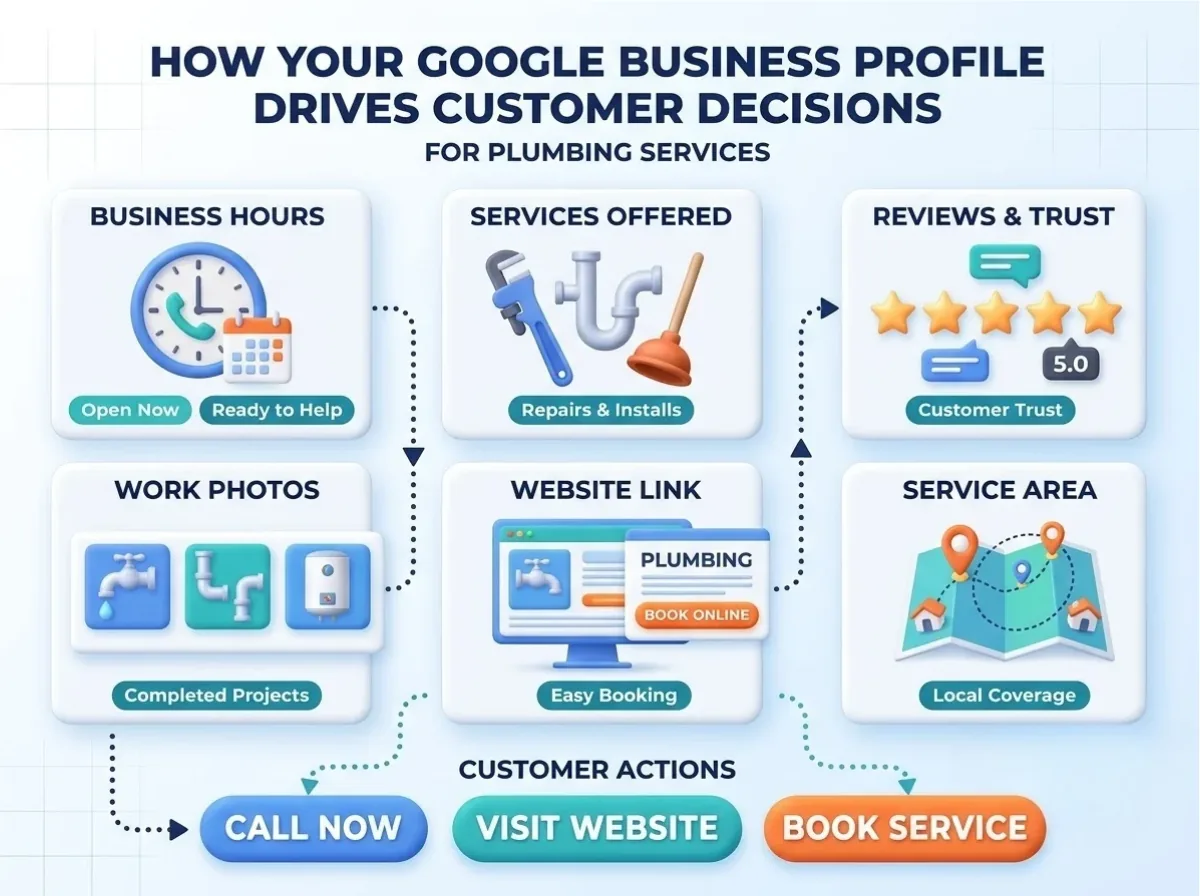
A listing must answer the questions a homeowner has before calling. Complete Google Business Profile information includes accurate business hours, a local phone number, a website link, and defined service categories such as drain cleaning, water heater repair, or emergency plumbing. Photos of completed jobs and the company's vehicles build familiarity, while reviews provide social proof.
Each element removes a barrier to contact. A homeowner who sees 24-hour availability and a click-to-call option is far more likely to act than one who must search for details elsewhere. The table below summarizes the most influential profile elements and the customer action each one supports.
Understanding Visibility Across Different Neighborhoods
Local rankings vary by location. A plumbing company may rank first for searches made near its office but fall to the fifth or sixth position a few miles away. Because most customers search from where they are standing, ranking performance in one neighborhood does not predict performance in another.
This variation is why businesses must monitor visibility across their full service area rather than relying on a single location check. Gaps in coverage reveal neighborhoods where competitors dominate and where additional content, reviews, or profile updates may produce new inquiries.
How Local Search Builds Trust Before Customers Contact a Plumber
Homeowners rarely call the first plumber they find. They compare several options, looking for signals that a company is reliable, honest, and responsive. Local search results give them those signals before any conversation begins. Reviews, accurate business information, and an active online presence work together to build the confidence that turns a search into a customer inquiry.
The Influence of Customer Reviews on Plumbing Decisions
Reviews are among the most persuasive factors in a plumbing decision. Plumbing work is often unfamiliar and costly, and customers have limited ability to judge quality before the job is complete. Past customers' experiences serve as a proxy for that judgment. Detailed reviews that mention punctuality, pricing transparency, and the quality of repairs help prospective customers evaluate service quality and reliability.
Authenticity matters as much as volume. Reviews that describe specific problems and outcomes carry more weight than generic praise, and a steady flow of recent reviews signals that the business is currently active. Plumbing companies should ask satisfied customers for feedback promptly after each job, while the experience is still fresh.
Maintaining Accurate and Consistent Business Information
Trust erodes quickly when information conflicts. A business with one phone number on its website, a different number on its Google Business Profile, and an outdated address in a directory creates doubt about whether it is still operating. Customers may also call a disconnected number or drive to a former location, which damages credibility before the first conversation.
NAP consistency, meaning consistent name, address, and phone number across the web, is a core local SEO practice. Operating hours, service descriptions, and the list of communities served should also match across every platform. Regular audits of major directories and the company website prevent errors from accumulating and help search engines confirm that the business is legitimate.
Using Online Reputation to Encourage More Inquiries
A complete online presence signals professionalism. Responding to reviews, especially negative ones, shows prospective customers how the company handles problems. Professional, courteous replies that acknowledge the concern and describe the corrective action often persuade readers more than the original complaint discourages them. Ignoring reviews, by contrast, suggests indifference.
Engagement beyond reviews also builds confidence. Photos of completed projects, service descriptions that explain the work process, and clear pricing guidance give customers a realistic picture of what to expect. Together, these elements reduce uncertainty and make the business the easiest choice to contact.
Turning Local Search Visibility Into More Plumbing Calls and Service Opportunities
Visibility matters only when it produces action. A plumbing company that ranks well but fails to convert searchers into callers wastes its marketing investment. The objective is to design every touchpoint, from the search result to the contact form, so that interested homeowners can reach the business quickly and without friction.
Connecting Local Search Discoverability With Customer Inquiries
Local visibility generates several types of customer response. A homeowner may call the listed number, visit the website, request directions, or submit an inquiry through a booking form. Each action represents a different level of intent, and each should be tracked. A direction request, for example, often signals that a customer is preparing to visit or that a service call is imminent.
The path from discovery to inquiry should be short. The Google Business Profile should link directly to a service page that matches the search, and that page should contain a clear phone number and a simple way to request service. Customers who must search again after landing on a website are likely to choose a competitor instead.
Making It Easier for Mobile Users to Contact Your Business
Most local plumbing searches occur on mobile devices, often during an emergency. A customer with water spreading across a kitchen floor needs to call within seconds. A mobile-friendly website with fast load times, readable text, and an easy-to-tap layout is therefore essential to conversion.
Click-to-call buttons should appear prominently on every page, and the phone number should be visible without scrolling. Service pages should describe the work clearly and state the communities served, so that customers can confirm within moments that the business can help them. Accessible contact information, including a short form for non-urgent requests, supports customers who prefer not to call.
Identifying Which Local Search Activities Generate Leads
Not every interaction carries equal value. Plumbing companies should evaluate Google Business Profile metrics, including calls, website clicks, direction requests, and profile views, to determine which activities correspond to real opportunities. Phone call tracking, which assigns unique numbers to different sources, can connect calls to specific search terms or service areas.
The table below outlines common local search activities and how to interpret them.
| **Activity** | **Lead Strength** | **Recommended Follow-Up** |
|---|---|---|
| Phone calls | High | Track by source and respond within minutes |
| Direction requests | High | Confirm availability and service scope |
| Website visits to service pages | Moderate | Ensure clear calls to action are present |
| Booking form submissions | High | Respond within one business hour |
| Profile views | Low to moderate | Monitor trends to identify visibility changes |
Reviewing these metrics monthly reveals which services, neighborhoods, and search terms produce the most valuable inquiries. That information guides decisions about where to focus content, advertising, and service coverage.
How Plumbing Businesses Can Measure and Improve Local Search Performance
Local search performance is not fixed. Competitors adjust their profiles, search behavior shifts with the seasons, and customer demand changes across neighborhoods. Plumbing companies that measure their visibility consistently can identify weaknesses early, respond to competitors, and direct their marketing budgets toward the activities that produce the most inquiries.
Identifying Local Visibility Gaps Across Your Service Area
A geo-grid is a map that tracks search rankings from many points across a service area. The tool places a grid over the region, runs a search from each point, and records where the business appears in the local results. The output is a heatmap that shows where the company ranks first, where it appears lower on the page, and where it does not appear at all.
These patterns are valuable because a single ranking check can be misleading. A business may rank first at its office address but fail to appear in neighborhoods five miles away. Geo-grid analysis reveals those gaps, so the company can add targeted service pages, collect reviews from underserved areas, or refine its Google Business Profile settings to expand coverage.
Monitoring Competitors to Find New Lead Opportunities
Competitor analysis reveals where the market is open. A business should review which rival plumbers appear in the local pack for priority keywords, how many reviews they hold, which services they promote, and which neighborhoods they cover. If a competitor dominates emergency searches in one area but has no presence in an adjacent community, that gap represents an opportunity.
Competitor monitoring should not become imitation. The goal is to identify unmet demand and differentiate the business through faster response times, more complete profiles, or stronger reviews. Regular comparisons, conducted quarterly, keep the company informed without requiring constant attention.
Using Local SEO Data to Make Better Marketing Decisions
Data becomes useful only when it informs action. Keyword tracking shows which high-intent keywords are gaining or losing visibility.Google Business Profile analytics reveal how customers find the listing, which actions they take, and how those patterns change over time. Geo-grid heatmaps show whether efforts to expand coverage are working, while performance reports consolidate these findings into a format that supports planning.
The table below summarizes the core measurements and the decisions each one supports.
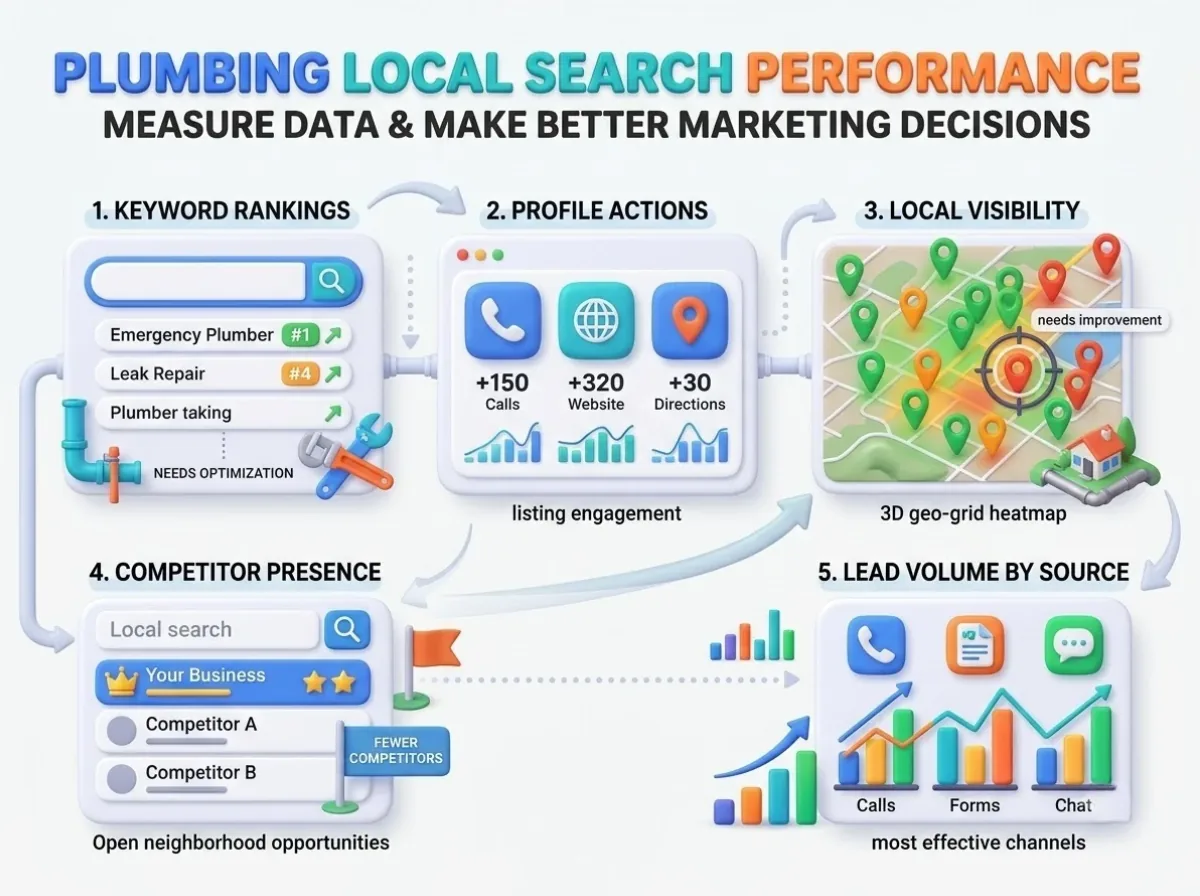
Reviewing these measurements monthly allows a plumbing business to test changes, confirm results, and allocate resources with confidence. Over time, this discipline turns local search from an uncertain channel into a predictable source of customers.
Conclusion
Local search is the most direct route to plumbing lead generation. Homeowners facing a leak or a failed water heater search for help nearby, and the businesses that appear first, with strong reviews and accurate information, receive the call. Visibility, trust, and clear paths to contact work together to turn that search into a booked appointment.
Sustained results depend on measurement. Tracking geo-grid rankings,Google Business Profile activity, and lead sources reveals where a business is strong and where competitors are gaining ground. Tools such as[Happy Rank](/)help plumbing companies monitor their local search visibility and identify the neighborhoods and services that need attention, so improvements are guided by data rather than assumptions.
When homeowners or businesses experience electrical problems, they often turn to Google Maps to find a reliable electrician nearby. Whether they need emergency repairs, wiring installations, or routine maintenance, customers prefer businesses they can locate and contact quickly. This makes Google Maps for electricians an important part of attracting local customers and generating service inquiries. Searches such as electrician near me,local electrical services, and electrical contractors nearby create opportunities for businesses to connect with customers actively looking for professional help.
A strong Google Maps presence allows electricians to showcase their services, display customer reviews, share contact information, and reach potential clients across their service areas. However, simply creating a Google Business Profile is not enough. Electricians also need to maintain accurate business information, build a positive online reputation, and improve their local search visibility to compete with other service providers.
With a local SEO platform like Happy Rank, electricians can monitor Google Maps rankings, track local search performance, and identify opportunities to improve their local online presence. These efforts can help turn nearby searches into valuable customer connections and more service inquiries.
How Google Maps Connects Electricians With Nearby Customers
Google Maps is often the first place a customer looks when electrical work is needed. For electricians, visibility in local results determines whether a business is considered at the moment of need. The sections below explain how customers search, why visibility matters, and how location shapes discovery.
How Customers Search for Electrical Services on Google Maps
Homeowners and property managers often start a local search the moment they need an electrician. A customer with a tripped breaker, a flickering fixture, or a failed outlet typically enters a short query such as "electrician near me" or "emergency electrical repair near me." Google Maps returns nearby businesses ranked by relevance, distance, and prominence, with the searcher's location as a central input.
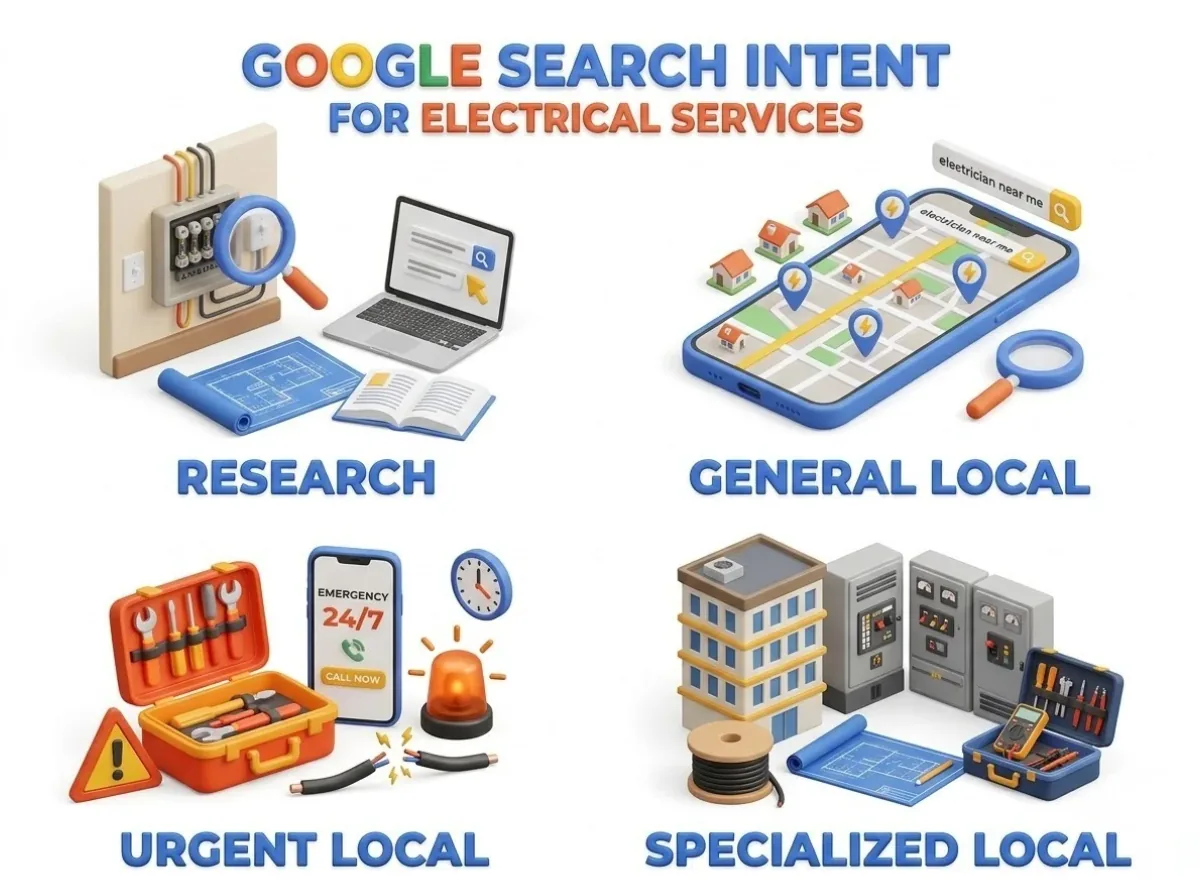
Search intent varies considerably. General research queries, such as "how to know if home wiring is outdated," signal early consideration. High-intent local searches, such as "residential electrician in Austin" or "commercial electrical contractors nearby," signal that the customer is ready to hire. Electricians who understand this difference can align their profile content with the searches that generate qualified inquiries.
Understanding these different local search intents helps electricians connect with customers at the right stage of their decision-making process. By optimizing their Google Maps presence for relevant electrical services, businesses can reach people researching solutions, comparing nearby providers, or looking for immediate assistance.
Why Google Maps Visibility Matters for Electricians
Appearing in Google Maps places an electrical business in front of customers who are actively looking for services. The local 3-pack, the group of three listings displayed prominently for many local queries, attracts a significant share of user attention. Businesses that appear in the 3-pack tend to receive more calls, direction requests, and website visits than competitors ranked lower.
Prominent listings also build recognition and trust. A customer who sees the same electrical business repeatedly in local results is more likely to consider it than an unfamiliar name. Electricians with weaker visibility can close this gap by strengthening the signals Google uses to assess prominence, including reviews, profile completeness, and consistent business information.
How Location-Based Discovery Creates More Service Opportunities
Google Maps matches customers with electricians based on their current location and service requirements. A homeowner in one neighborhood and a property manager across town may see different results for the same query. An electrician's reach therefore depends on where the business is located and how well its profile serves surrounding areas.
Google Maps also helps customers evaluate providers before they call. Ratings, photos, service listings, and business hours allow searchers to compare options side by side. Electricians who present clear, accurate information in these areas can attract residential repairs, commercial maintenance contracts, and emergency service calls through a single profile.
How an Optimized Google Business Profile Builds Customer Confidence
A Google Business Profile functions as an electrician's storefront in search results. Customers form their first impression from the information displayed there, and an accurate, well-maintained profile reduces hesitation before the first call.
Provide Accurate Business Information Customers Need
Complete and current business information is the foundation of an effective profile. Customers searching during an outage or safety concern need to reach the right business quickly, and outdated details create friction and lost inquiries.
Essential profile details include:
- Business name and primary category
- Phone number and website
- Business hours and emergency availability
- Service areas
- A concise business description that states the core services and credentials
Accurate information makes it easier for customers to contact an electrician with confidence, and it signals to Google that the listing is reliable.
Showcase Electrical Services Through Your Business Profile
Listing specific services helps customers understand what an electrician offers and whether the business fits their needs. Each relevant service should be added as a separate item in the profile, using clear terms that customers actually search.
Common services to include:
- Electrical wiring and rewiring
- Circuit breaker repairs
- Electrical panel upgrades
- Lighting installation
- EV charger installation
- Electrical safety inspections
Specific service descriptions also support semantic relevance, helping Google connect the profile to a broader range of related local searches.
Use Project Photos to Demonstrate Professional Experience
Genuine project photos provide visual proof of workmanship, which is particularly valuable in a trade where clients cannot easily evaluate quality before hiring. Photos should reflect actual work and should never be stock images or misrepresented projects.
Effective photo categories include:
- Completed electrical installations
- Lighting projects
- Panels, meters, and equipment
- Clean, professional work environments
Visual evidence of completed work helps potential customers feel more confident before they make contact, and it distinguishes an established business from one with little documented experience.
How Reviews and Local Reputation Influence Customer Decisions
Electrical work involves safety, property, and significant expense, so customers scrutinize the people they hire. Reviews and local reputation provide the external validation that customers need before they commit, and they often determine which electrician receives the call.
Why Customers Check Reviews Before Hiring an Electrician
Trust is central to electrical work. Customers cannot easily assess the quality of wiring or panel work after it is completed, so they rely on the experiences of others. Ratings, written reviews, and the details within them shape perceptions of reliability,workmanship, and professional conduct.
Reviews also allow customers to compare electricians offering similar services. When two businesses appear in the same results, the one with more verifiedcustomer feedback and a stronger overall rating typically earns the higher level of consideration.
| **Review factor** | **Customer question it answers** |
|---|---|
| Overall rating | Is this electrician generally well regarded? |
| Review volume | Is there enough experience to be confident? |
| Review detail | How did the work proceed, and was communication clear? |
| Recency | Does the business currently deliver consistent service? |
How Electricians Can Build a Consistent Review Profile
A consistent review profile is built through a deliberate, repeatable process rather than occasional requests. Electricians should ask for honest feedback after each completed project, while the experience is still fresh.
- Request feedback promptly after job completion
- Make the process convenient with a directGoogle review linksent by text or email
- Send a polite follow-up message if no response is received within a reasonable period
- Collect feedback from every client, not only those who are visibly satisfied
Steady, genuine feedback strengthens review velocity, which signals ongoing activity and supports long-term local prominence.
Respond to Customer Reviews to Strengthen Your Reputation
Professional responses demonstrate customer care and show prospective clients how the business handles both praise and problems. Every review deserves a response, and the tone should remain consistent regardless of the rating.
- Positive reviews:Thank the customer by name and reference the specific service provided
- Negative reviews:Acknowledge the concern, apologize for the experience, and invite offline resolution
- Complaints:Address the issue factually without defensiveness, and avoid disclosing private customer details
Active review management supports customer confidence and reinforces the overall local reputation that Google and prospective customers evaluate.
How Google Maps Helps Electricians Reach More Neighborhoods
Local visibility is not uniform across a service area. An electrician may dominate results near the business address yet remain largely invisible a few miles away. Understanding how ranking signals vary by location allows electricians to target gaps deliberately rather than relying on assumptions.
Understand How Local Search Rankings Change Across Service Areas
Google evaluates local rankings using three primary factors:relevance,distance, and prominence. Relevance measures how well the business profile matches the search. Distance measures how close the business is to the searcher. Prominence reflects how well known and well-reviewed the business appears across the web.
Because distance is a direct input, an electrician will typically rank strongly near its business address and weaker in areas farther away. Customer location also shapes the results a searcher sees, so the same query can produce different top listings in different neighborhoods.
| **Ranking factor** | **Primary influence** | **Practical lever** |
|---|---|---|
| Relevance | Match between query and profile | Accurate categories and services |
| Distance | Searcher's proximity to the business | Service-area coverage and location strategy |
| Prominence | Reputation and web presence | Reviews, citations, and content |
Identify Neighborhoods Where Your Electrical Business Needs More Visibility
Electricians should evaluate rankings across their entire service area, not only from the business address. Location-based rank tracking reveals neighborhoods where competitors hold stronger positions and where customer demand may be going unmet.
Geo-grid heatmaps are a useful method for this analysis. They display rankings for a keyword across a grid of search points, producing a visual map of strong and weak areas. These insights help electricians prioritize where to invest in local visibility.
Improve Your Local Presence in Important Service Areas
Once visibility gaps are identified, electricians can strengthen their presence in priority neighborhoods through several channels:
- Service-area contenton the business website that addresses specific communities
- Consistent business informationacross directories, including name, address, and phone number
- Local relationshipswith builders, property managers, and community organizations
- Genuine coverageof areas the business actually serves, rather than unnecessary location additions
Adding locations that the business does not genuinely serve can weaken profile credibility. Focused, accurate service-area signals produce stronger and more sustainable results.
How Electricians Can Measure Google Maps Performance and Generate More Leads
Visibility has little value unless it produces measurable customer activity. Electricians should monitor profile performance, identify the searches that generate leads, and use local rank tracking to confirm that their optimization efforts are working.
Track the Metrics That Reveal Customer Engagement
Google Business Profile provides performance indicators that show how customers find and interact with a listing. Each metric reveals a different stage of customer interest.
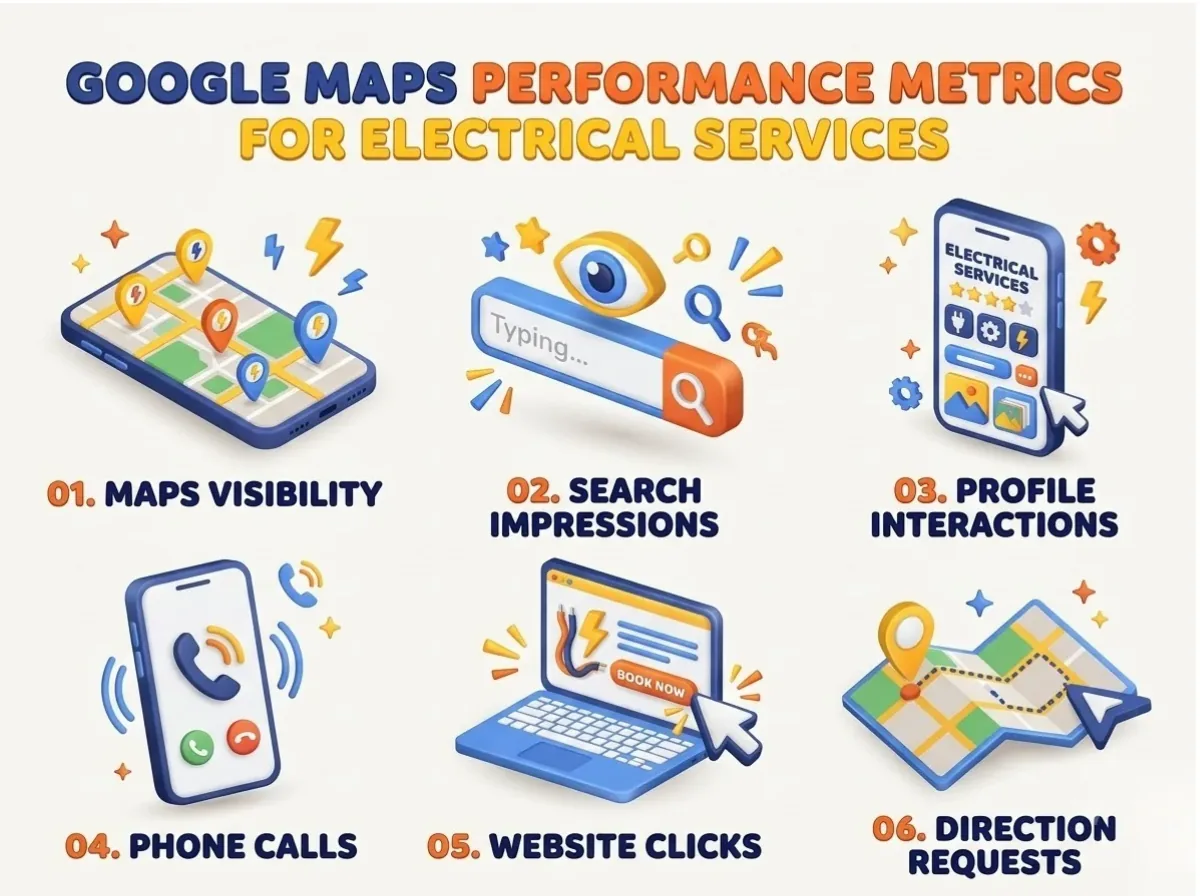
Tracking these metrics over time shows whether changes to the profile are producing more engagement, and which channels deliver the strongest customer intent signals.
Understand Which Searches Generate Valuable Electrical Leads
Not every search produces qualified inquiries. Electricians should monitor the keywords that attract potential customers and compare performance across query types.
- Service-specific searches, such as "EV charger installation near me," typically indicate a defined project and a higher likelihood of conversion
- Broad electrician searches, such as "electrician near me," generate higher volume but often involve more comparison shopping
- Emergency-related searches, such as "emergency electrical repair," signal urgent demand and often justify faster response times and visible after-hours availability
Keyword performance reveals opportunities in emergency repairs, new installations, and commercial electrical services, which often carry larger contract values.
Use Local SEO Tools to Monitor and Improve Google Maps Visibility
Manually checking rankings is unreliable because results change with the searcher's location, device, and search history.Local SEO software and geo-grid tracking measure rankings across many points in a service area and produce consistent, comparable reports.
These reports help electricians identify weak neighborhoods, monitor competitors, and evaluate whether optimization efforts are improving local rankings. Platforms such as Happy Rank provide this kind of Google Maps visibility monitoring, allowing electricians to track performance across neighborhoods and act on the results with confidence.
Conclusion
Google Maps connects electricians with nearby customers who are actively searching for electrical services. A complete and accurate Google Business Profile, genuine customer reviews, and clear service information build the trust that turns a search into a call. Neighborhood-level visibility then determines how far that trust reaches across the service area. Tracking calls, profile interactions, and local rankings shows whether the strategy is producing real business opportunities.
Consistent optimization and performance monitoring strengthen a local presence over time. Local SEO tools such as[Happy Rank](/)help electricians measure visibility across neighborhoods, identify gaps, and prioritize the improvements most likely to attract customers.
When homeowners experience a broken air conditioner or heating system, they often turn to Google to find a reliable contractor nearby. For HVAC businesses, these searches create valuable opportunities to connect with customers who are ready to book a service. However, simply appearing in local search results does not guarantee more inquiries. Contractors need strong local search visibility, relevant service information, and an easy way for potential customers to get in touch.
Effective HVAC local SEO helps businesses reach homeowners searching for AC repair near me, emergency heating services, and HVAC installation in their service areas. By improving Google Maps visibility, maintaining an optimized Google Business Profile, and monitoring local search rankings, contractors can attract more relevant inquiries.
With[Happy Rank](/), HVAC businesses can track their local performance, identify visibility gaps, and make informed optimization decisions. These efforts can help contractors generate more HVAC phone calls, connect with potential customers, and create more service opportunities.
Understand What Makes Local HVAC Searches Turn Into Phone Calls
Generating more phone calls from local search starts with understanding what homeowners are looking for when they search for HVAC services. Not every search indicates an immediate need. Some homeowners research heating and cooling systems, while others need urgent repairs and are ready to contact a contractor. Recognizing this difference helps HVAC businesses focus on searches that are more likely to generate service inquiries.
Identify Searches That Signal Immediate HVAC Service Needs
Homeowners often use specific search terms when they need professional HVAC assistance. Searches such as AC repair near me, emergency furnace repair, and same-day HVAC service usually indicate a stronger intention to hire a contractor than general searches about air conditioning systems.
For example, someone searching for "how does an air conditioner work" is probably gathering information, while someone searching for "emergency AC repair near me" may need immediate assistance. HVAC contractors should understand these differences when planning their local SEO strategy.
Prioritizing high-intent search terms helps businesses attract people who are actively looking for services rather than visitors who are only browsing for information.
Recognize the Local Search Moments That Matter Most
The demand for HVAC services often changes with weather conditions and seasonal requirements. During summer, homeowners may search for AC repair, cooling system installation, or air conditioner maintenance. In colder months, searches for furnace repair, heating system inspections, and emergency heating services become more common.
Understanding these seasonal patterns helps contractors align their online presence with customer requirements. For instance, promoting AC maintenance before summer begins can help attract homeowners preparing their cooling systems for warmer weather.
Contractors should also consider unexpected equipment breakdowns, which can create urgent demand throughout the year. Keeping relevant service information updated helps businesses remain visible when homeowners need assistance.
Match Your Services With Customer Search Intent
Different searches reflect different customer needs, so HVAC contractors should make sure their online content matches the services people are looking for. A homeowner searching for AC installation has different expectations from someone looking for emergency furnace repair.
For better local search visibility, businesses should organize their website content around their actual services and customer requirements. Consider these examples:
- AC repair:Target homeowners experiencing cooling problems or equipment breakdowns.
- Heating repair:Reach customers dealing with furnace or heating system issues.
- HVAC installation:Connect with homeowners considering new heating and cooling systems.
- Preventive maintenance:Attract customers looking for seasonal inspections and routine servicing.
Matching relevant services with customer search intent helps contractors attract more qualified visitors. It also creates better opportunities to turn local searches into phone calls and booked appointments.
Improve Your Google Maps Visibility Across Your HVAC Service Areas
Appearing in Google Maps results is important for HVAC contractors who want to attract homeowners from nearby communities. However, local visibility is not always consistent across every service area. A business may appear prominently in one neighborhood but remain difficult to find in another. This can limit opportunities to receive calls from potential customers outside its immediate location. Understanding these geographic differences helps contractors identify where their local search visibility needs improvement and focus their efforts on areas with greater business potential.
Understand Why Your Business Ranking Changes Across Locations
Google Maps rankings can vary depending on where someone performs a search. Google's local search results consider factors such as relevance, distance, and prominence when determining which businesses appear for a particular query.
For example, an HVAC contractor based in one part of a city may rank well for "AC repair near me" in nearby neighborhoods but have lower visibility in areas farther away. Local competitors, customer reviews, business information, and the searcher's location can also influence the results.
Several factors can contribute to these ranking differences:
- Search location:Google considers the distance between the searcher and the businesses providing relevant services.
- Business relevance:Accurate service categories and business information help Google understand what an HVAC company offers.
- Local prominence:Reviews, online mentions, and other reputation signals can influence how prominently a business appears.
- Competition:Other HVAC contractors with stronger local visibility may appear ahead of your business.
Contractors should understand that checking rankings from their office does not provide a complete picture of their Google Maps visibility.
Identify Neighborhoods Where Your HVAC Business Is Missing From Search Results
Knowing where your business appears in local search results is just as important as knowing its overall ranking. HVAC contractors can use geo-grid ranking analysis to evaluate their Google Maps positions across multiple geographic points within their service areas.
A geo-grid report provides a location-based view of search visibility and helps contractors identify neighborhoods where competitors appear more prominently.
For example, an HVAC company may rank well for furnace repair searches near its office but struggle to appear in nearby residential communities. Understanding these differences helps contractors decide where to focus their optimization efforts.
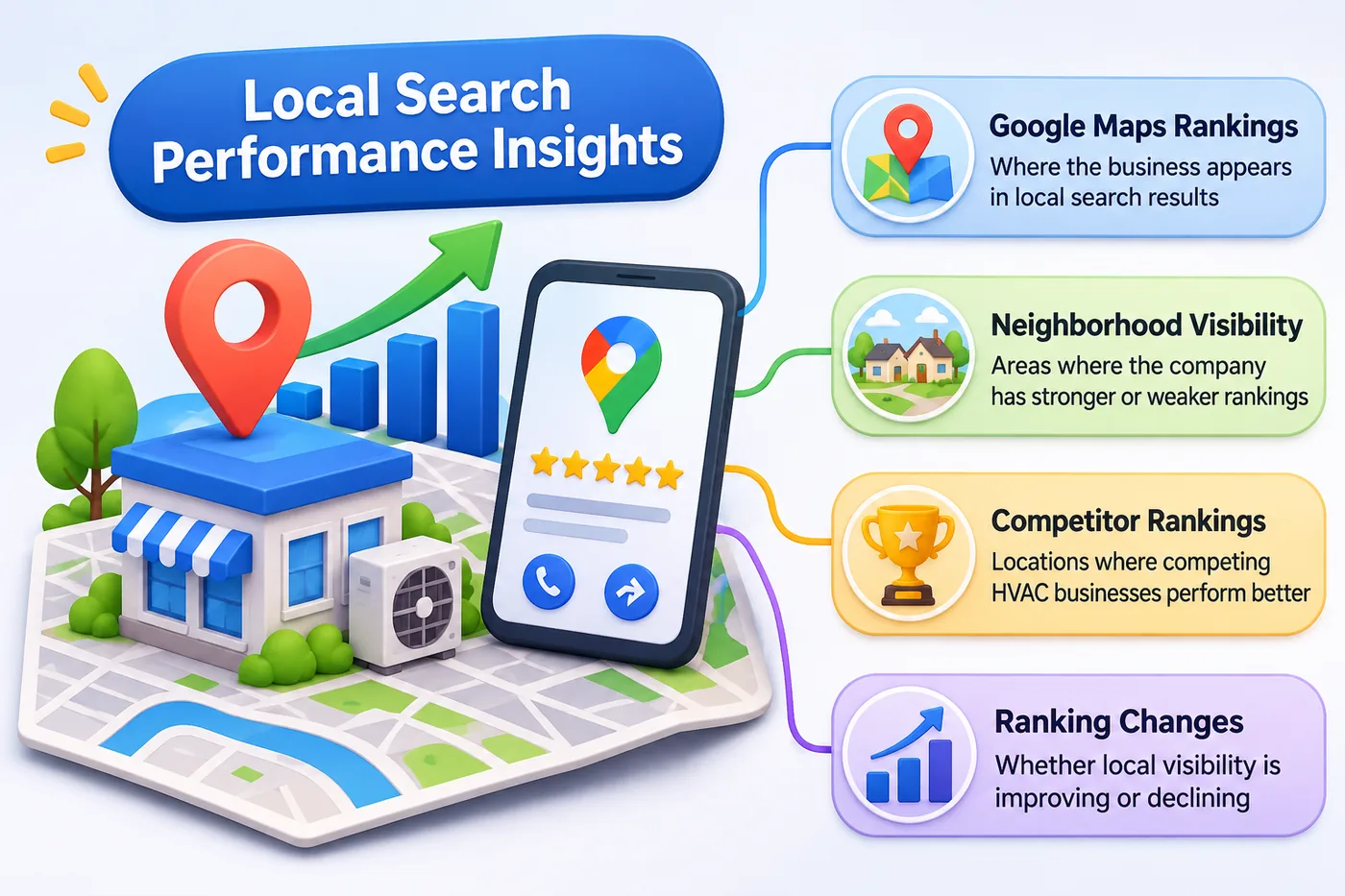
These insights allow businesses to make informed decisions instead of relying on occasional searches or assumptions.
Strengthen Your Presence in Important Service Areas
Once contractors identify weaker locations, they can prioritize relevant improvements. Some practical steps include:
- Review business information and ensure service details are accurate.
- Create useful website content addressing the HVAC needs of relevant communities.
- Maintain consistent business information across important online directories.
- Encourage genuine customer reviews after completed service appointments.
- Clearly communicate service coverage so homeowners understand where the company operates.
The goal is not to target every nearby location indiscriminately. It is to improve visibility in relevant service areas where the business can realistically provide HVAC services and generate valuable customer inquiries.
Make Your Google Business Profile More Effective at Generating Calls
A well-maintained Google Business Profile (GBP)helps HVAC contractors provide important business information to homeowners searching for heating and cooling services. When someone looks for an AC repair company or an emergency heating technician, they often compare nearby businesses before making a call. An informative profile can make this decision easier by showing customers what services are available, when the business operates, and how to get in touch. Rather than treating the profile as a basic business listing, contractors should use it to build customer confidence and encourage more HVAC phone calls.
Give Homeowners a Clear Reason to Choose Your HVAC Company
Homeowners want to know whether an HVAC contractor can handle their specific problem before contacting the business. Your profile should communicate essential details clearly and accurately.
Focus on keeping these elements updated:
- Business description:Explain your HVAC services, experience, and the types of customers you serve.
- Service categories:Choose relevant primary and additional categories that accurately represent your business.
- Service information:Highlight AC repair, furnace maintenance, heating installation, and other available services.
- Operating hours:Display accurate business hours and communicate emergency availability where applicable.
- Business photos:Add genuine images of technicians, service vehicles, equipment, and completed projects.
These details help homeowners understand what your company offers and whether it matches their requirements.
Use Google Posts to Promote Services Customers Need Now
Google Business Profile posts provide an opportunity to share timely business updates and highlight relevant HVAC services. Contractors can use these updates to communicate seasonal offers, maintenance reminders, and service announcements.
For example, businesses can publish updates about:
- Summer AC inspections before temperatures rise.
- Furnace maintenance before the winter season.
- Special installation services for homeowners upgrading their systems.
- Emergency repair availability during periods of extreme weather.
Relevant updates keep customers informed and give them more reasons to explore your services. Contractors should also include clear calls to action that direct interested homeowners toward available contact options.
Build Customer Confidence Through Review Activity
Online reviews influence how homeowners evaluate local HVAC companies. Positive feedback can provide reassurance about service quality, professionalism, and customer experience.
Contractors should develop a consistent process for requesting honest reviews after completing service appointments. They should also respond professionally to customer feedback, address concerns, and thank customers for sharing their experiences.
Keep Important Contact Information Easy to Access
Even an informative profile can lose potential inquiries if customers cannot reach the business easily. Check that your phone number, website link, operating hours, and other contact details are accurate.
Make sure customers can quickly identify how to contact your team and understand when assistance is available. Removing unnecessary confusion can make it easier for interested homeowners to take the next step and call your HVAC business.
Turn Local Search Visitors Into More HVAC Phone Calls
Getting your HVAC business in local search results is only the first step. Once homeowners discover your website or Google Business Profile, they need a clear and convenient way to contact your team. A confusing website, hidden phone number, or unclear service information can cause potential customers to leave and contact another contractor. HVAC businesses should focus on creating a smooth experience that encourages visitors to take action. Improving the website user experience, providing accessible contact options, and communicating service availability can help turn local search visitors into valuable phone inquiries.
Create a Website Experience That Encourages Immediate Contact
Homeowners looking for HVAC assistance often want quick answers, especially when their heating or cooling systems stop working. Your website should make it easy for visitors to find important information without navigating through multiple pages.
Consider implementing these elements:
- Visible phone numbers:Place your business phone number in the website header and contact section.
- Click-to-call buttons:Allow mobile visitors to call your team directly with a single tap.
- Mobile-friendly design:Ensure website pages, buttons, and contact details work properly on smartphones.
- Clear service descriptions:Explain your AC repair, heating installation, and maintenance services.
- Simple navigation:Help visitors find service information and contact options without unnecessary steps.
A convenient website experience reduces barriers between discovering your business and requesting professional assistance.
Give Emergency and Routine Services Different Contact Paths
Not every homeowner contacting an HVAC company has the same level of urgency. Someone experiencing an AC breakdown may need immediate assistance, while another customer might be planning a routine maintenance appointment.
Contractors should make these options easy to understand by:
- Providing clear contact information for emergency repair inquiries.
- Highlighting routine maintenance and inspection booking options.
- Creating dedicated service pages for installation, repairs, and maintenance.
- Explaining how customers can request estimates for larger HVAC projects.
This approach helps visitors identify the right service and contact method based on their requirements.
Communicate Availability and Service Expectations Clearly
Uncertainty about operating hours or service availability can discourage homeowners from calling. Display accurate business hours and explain whether emergency services are available outside regular working hours.
Contractors should also communicate realistic appointment availability, service coverage, and expected response times. Avoid promising immediate assistance unless the team can genuinely provide it.
Make Every Customer Interaction Count
Generating HVAC phone calls is valuable only when businesses handle incoming inquiries effectively. Missed calls, delayed callbacks, and unprepared staff can result in lost service opportunities.
Establish a consistent call-handling process that includes:
- Answering incoming calls professionally.
- Recording missed calls and following up promptly.
- Training staff to understand common HVAC service requests.
- Providing clear next steps for scheduling appointments.
- Managing after-hours inquiries appropriately.
A reliable communication process helps contractors turn more incoming calls into meaningful customer relationships and potential service bookings.
Measure Which Local Search Activities Generate the Most HVAC Calls
Improving local search performance requires more than updating business information or publishing website content. HVAC contractors also need to understand whether these efforts are generating meaningful customer inquiries. Tracking the right performance indicators helps businesses identify which activities attract potential customers and where improvements are needed. Instead of focusing only on search rankings, contractors should evaluate how local search visibility contributes to phone calls, website visits, and service requests. Regular performance monitoring also makes it easier to adjust marketing strategies based on actual results.
Track Phone Call Clicks and Other Local Search Actions
Monitoring customer interactions helps HVAC businesses understand how people respond to their online presence. Google Business Profile performance data and website analytics can provide useful information about how customers discover and engage with a business.
Some important metrics to monitor include:
- Phone call clicks:Shows how often customers select the call option on the business profile.
- Website clicks:Indicates how many people visit the website after discovering the business.
- Search impressions:Reveals how frequently the business appears in relevant search results.
- Google Maps visibility:Helps contractors understand how easily homeowners can discover their business.
- Direction requests:Indicates interest from customers looking for the business location.
These metrics provide a broader understanding of customer engagement. Contractors should remember that call clicks do not necessarily represent completed phone conversations, so combining them with actual call records can provide a more accurate picture of lead generation.
Compare Call Performance Across Services and Locations
Not every HVAC service or service area generates the same level of customer interest. For example, AC repair may attract more inquiries during summer, while furnace maintenance may receive greater attention before winter.
Contractors should compare performance across different services and locations to identify useful patterns. They can evaluate:
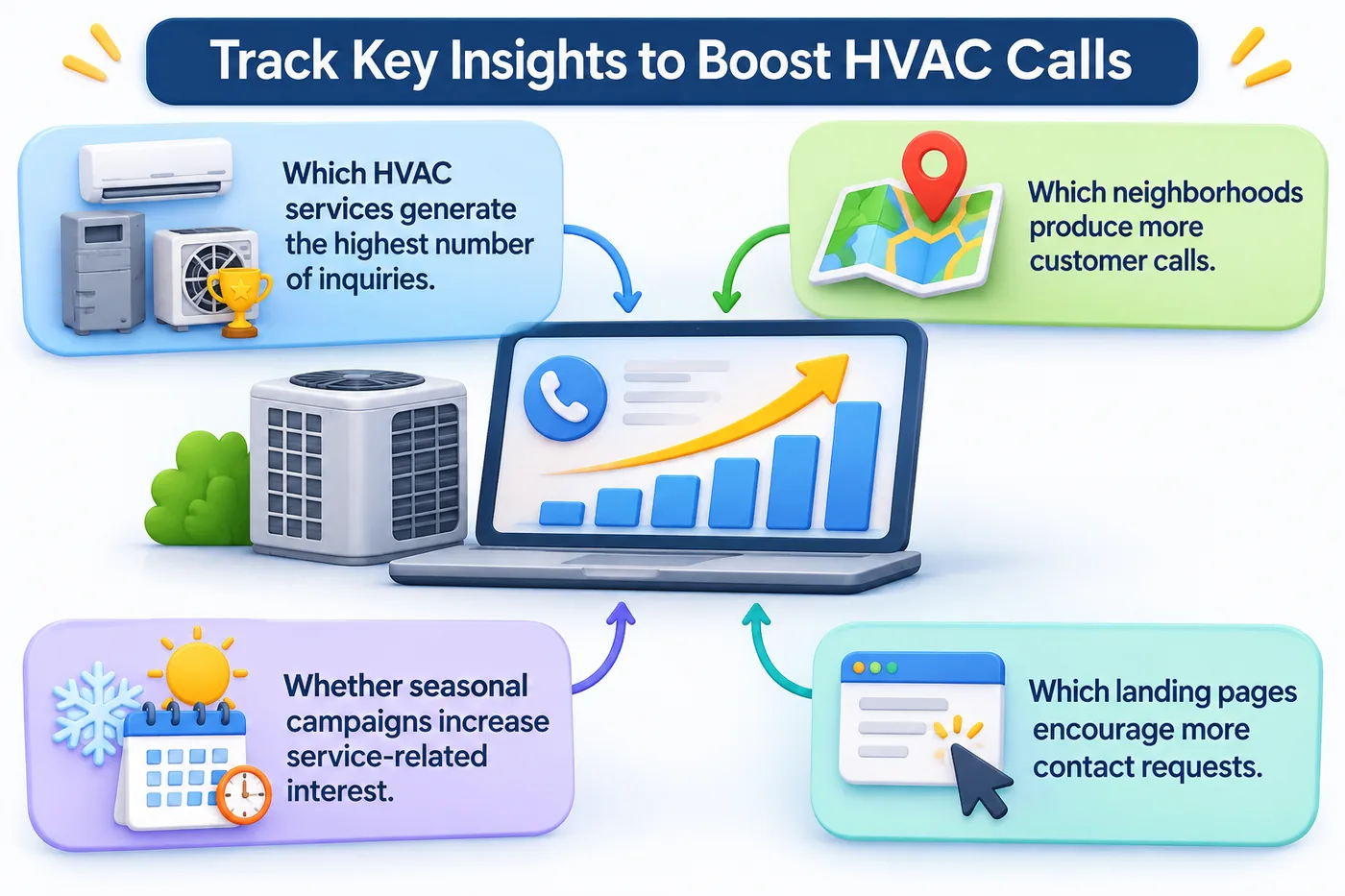
This information helps businesses identify stronger opportunities and allocate their marketing efforts more effectively.
Use Local SEO Insights to Improve Call Generation
Tracking performance is useful only when businesses apply the findings to future improvements. HVAC contractors should regularly review their local search rankings, Google Business Profile activity, and location-based visibility to understand where their strategy needs attention.
Tools such as Happy Rank can help contractors monitor Google Maps rankings, analyze geo-grid performance, track review activity, and understand local visibility across different service areas. These insights make it easier to identify ranking gaps, evaluate competitors, and prioritize optimization efforts.
By consistently reviewing performance data and making informed adjustments, HVAC businesses can strengthen their local presence, attract relevant homeowners, and create more opportunities to generate phone calls.
Conclusion
Generating more calls from local search requires HVAC contractors to focus on more than just appearing in Google results. Understanding customer search intent, improving Google Maps visibility, maintaining an informative Google Business Profile, and creating convenient contact options all contribute to attracting potential customers. Regularly monitoring local rankings and customer interactions also helps businesses identify opportunities to improve their HVAC lead generation efforts.
With[Happy Rank](/), HVAC contractors can monitor local search performance, track geo-grid rankings, analyze competitor visibility, and manage their online reputation. These insights help businesses identify areas that need attention and make smarter optimization decisions. By combining consistent local SEO strategies with effective customer communication, HVAC companies can strengthen their online presence, connect with more homeowners, and generate more valuable service calls.
Frequently asked questions
Why is local search more effective than paid shared leads for plumbers?
Local search leads are exclusive, direct inbound calls from motivated local homeowners, eliminating high platform fees and bidding wars against competitors.
What are the key pillars of local plumbing lead generation?
A fully optimized Google Business Profile, fast mobile-friendly service landing pages, strong local directory citations, and steady customer review velocity.
How does website speed influence plumbing lead conversion?
Emergency customers will abandon a slow-loading site within 3 seconds to call the next plumber on Google Maps. Fast mobile load times and prominent click-to-call buttons are critical.
What local citations should every plumbing contractor build?
List your business on Yelp, Angi, HomeAdvisor, BBB, Apple Maps, Bing Places, and local trade association directories with identical Name, Address, and Phone numbers.
How do I measure the ROI of plumbing local SEO?
Track exclusive inbound phone calls and form requests generated from organic search and Google Maps against your total local marketing spend.