
How Cleaning Businesses Can Stand Out Locally
Cleaning businesses stand out locally by knowing their ideal customers and competitors, then building visibility and trust: an accurate Google Business Profile with every cleaning service listed, a page for each service, consistent listings, genuine reviews with professional replies, a clear specialty, transparent pricing, easy booking, and regular tracking of rankings and bookings.
Not every cleaning job starts with a phone call anymore. It starts with a search bar. A homeowner types “house cleaning near me” before a family visit. A tenant looks up move-out cleaning the night before the inspection. A property manager hunts for commercial cleaning services that can start Monday. Each of them is ready to book. The only question is whether they find you or the business down the street. For cleaning businesses, that question matters more than ever. Established companies and independent cleaners are all competing for the same local cleaning services searches, and a low price rarely settles it on its own. Customers lean toward the business that looks trustworthy, shows up in Google Maps results, and has genuine customer reviews to back up its claims. In other words, local search visibility is the foundation of effective cleaning business marketing. Pair it with consistent service quality and a solid online reputation, and you give people a real reason to pick you. So where do you stand today? Happy Rank, a local SEO tool, lets you track your local rankings and spot opportunities to strengthen your online presence. Let’s look at how to make your business the one locals call first.
Understand Your Local Market and Competitors
Before I spend a dollar on marketing, I always start with one question: who exactly am I trying to reach, and who else is already reaching them? Here’s how I break that down.
Identify Your Ideal Local Customers
Early on, I tried to serve everyone, and it showed. Once I sorted my leads by type, my marketing got sharper fast. Most local cleaning services customers fall into these groups:
- Residential clients who want reliable recurring cleaning
- Commercial clients such as offices and property managers
- Move-in and move-out cleaning customers on tight deadlines
- Deep cleaning and specialized cleaning customers
Across all of them, I’ve found the priorities are similar: reliability, flexible scheduling, affordability, and consistent results. Map your best-performing service areas and neighborhoods, then focus there first.
Analyze Competing Cleaning Businesses in Your Area
I once spent an evening reading every competitor’s Google Business Profile and reviews. It was eye-opening. Review these four areas:
- Websites and service offerings
- Google Business Profiles
- Customer reviews
- Pricing, service guarantees, credentials, and availability
Notice what they communicate well and where the customer experience falls short. Slow replies and vague pricing came up constantly in the complaints I read.
Find Opportunities to Differentiate Your Services
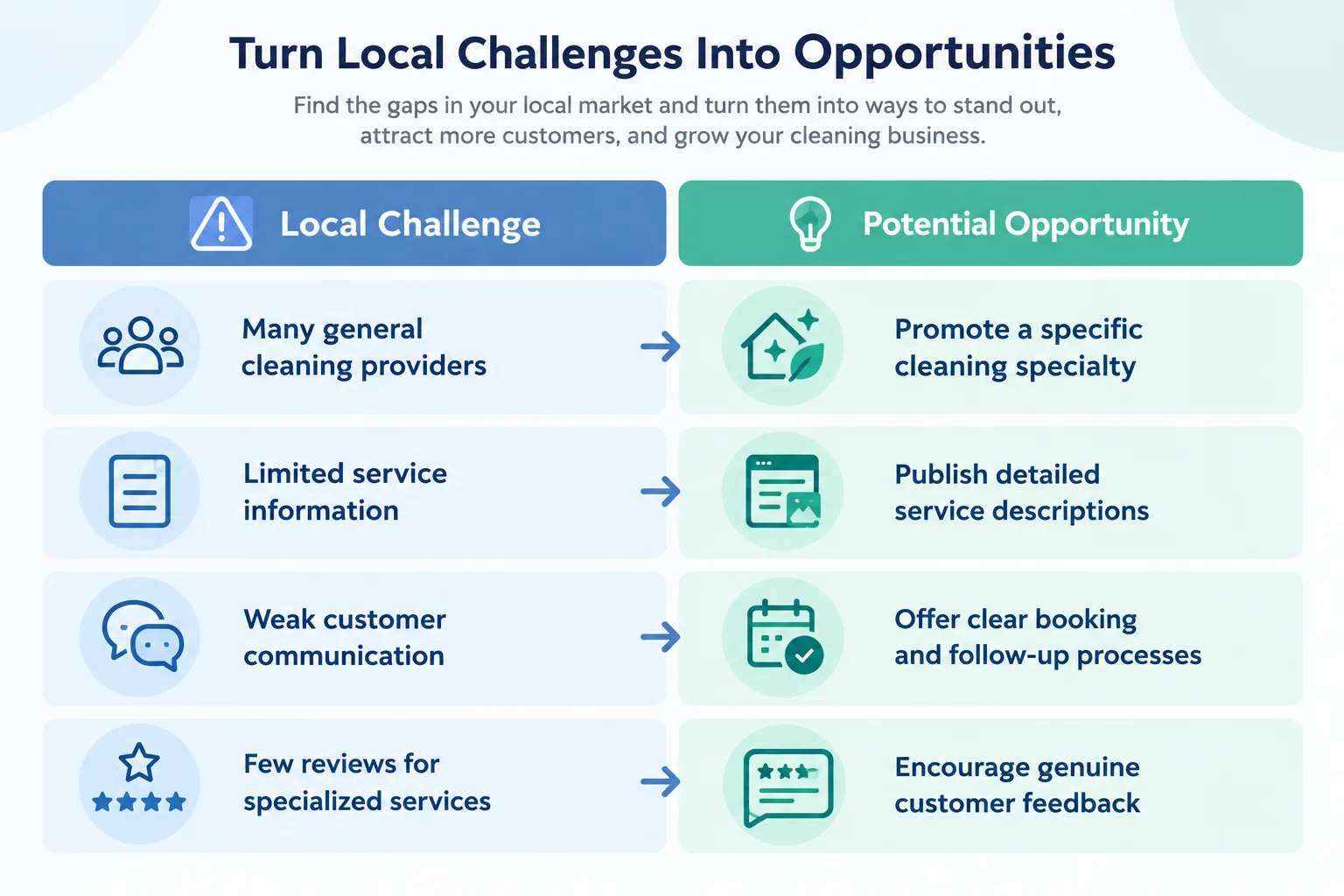
Look for underserved neighborhoods or niche needs, like post-construction cleaning, recurring office cleaning, or eco-friendly cleaning. When I stopped competing on price and leaned into what competitors overlooked, inquiries got noticeably better. Here’s how common local challenges can become openings:
Turning Local Challenges Into Opportunities
Understanding your market this way gives your local SEO and cleaning business marketing a clear direction before you build anything else.
Improve Local SEO to Attract Nearby Customers
When I first tackled local SEO, I assumed it was a technical maze. It turned out to be a handful of habits done consistently. Here’s where I’d focus first.
Optimize Your Google Business Profile
Your Google Business Profile is often the first thing a nearby customer sees, so I treat it like a storefront window. I once discovered my hours were wrong during a holiday week, and it cost me a few bookings I’ll never get back. Keep these details sharp:
- Accurate business name, service area, phone number, hours, and website
- The most relevant primary category, plus every applicable cleaning service
- Authentic photos of your team, equipment, and completed work (get customer permission first)
- Prompt updates whenever services or operating hours change
Target Local Keywords on Your Website
Think about how people actually search. Phrases like “house cleaning services in [city]” and “commercial cleaning near [area]” are your local keywords, and they belong in your page titles, meta descriptions, headings, and service copy, worked in naturally. Create location pages only when each one offers genuinely distinct information for that service area. I’ve seen near-duplicate pages with swapped city names do more harm than good, so skip keyword stuffing entirely.
Build Useful Service and Location Pages
Give each offering its own page: residential cleaning, office cleaning, deep cleaning, and any specialties. Each page should cover:
- Service coverage and the cleaning process
- Customer benefits
- Answers to frequently asked questions
- Easy-to-find contact details and booking options, especially on mobile devices
Most of my inquiries come from phones, so I always test the booking flow on mine before publishing.
Strengthen Local Citations and Business Information
Keep your business listings consistent across relevant directories, because mismatched names or phone numbers confuse both customers and search engines. Seek legitimate local citations from business associations, community organizations, and industry directories. Building relationships with property managers and real estate agents also pays off when it’s done genuinely. Here’s how these tasks fit together: Improving local SEO helps cleaning businesses appear when nearby customers search for relevant services. Each optimization task serves a different purpose, from making business information easier to find to helping potential customers understand available services. The table below outlines key local SEO tasks and the benefits they can offer.
| SEO Task | Purpose | Expected Benefit |
|---|---|---|
| Google Business Profile optimization | Improve local business information | Better discoverability |
| Local keyword targeting | Match service and location searches | More relevant local traffic |
| Service pages | Explain offerings clearly | More customer inquiries |
| Consistent business listings | Reinforce accurate details | Stronger customer trust |
Build Trust Through Reviews and Customer Experience
Early in my cleaning business, I learned that customers rarely hire the company with the flashiest ad. They hire the one that feels safe to let into their home or office. Trust is built in small, repeatable moments, and here’s how I approach it.
Encourage Genuine Customer Reviews
I used to feel awkward asking for customer reviews, until I realized happy clients usually don’t mind. They just need a nudge. After a job is finished, I send a polite follow-up message with a direct review link, and I keep it low pressure. A few rules I stick to:
- Ask satisfied customers for honest feedback right after a completed cleaning
- Use an appropriate follow-up channel, like text or email
- Make the review process simple, without pushing anyone
- Never buy fake reviews or offer incentives for positive ratings, since it damages your online reputation and breaks platform rules
Respond to Reviews Professionally
Your replies are public, so future customers read them as closely as the reviews themselves. I once got a frustrated review about a missed spot, and a calm, helpful reply ended up winning that client back. Here’s my approach to review responses:
- Thank customers for positive feedback and mention specific details when it fits
- Address negative reviews calmly and offer a practical way to resolve the issue
- Never share private customer information in a public reply
- Watch for recurring comments, since they point to real service improvements
Demonstrate Reliability and Professionalism
People want proof that you’re dependable. Explain your staff training, cleaning procedures, insurance coverage, and relevant credentials accurately. Communicate arrival times, booking confirmations, cancellation policies, and service expectations clearly, because I’ve found that most complaints come from mismatched expectations rather than poor cleaning. Use authentic testimonials and project photos only with permission.
Turn Customer Satisfaction Into Repeat Business
Repeat clients are the backbone of my schedule. Offer convenient recurring cleaning schedules, follow up to confirm customer satisfaction, and fix unresolved concerns quickly. Make rebooking easy, and be upfront about any changes to service terms or pricing. Here’s what each trust signal tells potential customers:
| Trust Signal | What It Communicates |
|---|---|
| Detailed customer reviews | Real experiences from previous customers |
| Professional responses | A genuine commitment to customer service |
| Clear service descriptions | Transparent expectations |
| Consistent communication | Reliability and organization |
| Authentic project photos | Evidence of the work performed |
These trust signals work best when they reflect your actual service quality and customer experience. Make sure your team follows through on the promises you make, responds to customer concerns promptly, and maintains consistent standards across every booking. Over time, these efforts can strengthen your reputation, encourage repeat business, and help your cleaning company stand out in the local market. When you combine honest reviews with dependable service, you earn the kind of customer trust that no ad budget can buy.
Differentiate Your Cleaning Business With a Clear Local Brand
For a long time, my business looked like every other cleaner in town: same promises, same pricing pitch, same forgettable name recall. Once I got deliberate about my local brand, people started remembering me. Here’s how I’d build yours.
Develop a Clear Unique Selling Proposition
Your unique selling proposition answers one question: why should a specific group of local customers choose you? I stopped saying “we clean everything” and started saying “we specialize in move-out cleaning for renters who want their deposit back.” Inquiries got better almost overnight. Build yours around real strengths:
- Specialized equipment or eco-friendly cleaning products
- Flexible appointments and recurring service plans
- A clear explanation of how you solve customers’ practical concerns
- No unsupported claims like “the best” or “cheapest” cleaning company in town
Offer Convenient Booking and Transparent Pricing
Confusing quotes lose customers faster than a bad review. I learned to spell out exactly how estimates are calculated, and my price transparency cut down on awkward back-and-forth. Make these basics easy:
- Explain how pricing is determined and which services are included
- Note whether additional charges may apply
- Offer simple inquiry forms, convenient contact options, and timely responses
- Set realistic expectations about availability and service completion
Use Local Content to Connect With Your Community
Helpful content positions you as the neighborhood expert. I started sharing seasonal cleaning checklists, move-out cleaning tips, and office maintenance recommendations tailored to local property types, and customers began mentioning them during calls. Join relevant community events and local partnerships when it makes sense. Just remember to share useful information, not location names stuffed in solely to chase search terms.
Showcase Your Work Across Relevant Channels
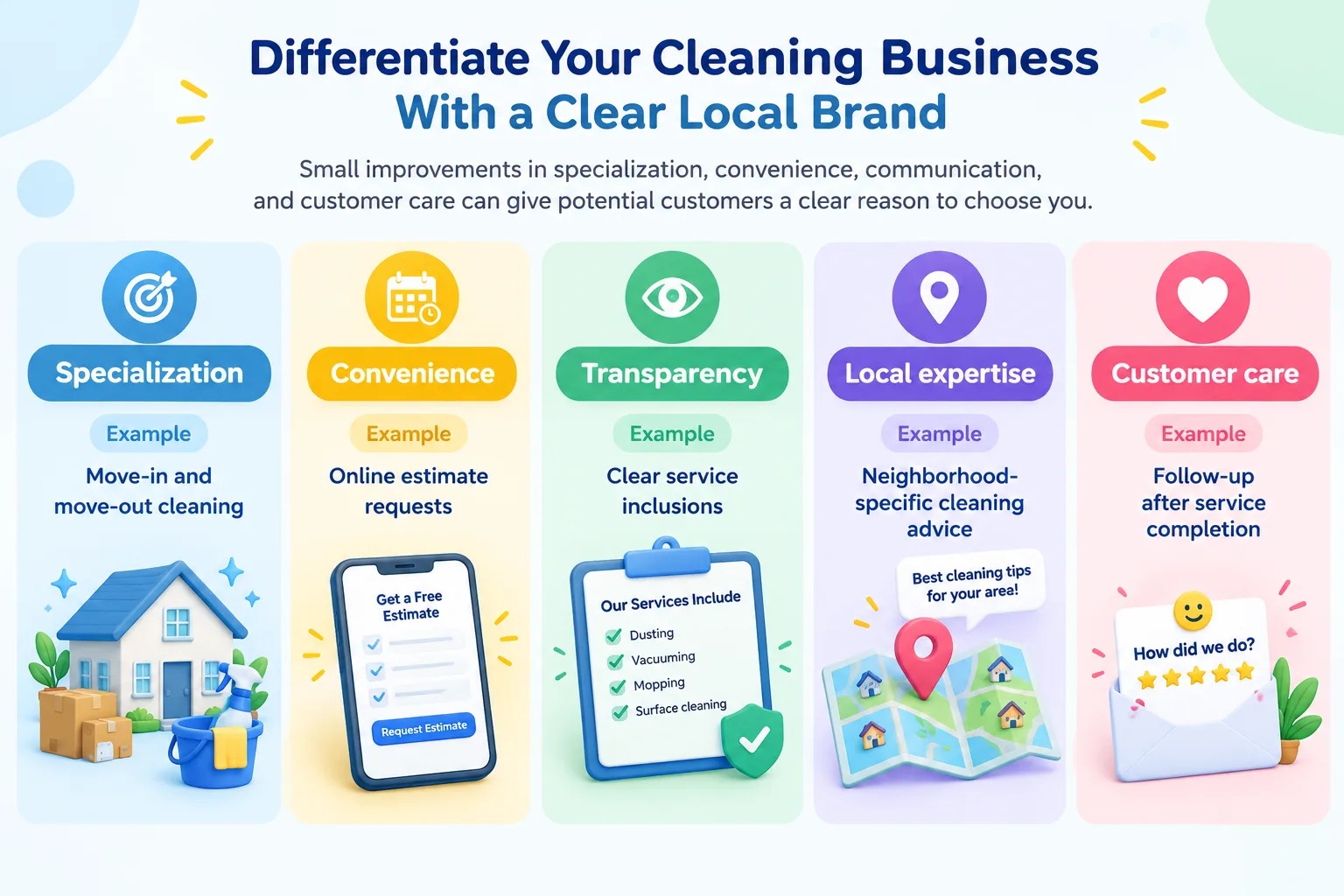
Keep your website informative and your Google Business Profile current. Post authentic before-and-after photos once customers approve them, and use suitable social media channels to show expertise and share service updates. Most importantly, keep your business identity, service descriptions, and contact information consistent everywhere, since brand consistency builds recognition. Here’s how each strategy looks in practice: Cleaning businesses can stand out by offering more than basic cleaning services. Small improvements in convenience, service specialization, communication, and customer care can give potential customers a clear reason to choose your business over local competitors. Here are some practical strategies, along with examples of how to apply them.
Differentiate your cleaning business
A clear brand won’t replace great work, but it makes sure the right customers notice that great work in the first place.
Track Local Visibility and Improve Your Marketing Results
For years, I judged my marketing by gut feeling, and gut feeling is a terrible analyst. Once I started tracking real numbers, I stopped guessing and started fixing what actually mattered. Here’s the system I’d use.
Monitor Local Search Rankings
Start by tracking the cleaning service keywords that matter, such as “house cleaning in [city]” or “office cleaning near [area],” across your key service areas. Keep in mind that local rankings shift by search term, location, and search context. I’ve seen my business sit near the top in one neighborhood and barely appear two miles away. Review your Google Maps visibility regularly to spot the areas that need work.
Measure Leads and Customer Actions
Rankings only matter if they turn into customers. I watch these customer actions closely:
- Phone calls and website visits
- Direction requests, where applicable
- Estimate inquiries and booking requests
- The share of inquiries that become bookings and recurring customers
Compare lead quality and conversion rates instead of leaning on website traffic alone. A smaller number of qualified leads beats a flood of tire-kickers every time.
Use Local SEO Tools to Find Improvement Opportunities
Manually checking rankings from different locations gets old fast. A local SEO tool can organize your keyword rankings, Google Business Profile insights, competitor visibility, and performance reports in one place. That’s where Happy Rank fits in: it’s a handy option if you want to monitor local rankings and evaluate your local search performance without the spreadsheet headaches. Just remember that tools reveal opportunities, they don’t do the work for you. Results still depend on your business relevance, local competition, customer experience, and consistent implementation.
Create a Repeatable Local Marketing Routine
Consistency beats intensity. I block out time on a regular schedule to:
- Review local rankings and customer feedback
- Update outdated business information and service pages
- Test improvements to booking processes and customer communication
- Use performance data to prioritize actions most likely to bring qualified local leads
Here’s what each metric tells you: Tracking the right metrics helps you understand whether your local SEO efforts are improving visibility and attracting potential customers. Rather than focusing only on rankings, cleaning businesses should also measure customer engagement and actions that can lead to bookings. The following metrics can help you evaluate performance and identify areas for improvement.
| Metric | What It Helps You Understand |
|---|---|
| Local keyword rankings | Visibility for relevant searches |
| Google Maps presence | How your business appears across target areas |
| Calls and inquiries | Whether search visibility generates interest |
| Website conversions | Whether visitors actually contact you |
| Review activity | How customers engage with your business |
Conclusion
Looking back, every real turning point in my business came from the same few things: a clear service offering, smart local SEO, genuine customer trust, and a consistent customer experience. None of them required a huge budget. They just required showing up the same way, every time. Here’s my advice: stop trying to appeal to everyone. Focus on the needs of your actual service areas, and become the obvious choice for those local customers. Not sure where to begin? Start small:
- Polish your Google Business Profile
- Collect genuine customer reviews
- Refine your service pages
Then use Happy Rank to monitor your local visibility and spot where your local search performance can improve. So here’s your challenge: take a few minutes to review your current local presence and pick one improvement to put into action this week. Which one will you choose?
Frequently asked questions
How can a cleaning business get more local customers?
Appear where people search: keep your Google Business Profile accurate and complete, target searches like 'house cleaning services in [city]' on your website, build a page for each service, and collect genuine reviews from satisfied clients.
What should a cleaning company's Google Business Profile include?
An accurate name, service area, phone, hours and website, the most relevant primary category plus every cleaning service you offer, and authentic photos of your team, equipment and finished work, used with customer permission.
How do I ask cleaning clients for reviews?
Send a polite, low-pressure follow-up by text or email with a direct review link right after the job. Ask for honest feedback and never buy reviews or offer incentives for positive ratings.
How can a cleaning business stand out from competitors?
Pick a clear specialty, such as move-out cleaning for renters, eco-friendly cleaning or recurring office cleaning, and explain it plainly. Avoid unsupported claims like 'the best' or 'cheapest' in town.
Should cleaning businesses show prices online?
Explain how prices are determined, what's included and when extra charges apply. Transparent pricing cuts back-and-forth and builds trust before the first call.
What should cleaning businesses track?
Local keyword rankings and Google Maps presence across your service areas, plus calls, estimate and booking requests, and how many inquiries become bookings and recurring clients.