

How Electricians Can Beat Local Search Competitors
Electricians beat local competitors by first checking who actually outranks them in Google Maps for their services, then fixing the gaps: an accurate Electrician category with specific services listed, real project photos, a service page for each major job, honest service areas, consistent listings, a routine for requesting reviews, and monthly tracking of rankings and leads.
Quick question: when did you last Google your own business the way a customer would?
Try it right now. Search “electrician near me” and see who shows up. If your name isn’t near the top, someone else is booking the panel upgrades, EV charger installs, and emergency calls that should have been yours. Here’s the thing: homeowners rarely hire the “best” electrician. They hire the one they can find fast and trust quickly. That’s the real game behind local SEO for electricians, and you can win it without a huge marketing budget. So what are we going to talk about? We’ll look at how to size up your competitors and spot easy openings, then fix up your Google Business Profile for electricians so it works harder for you. From there, we’ll move on to website content that turns searches into electrician leads, plus simple ways to build trust through reviews and local listings. Finally, we’ll see how to track your Google Maps rankings with a tool like Happy Rank so you can keep improving month after month. Ready to climb the local search rankings and make your electrician marketing pay off? Let’s get started.
Understand Your Local Search Competitors and Find Ranking Opportunities
Before you change a single thing on your website or profile, you need to know who you’re actually up against. I’ve seen this step skipped more than any other, and it’s usually the one that pays off fastest.
Identify Which Electricians Compete With You on Google
Start by searching the way your customers do. Try “electrician near me,” “emergency electrician,” and “licensed electrician in [your city],” then note who appears in both the Google Maps results and the organic listings. I once worked with an electrician who was sure a big regional company was stealing his calls. When we searched together, the ones outranking him in his own neighborhood were two small shops he’d barely heard of. Without that check, he’d have spent months chasing the wrong rival. Not every business you see is a true local search competitor, so sort them into groups:
- Direct competitors: same services, same service area
- Partial competitors: similar services, but a different focus, such as commercial-only work
- Irrelevant listings: different locations or unrelated electrical services
Analyze Competitors’ Google Business Profiles
Next, open each competitor’s Google Business Profile for electricians and look closely. Check their primary and secondary categories, service descriptions, business hours, service areas, photos, and how recently they’ve received reviews. What you’re really hunting for is what’s missing. If a competitor has few photos, no service list, or unanswered reviews, that’s an opening you can use to build a more helpful profile of your own.
Find Keyword and Content Gaps Your Competitors Overlook
This is where I get the most excited, because the gaps are often obvious once you look. Research service-specific and location-based local SEO keywords, then check whether competitors actually have pages for them. In my experience, many skip topics like panel upgrades, EV charger installation, and emergency electrical services, or cover them in a single paragraph. Also look at their service pages, local landing pages, and FAQs. If customers have questions nobody is answering, that’s your chance to answer them first. To keep your research organized, here’s a quick checklist you can run through for every competitor. It covers the five areas that matter most for electrician SEO, so you can compare businesses side by side.
Local SEO Competitor Analysis Checklist for Electricians
Once you’ve filled this in, you’ll know exactly where you’re behind and where you can pull ahead. Next, let’s put that knowledge to work by fixing your own Google Business Profile.
Optimize Your Google Business Profile to Improve Local Visibility
Once you know where competitors are strong and where they’re slipping, it’s time to fix your own profile. In my experience, your Google Business Profile does more heavy lifting than your website for local searches, and most electricians never finish setting it up properly.
Choose Accurate Business Categories and List Your Services
Your primary category is the single most important setting, so pick the one that best describes your main work, usually “Electrician.” Then add secondary categories only where they truly apply. Next, list specific services instead of vague labels. Think wiring repairs, circuit breaker replacement, lighting installation, and electrical inspections. I once helped an electrician who listed only “electrical services.” After he added individual services, he started getting calls for jobs he’d always done but never advertised. Keep every detail accurate and consistent across the web.
Strengthen Your Profile With Photos, Updates, and Useful Information
Genuine photos build trust faster than any slogan. Upload shots of completed projects, your service vehicle, your equipment, and your team. Also keep these details current:
- Business hours, including holiday changes
- Phone number and website link
- Service information and availability
Posting occasional updates, such as seasonal electrical safety tips, shows customers you’re active.
Build Trust With Reviews and Helpful Responses
Ask satisfied customers for honest reviews after each job. Make it easy, but never offer incentives or cherry-pick only happy clients. I always tell colleagues that a calm, professional reply to a bad review can win more trust than five perfect ones. Respond to every review, positive or negative.
Maintain Accurate Service-Area Information
Define only the areas you genuinely serve, and choose a service-area or storefront setup that matches how you operate. Avoid fake locations or padding your service areas to chase rankings, because that can backfire and get your listing suspended. Here’s a quick checklist to keep your Google Business Profile optimization on track. It covers the six elements that influence local search rankings the most, so you can review your profile in a few minutes.
| Profile element | Recommended action |
|---|---|
| Business categories | Choose the most accurate categories |
| Services | List relevant electrical services |
| Photos | Upload authentic, recent images |
| Reviews | Request honest feedback and respond |
| Contact details | Keep phone number and website accurate |
| Service areas | Include only areas you genuinely serve |
With a complete, honest profile in place, you’ve built a strong foundation. Next, let’s turn your website into a lead-generating machine with localized content.
Create Localized Website Content That Attracts More Electrical Leads
Your Google Business Profile gets people to notice you, but your website is where they decide to call. I’ve watched electricians with great profiles lose jobs simply because their site was vague, slow, or hard to use on a phone.
Target Local and Service-Specific Keywords
The easiest win is pairing a service with a location. People rarely search “electrician” alone. They search “electrician in Austin,” “emergency electrician in Dallas,” or “EV charger installation in Denver.” Use these local SEO keywords naturally in your page titles, headings, meta descriptions, and body copy. Don’t stuff them in. If a sentence sounds awkward when you read it aloud, rewrite it. Here’s a quick reference showing how each type of search lines up with the right page. It helps you match search intent to the content you need, so no valuable keyword goes unused.
| Search intent | Example keyword | Suitable page |
|---|---|---|
| General service | Electrician in Austin | Main location page |
| Urgent need | Emergency electrician in Dallas | Emergency service page |
| Specific repair | Circuit breaker repair in Denver | Repair service page |
| Installation | EV charger installation in Phoenix | EV charger service page |
| Upgrade | Electrical panel upgrade in Miami | Panel upgrade page |
One “Services” page listing everything rarely ranks well. Give each major job its own page, such as electrical repairs, panel upgrades, lighting installation, and rewiring. On each page, explain:
- What the service involves
- When a customer might need it
- Your qualifications and relevant experience
- How to request help, with clear contact options
I once helped an electrician who had a single paragraph about panel upgrades. After we gave it a full page with common warning signs and a simple quote button, it became one of his most consistent sources of electrician leads.
Create Location Pages That Offer Real Value
If you serve several towns, separate location pages can work, but only when you have something unique to say. Add local project examples, details about the area, and practical information customers can use. Please don’t copy one page and swap the city name. Near-identical pages add little value and can hurt your local search rankings over time.
Improve Website Experience and Local Conversion Rates
Even great content fails on a clunky site. Make sure your website is mobile-friendly, loads quickly, and uses secure browsing. Put your phone number and a prominent call to action at the top of every page, and keep quote or booking forms short. If you offer emergency service, say so clearly, but never promise availability you can’t deliver. A broken promise at 2 a.m. costs you more than the job. With strong, useful pages in place, customers can find you and trust what they see. Next, let’s strengthen that trust through reviews, citations, and community signals.
Strengthen Local Trust Through Reviews, Citations, and Community Signals
Rankings get you seen, but trust gets you hired. I’ve noticed that two electricians with nearly identical websites can see very different results, and the difference usually comes down to who looks more credible in the places customers check.
Build Consistent Business Listings Across Relevant Directories
Your business name, phone number, website, and address (where applicable) should match exactly everywhere they appear. Search engines treat these local citations as a way to verify that you’re real and reliable. I once audited an electrician whose phone number was different on three directories because he’d changed numbers years earlier. Once we cleaned that up, his listing stopped jumping around in the results. Keep your approach focused:
- Review local directories, business associations, and industry platforms
- Fix or remove duplicate listings and outdated information
- Prioritize reliable directories instead of submitting to every site you find
Earn More Customer Reviews Through a Repeatable Process
Most happy customers never leave a review unless someone asks. So make asking part of your routine. Add it to your post-service workflow and send a convenient review link by text or email right after the job. Encourage honest feedback only. Don’t script reviews or offer rewards for positive ratings. Also pay attention to what customers say repeatedly. If several mention slow callbacks, that’s a customer experience problem worth fixing, not just a review problem.
Develop Local Relationships and Earn Relevant Backlinks
Some of the best local backlinks come from relationships, not tactics. Get to know local contractors, builders, property managers, and related businesses. Sponsor or join community events, or share useful electrical safety resources. An electrician I know sponsored a local youth sports team and shared a home-safety checklist with the school. A few mentions from legitimate local organizations followed, and they carried far more weight than any paid link ever could. Avoid paid link schemes and low-quality directories, because they can do more harm than good.
Demonstrate Professionalism and Electrical Expertise
Show customers why they can trust you. Accurately highlight your licenses, insurance, qualifications, and certifications. Publish helpful guidance on electrical safety, common repairs, and installation considerations, and make your service expectations and communication clear. Here’s a quick summary of the main trust signals and what each one does for you. Treat it as a reference for deciding where to spend your time first.
| Trust signal | Why it matters |
|---|---|
| Consistent listings | Confirms your business details are accurate |
| Authentic reviews | Helps customers evaluate your service |
| Local backlinks | Shows community credibility |
| Licenses and insurance | Builds confidence before the first call |
| Helpful content | Demonstrates real expertise |
With trust signals working in your favor, the final step is measuring what’s working. Next, let’s look at how to track your local SEO performance and turn rankings into leads.
Track Local SEO Performance and Turn Rankings Into More Leads
Everything we’ve covered so far only matters if it shows up in your results. I’ve seen electricians work hard on their profiles and websites, then never check whether any of it moved the needle. Tracking is what separates guessing from improving.
Monitor Local Rankings Across Your Target Service Areas
Track your most important keywords in both Google Search and Google Maps. Don’t rely on a single ranking, though. Your position can look great from your shop and disappear two miles away. I once worked with an electrician who was thrilled to rank first for “electrician near me.” When we checked other neighborhoods, he was nowhere to be seen in the areas where most of his customers lived. That’s why I like geo-grid tracking, which gives you a visual map of how your local search rankings change across an area. Compare your progress against key competitors over time, too.
Measure Calls, Website Visits, and Qualified Inquiries
Rankings are a means to an end. What you really want is the phone ringing. Watch these numbers using your Google Business Profile insights and website analytics:
- Calls and website clicks
- Direction requests, where relevant
- Form submissions and quote requests
A ranking jump that brings no qualified leads isn’t a win. Focus on lead quality, not just traffic volume.
Use Local SEO Software to Identify and Fix Gaps
Doing this by hand gets tedious fast. Local SEO software can organize ranking reports, profile checks, competitor monitoring, and listing management, depending on the platform. I use Happy Rank as one option for monitoring local search visibility and spotting areas that need work. Just remember that software supports your decisions. It doesn’t guarantee higher rankings.
Follow a Consistent Monthly Improvement Cycle
Keep it simple and repeat it every month:
- Review your ranking and lead data
- Identify underperforming services or locations
- Update website pages and business information
- Address recurring customer concerns
- Measure what improved, then repeat
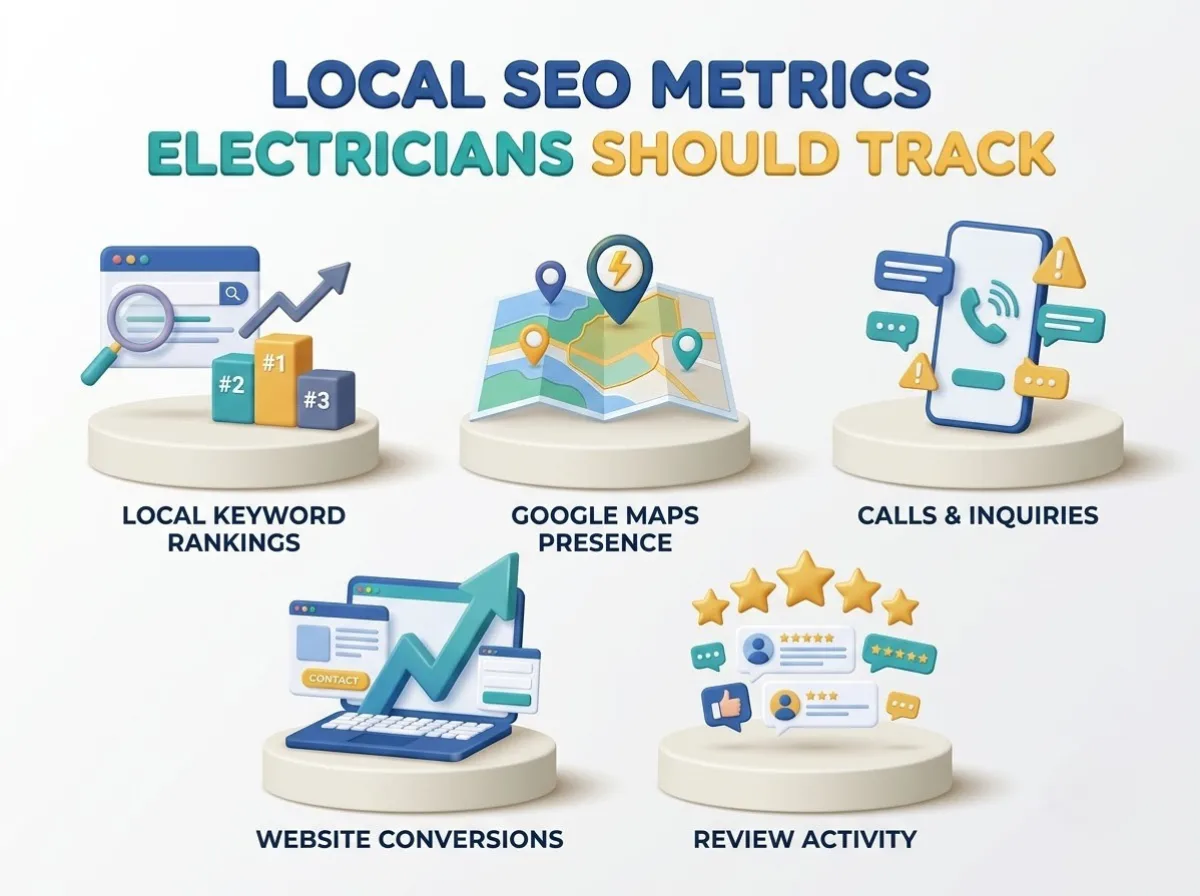
Here’s a quick reference for the metrics worth watching. It shows what each number tells you, so you can tell the difference between visibility and real electrician lead generation. Local SEO success involves more than checking rankings. Electricians need to monitor key performance indicators to understand how customers find their business, interact with their website, and decide to get in touch. The following metrics help evaluate local search visibility, customer engagement, and opportunities to generate more electrical service leads.
Local SEO metrics electricians should track
Once you have a monthly rhythm, improvement stops feeling random and starts compounding. Now let’s wrap everything up with a simple plan you can act on.
Conclusion
Beating your local competitors doesn’t come from one big fix. In my experience, the electricians who win are the ones who keep showing up, month after month, while everyone else tweaks their profile once and moves on. Let’s recap the priorities. Start with competitor research, so you know exactly where the openings are. Then optimize your Google Business Profile, build localized website content that answers real customer questions, and strengthen trust through honest reviews and consistent listings. Finally, track your local search rankings and lead data so you can see what’s actually working. You don’t need to do everything at once. Pick the one or two gaps with the biggest potential to bring in qualified leads, fix those first, and build from there. A tool like Happy Rank can make it easier to track your Google Maps rankings and manage your ongoing local SEO improvements. So here’s your next step: search for your business the way a customer would, note what you see, and write down three things you can improve this week. Small, steady changes add up, and soon you’ll be the electrician people find first and choose with confidence.
Frequently asked questions
How do I find my real local competitors as an electrician?
Search the way customers do, for example 'electrician near me', 'emergency electrician' and 'licensed electrician in [city]', then note who appears in Maps and organic results. Group them into direct, partial and irrelevant competitors.
What Google Business Profile category should an electrician use?
Usually Electrician as the primary category, with secondary categories only where they truly apply. List specific services like wiring repairs, circuit breaker replacement, lighting installation and inspections instead of a vague 'electrical services'.
Do electricians need separate pages for each service?
Yes. A single services page rarely ranks well. Give major jobs such as repairs, panel upgrades, EV charger installation, lighting and rewiring their own pages explaining the service, when it's needed, your qualifications and how to request help.
Should electricians create pages for every town they serve?
Only when you have something unique to say, like local project examples and area-specific details. Copying one page and swapping the city name adds little value and can hurt rankings.
How can electricians get more Google reviews?
Make asking part of every job: send a review link by text or email right after the work is done. Ask for honest feedback, don't offer rewards for positive ratings, and reply to every review.
How should electricians track local SEO?
Track key keywords in Google Search and Maps across your service area, not just from your shop, and watch calls, website clicks, direction requests and quote requests. Review the data monthly and fix the weakest services or locations first.