
Why Local SEO Matters for Plumbing Businesses
Local SEO matters for plumbing businesses because customers with burst pipes or failed water heaters search Google and call one of the top local results within minutes. A complete Google Business Profile, local service keywords, genuine reviews and consistent business details put you in that local pack, bringing high-intent calls without relying only on paid ads.
It’s 11 p.m., and a burst pipe is sending water across your kitchen floor. What’s the first thing you do? You grab your phone, type “emergency plumber near me,” and tap one of the top results within seconds. Sound familiar? That’s how most homeowners find plumbing services today. They rely on Google Search and Google Maps to find nearby help fast, and they rarely scroll past the local pack. This is where local SEO for plumbing businesses makes a real difference. It boosts your online visibility, helps you reach local customers, and brings in qualified leads. At Happy Rank, we’ve seen how a consistent strategy built on an optimized Google Business Profile, genuine customer reviews, and strong local search rankings helps plumbers compete with larger service providers. In this article, we’ll cover how local SEO works, its biggest benefits, strategies, common mistakes to avoid, and how to measure your results. Ready to dive in?
How Local SEO Helps Plumbing Businesses Get Found Online
When a customer has a leaking pipe or a dead water heater, they don’t browse casually. They search, compare a few options, and call fast. I’ve watched this play out with plumbing clients many times, and the businesses that show up first almost always win the job. Let’s break down exactly how local SEO puts your company in front of those customers.
Improve Visibility in Local Search Results
Early in my career, I worked with a small plumbing company that had great reviews and fair prices but barely appeared online. Their phone stayed quiet until we fixed their local search visibility. Once they began appearing for nearby searches, calls picked up within weeks. Local SEO helps your company show up when customers search for nearby plumbing services. Common searches include:
- “plumber near me”
- “emergency plumber in Austin”
- “drain cleaning service”
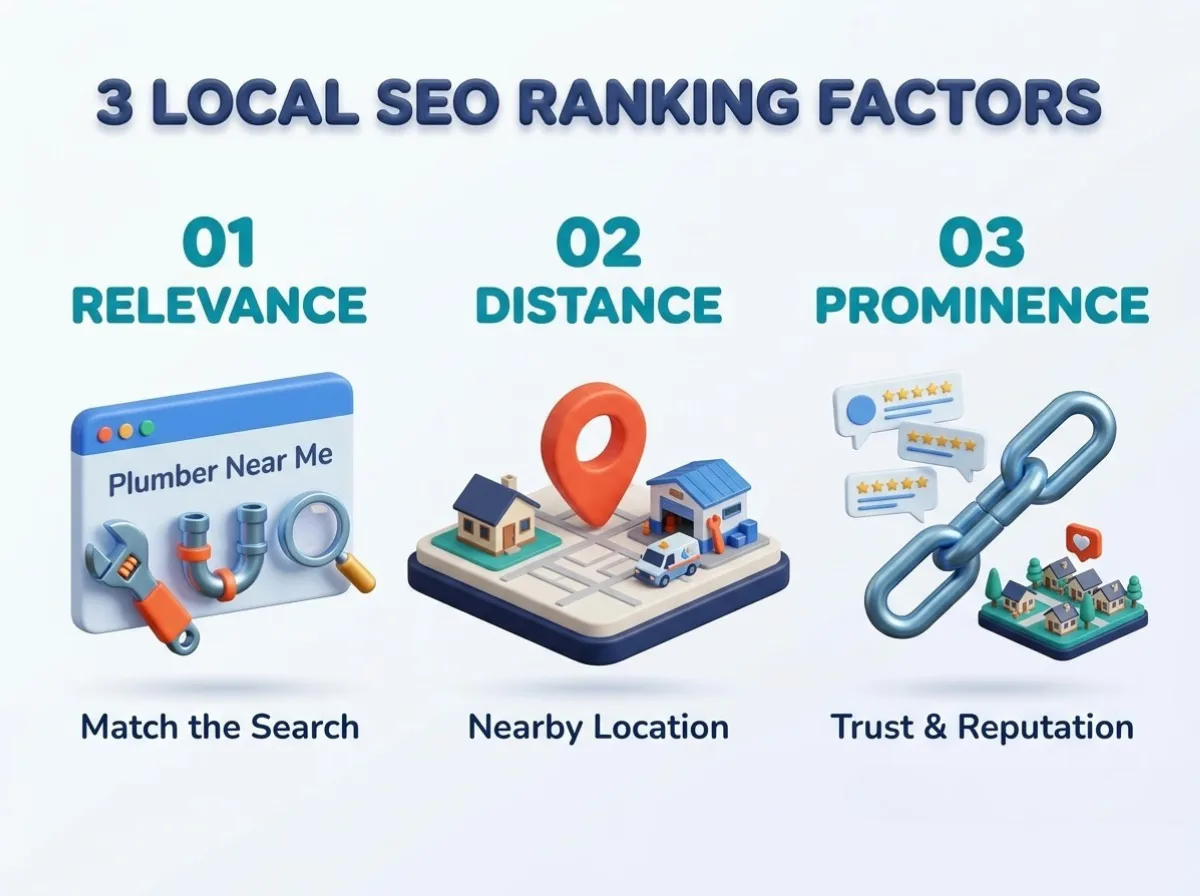
Google decides which businesses to show based on three local ranking factors: Local SEO rankings depend on several factors that help Google determine which businesses are most relevant to a search. For plumbing businesses, understanding these factors can help improve local visibility and connect with customers who need plumbing services nearby. The three key factors are relevance, distance, and prominence, and each plays a different role in how your business appears in local search results.
Local SEO ranking factors
You can’t change where a customer is standing, but you can strengthen relevance and prominence. In my experience, that’s where most plumbers have the biggest room to grow.
Appear in Google Maps and the Local Pack
The local pack is the group of three businesses that appears with a map at the top of many local searches. I like to call it prime real estate, because customers often call one of these listings without ever visiting a website. Your Google Business Profile is the key to earning a spot there. I once audited a plumber who had the wrong phone number listed for almost a year. Think about how many calls that cost him. To avoid the same mistake, make sure your profile includes:
- Accurate business name, address, and phone number
- The right primary category (such as “Plumber”) plus relevant secondary categories
- Current business hours, including emergency availability
- Defined service areas that reflect where you actually work
- Genuine photos of your team, vehicles, and completed jobs
A complete and accurate profile tells both Google and customers that you’re a legitimate, reliable business.
Reach Customers Who Need Plumbing Services Now
Here’s what I find most exciting about local search: the search intent is incredibly strong. Someone searching for a burst pipe repair at midnight isn’t doing research. They want a plumber on the way. These high-intent searches often include:
- Burst pipes
- Clogged drains
- Leaking faucets
- Water heater repair
Compared with general web traffic, these customers are much closer to booking. When your business ranks well for these searches, you create more chances for phone calls, service bookings, and emergency service requests. One of my clients told me that a single strong local ranking for “emergency plumber” brought in more urgent jobs than months of paid ads had. Local SEO won’t make every search turn into a booking, but being visible at the right moment gives you a real shot at winning the job. Next, we’ll look at the specific benefits that visibility can bring to your business.
The Key Benefits of Local SEO for Plumbing Companies
I’ve seen local SEO change the trajectory of plumbing businesses of every size. Once your visibility improves, the benefits show up in your calls, your reputation, and your bottom line. Here’s what I tell every plumber who asks whether it’s worth the effort.
Generate More Qualified Plumbing Leads
Local search brings in people who are actively looking for help, which makes for better qualified leads. These leads usually arrive as:
- Phone calls
- Website inquiries
- Quote requests
- Appointment bookings
One client noticed that location-specific traffic converted far better than general visitors. A homeowner in your service area is simply more likely to book than someone browsing from three states away.
Build Trust Through Reviews and Business Information
Most customers read customer reviews before they call. I always tell plumbers that reviews work like a digital handshake. Respond professionally to both praise and criticism, and show future customers how you handle problems. Trust also depends on consistent business information. Keep these details accurate everywhere:
- Contact details
- Service information
- Business hours
Compete With Larger Plumbing Companies
I once worked with a two-truck plumbing shop that was up against a big regional brand. We didn’t try to outspend them. Instead, we focused on neighborhood targeting and specialized services like tankless water heater installation. Within a few months, they were winning local searches the larger company ignored. A focused strategy lets smaller businesses compete without relying entirely on paid advertising.
Support Long-Term Business Growth
Unlike ads, which stop the moment your budget runs out, local SEO builds a lasting online presence. Tracking the right numbers keeps you on course:
| Metric | What It Tells You |
|---|---|
| Phone calls | How many customers are reaching out |
| Website visits | Whether your pages attract local traffic |
| Search visibility | How often you appear in local results |
| Conversions | How many visitors become paying customers |
I’ll be honest: results take time. They depend on your competition, website quality, and ongoing optimization. The plumbers who stay consistent are the ones who see compounding returns. Now that you know why local SEO pays off, let’s look at the strategies that make it happen.
Essential Local SEO Strategies Every Plumbing Business Should Use
Over the years, I’ve noticed that the plumbers who win locally don’t chase tricks. They nail a handful of fundamentals and stay consistent. Here are the strategies I recommend first.
Optimize Your Google Business Profile
Your Google Business Profile is the foundation of everything else. Make sure it includes:
- The correct business name, primary category, phone number, website, and business hours
- Relevant plumbing services and accurate service areas
- Genuine photos, updated regularly
Follow Google’s guidelines and never stretch the truth. I once saw a profile get suspended for keyword-stuffing the business name, and recovering took weeks.
Target Local Plumbing Keywords
Start with local keyword research, pairing services with cities and neighborhoods. Good examples include “water heater repair in Dallas” and “licensed plumber in Tampa.” Work these terms naturally into service pages, headings, title tags, and meta descriptions. Avoid keyword stuffing, because it reads poorly and can hurt your rankings.
Create Location-Specific Plumbing Service Pages
Build useful pages for drain cleaning, pipe repair, leak detection, and water heater installation. Include only locations where you genuinely operate, and add local customer concerns, service details, and a clear call to action. I worked with a plumber who had copied one page across 12 cities. Rankings stalled until we rewrote each page with unique details, such as common hard water issues in each area.
Collect and Manage Customer Reviews
Ask satisfied customers for honest customer reviews right after a completed job, and make the process easy with a direct link. Respond professionally without sharing private details. Never buy reviews or offer prohibited incentives, since that can put your profile at risk.
Strengthen Local Citations and Website Performance
Here’s a quick checklist I share with clients:
| Area | What to Do |
|---|---|
| Local citations | Keep your name, address, and phone number consistent across directories |
| Website speed | Maintain a fast, secure, mobile-friendly site |
| Click-to-call | Add a visible button on every page |
| Local backlinks | Earn mentions from community groups and local directories |
Even the best strategy can fall short if you make avoidable errors, so let’s cover the most common mistakes next.
Common Local SEO Mistakes Plumbing Businesses Should Avoid
I’ve audited plenty of plumbing websites, and the same handful of errors keep showing up. The good news is that they’re all fixable. Let’s walk through the ones I see most often.
Using Incorrect or Inconsistent Business Information
Outdated business information confuses customers and weakens trust with Google. I once worked with a plumber who had moved offices but never updated his old directory listings. Customers kept showing up at the wrong address, and some simply called a competitor instead. Wrong phone numbers, old hours, and mismatched details can all cost you jobs. Check your website, Google Business Profile, and key local directories regularly to keep everything consistent.
Ignoring Reviews and Customer Feedback
Unanswered customer reviews make a business look careless. I’ve seen plumbers with excellent work lose calls simply because a harsh review sat there with no reply. Set up a simple review management process and respond promptly and professionally, whether the feedback is good or bad.
Targeting Too Many Locations With Thin Content
Copying the same page for ten cities and swapping the city name is a classic shortcut that doesn’t work. This is thin content, and it offers customers very little value. Publish location pages only when you can share useful, distinct details about the area and your work there.
Neglecting Mobile Users and Website Conversions
Most people searching for a plumber are on their phones, often in a stressful moment. If your site is slow or your number is hard to find, they’ll leave. Here’s what I look for during website conversion audits:
| Problem | Why It Hurts | Quick Fix |
|---|---|---|
| Slow page speed | Visitors leave before the page loads | Compress images and improve hosting |
| Hidden phone number | Customers can’t call easily | Add a click-to-call button |
| Confusing navigation | Visitors can’t find services | Simplify menus and service links |
| Missing calls to action | No clear next step | Add “Call Now” or “Request a Quote” buttons |
Early on, I had a client who proudly pointed to a first-page ranking while his phone stayed silent. Rankings alone don’t pay the bills. Track qualified calls, form submissions, booked jobs, and lead sources to see what’s truly working. Avoiding these mistakes keeps your efforts on track, but you also need to know whether your strategy is working. Next, we’ll look at how to measure and improve your results.
How to Measure and Improve Your Plumbing Business’s Local SEO Results
I always tell plumbers that you can’t improve what you don’t measure. Tracking the right numbers shows you what’s working, what’s wasting time, and where your next job is likely to come from. Here’s how I approach it.
Track the Right Local SEO Metrics
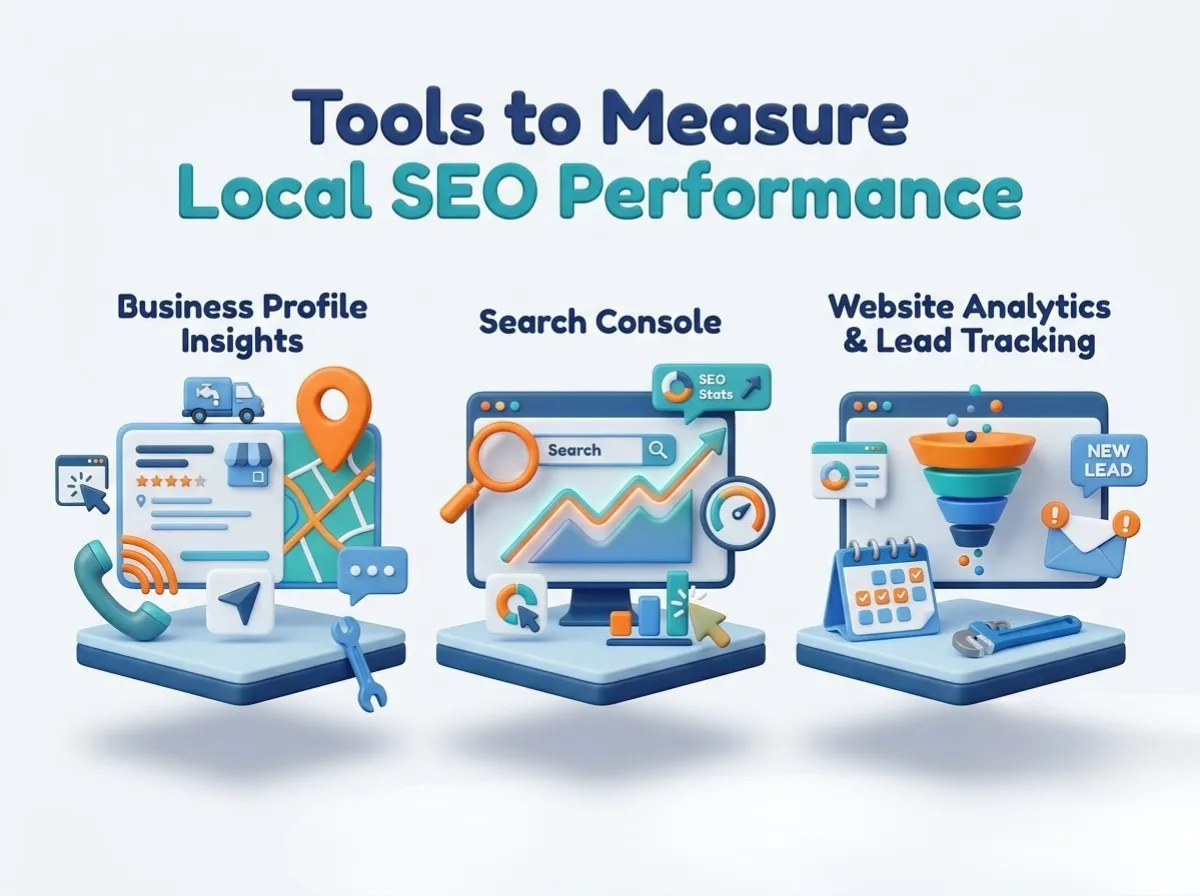
When I start with a new client, I set up three core tools so nothing slips through the cracks: Tracking the right metrics helps you understand whether your local SEO efforts are bringing real results to your plumbing business. Different tools provide insights into how customers find you, interact with your website, and contact your team. By combining these data sources, you can identify which search terms attract potential customers, which channels generate inquiries, and how many leads turn into booked plumbing jobs.
Tools to measure local seo performance
One plumber I worked with was thrilled about his traffic until we checked his lead tracking. Most of his visitors came from outside his service area. Once we shifted our focus to local searches, his calls became far more valuable.
Review Performance and Refine Your Strategy
Measurement only helps if you act on it. I recommend a regular review where you:
- Identify the services and locations generating the most relevant leads
- Update underperforming service pages and fix outdated business information
- Read recent customer feedback for patterns and improvement ideas
- Check competitor visibility to spot gaps you can fill
I do this monthly with my clients. A small tweak, like rewriting a weak page for drain cleaning, often brings noticeable gains within a few weeks. Consistent measurement lets you make informed improvements instead of guessing. Now that you know how to track your progress, let’s wrap everything up and talk about where to start.
Conclusion
We’ve covered a lot of ground, so let’s bring it all together. Local SEO for plumbing businesses helps you improve your online visibility, build trust with local customers, attract qualified leads, and compete with larger companies in your service area. The real power comes from how the pieces work together: a complete Google Business Profile, relevant local keywords, useful service pages, genuine customer reviews, and consistent performance tracking. Skip one, and the others have to work harder. Here’s my advice: don’t try to fix everything at once. Start with the biggest wins, like updating your business information and responding to reviews, then build from there. So, how does your local search presence look right now? Take a few minutes to search for your own services, see where you show up, and note what needs work. Then create a consistent local SEO strategy and stick with it. If you’d like expert help along the way, the team at Happy Rank is ready to guide you.
Frequently asked questions
Why is local SEO important for plumbers?
Plumbing searches are urgent. Homeowners search for help nearby, rarely scroll past the local pack, and call quickly, so appearing in those top results turns directly into phone calls and booked jobs.
What are the local ranking factors for plumbers?
Relevance, distance and prominence. You can't change where a customer is searching from, but you can improve relevance with accurate categories and services, and prominence with reviews, citations and local links.
What should a plumber's Google Business Profile include?
An accurate name, address and phone number, Plumber as the primary category with relevant secondary categories, current hours including emergency availability, honest service areas, and real photos of your team, vehicles and completed jobs.
Can a small plumbing company compete with larger companies in local search?
Yes. Focusing on specific neighborhoods and specialized services, such as tankless water heater installation, lets smaller plumbers win local searches that bigger brands overlook, without outspending them on ads.
What local SEO mistakes should plumbers avoid?
Inconsistent business information across directories, ignoring reviews, copying one page across many cities with only the name changed, and slow mobile sites with hidden phone numbers or no clear call to action.
How do plumbers measure local SEO results?
Track phone calls, website visits, search visibility and conversions into booked jobs, and check where leads come from. Review the data monthly and update weak pages or outdated business details.