
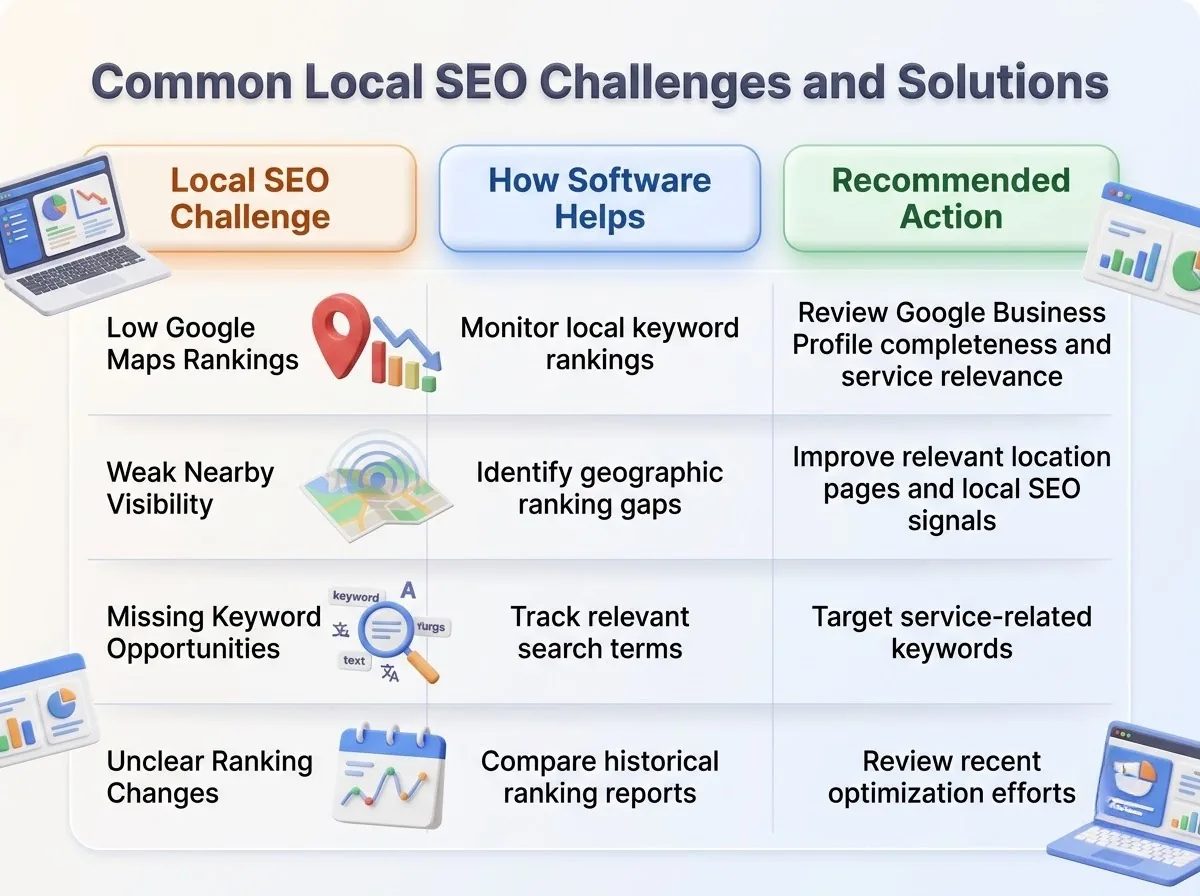
Common Local SEO Problems That Software Can Help You Solve
Local SEO software helps solve five common problems: low Google Maps visibility, inconsistent business listings (NAP), hard-to-manage reviews, difficulty tracking rankings and competitors, and time-consuming, disorganized workflows. It finds visibility gaps with geo-grid tracking, flags listing errors, centralizes reviews and reports. Fixing the issues still takes accurate information and consistent work.
Local businesses often struggle to appear in search results, even when they offer great services and serve the right audience. Inconsistent business listings, low Google Maps rankings, limited customer reviews, and difficulty tracking competitors can all make it harder to attract nearby customers. Managing these issues manually can also take time away from running the business.
This is where local SEO software can make a difference. The right tools help you identify local SEO problems, monitor local search rankings, maintain accurate business information, and understand where your online visibility needs improvement. Platforms like [Happy Rank](/) can help businesses monitor local search performance and make more informed optimization decisions.
In this article, we’ll discuss five common local SEO issues that businesses face and explain how local SEO tools can help solve them. From improving Google Maps rankings and maintaining NAP consistency to managing customer reviews, tracking competitors, and streamlining everyday SEO tasks, you’ll learn practical ways to make local SEO management more efficient and effective.
Poor Local Search Visibility and Low Google Maps Rankings
Have you ever searched for a local service and noticed that the same businesses appear at the top of Google Maps while others remain difficult to find? This is a common challenge for local businesses. Even if you provide excellent services, customers may choose a competitor simply because they see that business first. I believe the first step toward fixing this problem is understanding what affects your local search visibility and identifying where your business needs improvement.
Why Your Business Is Not Appearing in Local Search Results
Several factors can contribute to poor local SEO performance. Your Google Business Profile might be incomplete, your business categories may not accurately reflect your services, or your website may lack relevant local content. Strong competitors with established local visibility can also make it harder to appear prominently.
Google considers relevance, distance, and prominence when determining local search results. While you cannot control every ranking factor, you can improve the information and signals within your control.
Common reasons for low Google Maps rankings include:
- An incomplete or outdated Google Business Profile.
- Incorrect primary or secondary business categories.
- Limited location-specific website content.
- Inconsistent business information across online directories.
- Strong local competitors targeting the same services and keywords.
How Local Rank Tracking Software Identifies Visibility Gaps
I recommend using local SEO software to understand how your business performs across different search terms and geographic areas. Instead of checking rankings manually and relying on a single search, local rank tracking software can help you monitor performance consistently and identify areas that need attention.
For example, a plumbing company might rank well for searches near its office but struggle to appear in neighboring areas. Geo-grid rank tracking can reveal these geographic differences, helping the business decide where to focus its optimization efforts.
Regularly monitoring local SEO performance helps businesses identify ranking gaps, refine keyword targeting, and improve location-specific content. Consistent optimization can strengthen local search visibility and help businesses connect with customers searching for relevant products or services nearby.
Practical Steps to Improve Local Search Visibility
Once you identify the problem, focus on improvements that support your business goals. I suggest starting with these actions:
- Complete your Google Business Profile with accurate details, services, and operating hours.
- Choose relevant business categories that reflect what you actually offer.
- Create useful website content targeting your services and the locations you serve.
- Monitor local keyword rankings to understand where visibility is improving or declining.
- Review competitor performance to identify potential gaps in your local SEO strategy.
The key is to use ranking data as a starting point, not a guarantee of success. Consistent monitoring, accurate business information, and relevant content give you a clearer path toward improving local search performance.
Inconsistent Business Listings and Incorrect Information
Imagine a customer searching for your business online, only to find an outdated phone number or an old business address. They might struggle to contact you or choose a competitor instead. This is one of the most overlooked local SEO problems, yet it can directly affect customer trust and the accuracy of your online presence. I recommend treating business information as something that needs regular attention, especially if your company operates across multiple locations.
How Inconsistent NAP Information Creates Local SEO Problems
NAP consistency, which stands for name, address, and phone number consistency, means keeping your core business details accurate across relevant online platforms. When directories display conflicting information, customers may become confused about which details are correct.
Common local listing management challenges include:
- Outdated phone numbers or business addresses on directories.
- Different business names appearing across online platforms.
- Incorrect operating hours, website links, or service details.
- Duplicate listings that create confusion for customers.
- Old information remaining online after a business relocation.
I have found that these issues can become particularly difficult to manage when businesses rely on separate spreadsheets or update each directory manually. Accurate information helps customers contact the right business and supports a consistent online presence.
How Local SEO Tools Help Find Listing Errors
This is where local SEO software and listing audit tools can simplify the process. Depending on their features and directory integrations, these tools can help businesses review their information, identify inconsistencies, and organize corrections.
| Common listing problem | How software can help | Recommended action |
|---|---|---|
| Incorrect phone numbers | Identify conflicting details in supported directories | Update incorrect contact information |
| Outdated addresses | Highlight address discrepancies | Verify the current business location |
| Duplicate listings | Help identify potential duplicate profiles | Review and resolve duplicates appropriately |
| Inconsistent business names | Compare business details across supported platforms | Use accurate, consistent business information |
For businesses with multiple locations, local listing management software can make these checks more manageable by centralizing supported information. However, coverage varies by tool, and some corrections may still require manual updates or verification.
How to Maintain Accurate Business Listings
I recommend building a simple routine to prevent small errors from becoming recurring problems:
- Maintain a master record of your official business name, address, phone number, and website.
- Review your Google Business Profile whenever important details change.
- Audit relevant online directories periodically.
- Check for duplicate listings before creating new profiles.
- Recheck business information after a relocation, rebranding, or change in operating hours.
Ultimately, accurate listings make it easier for customers to find and contact your business. Regular checks and a consistent update process help you maintain reliable business information as your company grows.
Difficulty Managing Customer Reviews and Online Reputation
Customer reviews can influence whether someone chooses your business or a competitor. When potential customers compare local businesses, they often look at ratings, recent feedback, and how professionally a business responds. However, keeping up with reviews across multiple platforms can become difficult, especially when you are already managing daily operations. I believe effective review management is essential for maintaining customer trust and understanding what people think about your services.
Common Review Management Challenges for Local Businesses
Many businesses collect customer feedback but struggle to manage it consistently. Without a clear process, important feedback can go unnoticed, and recurring customer concerns may remain unresolved.
Some common local SEO problems related to reviews include:
- Unanswered customer reviews: Delayed responses can make customers feel overlooked.
- Negative online reviews: Unresolved complaints may discourage potential customers from choosing your business.
- Inconsistent review monitoring: Checking several platforms manually makes it easier to miss new feedback.
- Limited review insights: Businesses may overlook recurring complaints or opportunities to improve their services.
- Difficulty tracking ratings: Without regular monitoring, it becomes harder to understand changes in customer sentiment.
I recommend treating reviews as more than a reputation metric. They can reveal practical ways to improve your service, communication, and overall customer experience.
How Review Monitoring Software Simplifies Reputation Management
Using local SEO software with review monitoring capabilities can make this process easier. Depending on the platform and its integrations, review management software can help you monitor feedback, organize reviews, track rating trends, and manage responses from a more centralized workspace.
For example, review monitoring tools can help businesses:
- Identify new reviews on supported platforms.
- Track changes in average ratings and review volume.
- Recognize recurring customer feedback and service concerns.
- Organize response tasks and prioritize reviews that need attention.
- Evaluate customer sentiment over time.
These insights help businesses make informed decisions instead of reacting to individual reviews without considering broader patterns.
Turning Customer Feedback Into Local SEO Improvements
I suggest building a consistent process for managing reviews and acting on customer feedback.
- Respond professionally to positive and negative reviews.
- Address legitimate complaints and explain how you are working to resolve them.
- Encourage customers to share honest feedback without offering incentives.
- Look for recurring comments that reveal service improvements.
- Monitor review trends to understand how customer sentiment changes.
Ultimately, software can make review monitoring more organized, but genuine customer experiences determine the quality of your reputation. By combining consistent review management with responsive customer service, you can build trust and strengthen your local presence over time.
Difficulty Tracking Local Rankings and Competitor Performance
How do you know whether your local SEO efforts are actually working? If you only check Google rankings occasionally, it can be difficult to understand what is improving, what is declining, and where your competitors are gaining visibility. I believe consistent performance tracking is essential because local search results can vary by location, keyword, and competition. Without reliable data, you may spend time improving areas that do not address your biggest challenges.
Why Manual Local SEO Tracking Often Falls Short
Managing local SEO tracking manually can quickly become time-consuming, particularly when your business targets several neighborhoods or service areas. Searching for your business on Google gives you a snapshot, but it does not provide a complete picture of your local search performance.
Common challenges include:
- Inconsistent ranking checks: Checking rankings at irregular intervals makes it harder to identify meaningful trends.
- Location-based ranking differences: Your business may appear prominently near its address but have lower visibility in surrounding areas.
- Limited competitor analysis: Without regular comparisons, you may miss opportunities to understand what competing businesses are doing well.
- Missed ranking changes: Manual checks can overlook gradual improvements or declines in important search terms.
- Disconnected SEO reports: Data scattered across different platforms makes performance harder to evaluate.
I recommend replacing occasional manual checks with a repeatable process that helps you measure progress over time.
How Local SEO Software Makes Performance Tracking Easier
Using local SEO software can simplify how you monitor rankings and evaluate competitors. Depending on the tool, local rank tracking software can organize keyword data, provide historical reports, and help identify geographic differences in search visibility.
Useful capabilities may include:
- Local keyword tracking: Monitor rankings for relevant service-related and location-specific searches.
- Geo-grid rank tracking: See how rankings vary across different points within a target area.
- Local competitor analysis: Compare your visibility with selected competing businesses.
- Historical ranking reports: Identify changes and evaluate performance after optimization efforts.
- Centralized SEO dashboards: Review important metrics without repeatedly switching between tools.
Which Local SEO Metrics Should You Monitor?
I suggest focusing on metrics that connect search visibility with meaningful business outcomes. The following table outlines what to track and how to use the information.
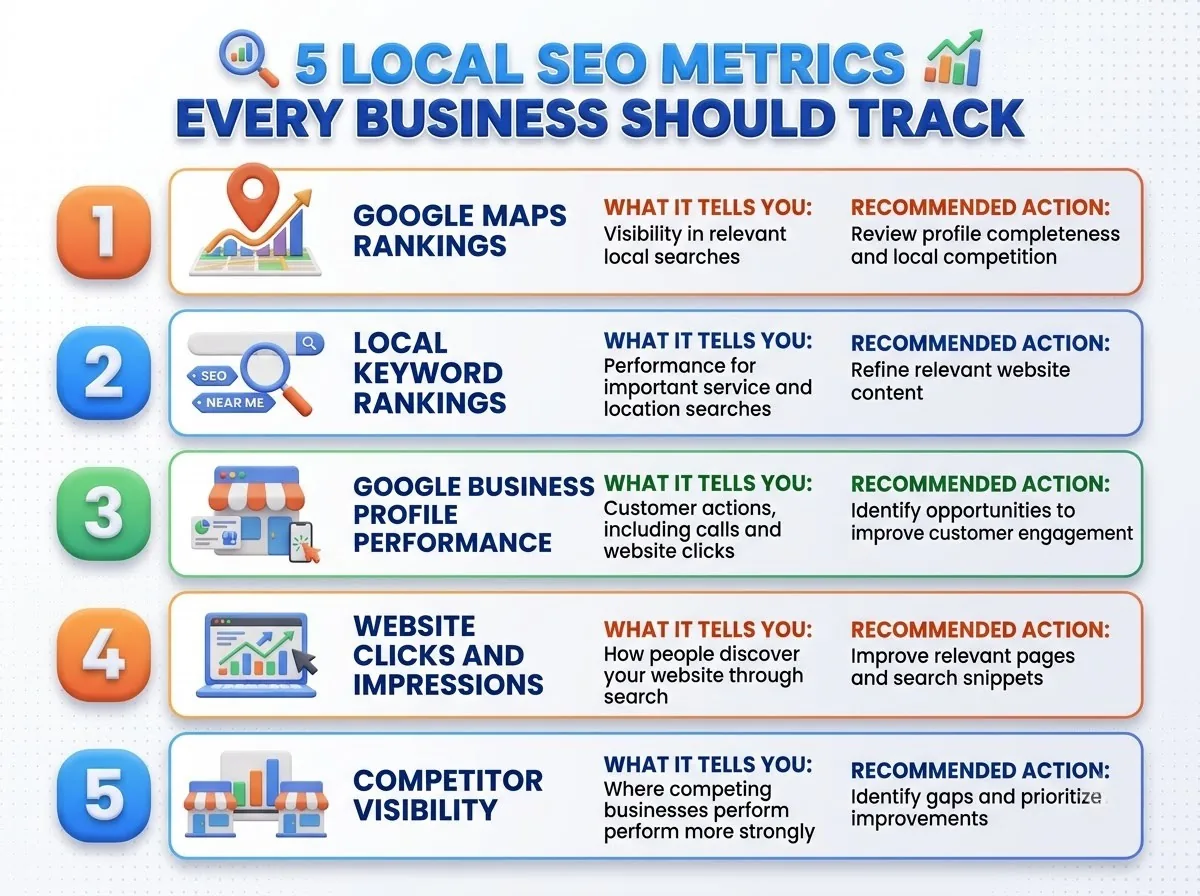
Tracking the right metrics helps you understand whether your local SEO strategy is improving visibility and attracting potential customers. I recommend reviewing Google Maps rankings, local keyword performance, Google Business Profile interactions, website search data, and competitor visibility regularly. These insights can help you identify what is working, spot areas that need attention, and prioritize improvements based on actual performance rather than guesswork.
Remember, rankings alone do not guarantee more customers. I recommend reviewing them alongside customer actions and website performance to understand whether your local SEO strategy is moving in the right direction. Consistent measurement makes it easier to spot opportunities, prioritize improvements, and make decisions based on evidence rather than assumptions.
Time-Consuming Local SEO Management and Disorganized Workflows
Managing local SEO involves more than updating a business profile or checking keyword rankings once in a while. You need to monitor listings, review customer feedback, track competitors, and measure search performance consistently. When these tasks are handled manually, they can quickly become overwhelming. I believe the biggest challenge is not always knowing what to do, but finding enough time to do it consistently while running a business.
Why Managing Local SEO Manually Becomes Overwhelming
Many businesses rely on spreadsheets, separate dashboards, and manual checks to manage their local SEO strategy. Although these methods can work initially, they become less practical as the number of tasks or business locations increases.
Common challenges include:
- Repetitive SEO tasks: Checking rankings and collecting performance data manually takes valuable time.
- Scattered information: Switching between different platforms makes it harder to maintain a clear overview.
- Missed optimization opportunities: Without regular monitoring, important ranking changes or listing issues may go unnoticed.
- Inconsistent reporting: Manually compiling data makes it difficult to compare performance over time.
- Limited resources: Small businesses may not have a dedicated team to manage every aspect of local search optimization.
I recommend creating a repeatable process instead of treating each SEO task as a separate responsibility.
How Local SEO Software Helps Organize Everyday Tasks
The right local SEO software can help simplify routine work by bringing relevant performance data and monitoring activities into a more organized workflow. Depending on the platform, businesses can use local SEO tools to track rankings, review visibility trends, identify potential issues, and generate reports.
For example, software may help you:
- Monitor local keyword rankings without repeatedly checking search results manually.
- Review Google Maps visibility across relevant locations.
- Organize ranking data and historical performance reports.
- Identify areas that need further investigation.
- Reduce repetitive reporting and improve the consistency of SEO monitoring.
Building a Repeatable Local SEO Management Routine
Software works best when you combine it with a clear process. I recommend following these steps:
- Audit: Review your business profile, listings, and local search visibility.
- Prioritize: Identify the issues that need attention first.
- Optimize: Update relevant business information and improve website content.
- Monitor: Track rankings and other available performance metrics.
- Review: Evaluate results and adjust your strategy when necessary.
This approach makes local SEO management more systematic without requiring you to handle every task at once.
Ultimately, local SEO automation can reduce repetitive work, but it does not replace sound judgment or ongoing optimization. By combining useful software with a consistent workflow, you can spend less time gathering information and more time acting on insights that support your business goals.
Conclusion
Local SEO can feel overwhelming when you are trying to manage rankings, business listings, customer reviews, and competitor research at the same time. The good news is that you do not have to handle every task manually. With the right local SEO software, you can identify visibility gaps, monitor performance, maintain accurate business information, and organize your optimization efforts more efficiently.
I recommend starting with the problems that affect your business most. If your Google Maps rankings are weak, review your profile and local visibility. If your business information is inconsistent, prioritize listing accuracy. If you struggle to measure results, use local rank tracking and performance reports to understand where improvements are needed.
Tools like [Happy Rank](/) can help businesses monitor local search visibility and make more informed decisions about their local SEO strategy. The key is to choose tools that fit your needs and use the insights they provide to guide meaningful improvements.
Remember, software alone will not guarantee higher rankings or more customers. Consistent optimization, accurate business information, helpful website content, and genuine customer feedback remain essential. Start by identifying your biggest local SEO challenge, establish a clear workflow, and track your progress over time. Small, consistent improvements can help you build a stronger local presence and make it easier for nearby customers to discover your business.
Frequently asked questions
Why isn't my business showing up on Google Maps?
Common causes include an incomplete or outdated Google Business Profile, wrong primary or secondary categories, little location-specific website content, inconsistent business information across directories, and strong competitors targeting the same keywords.
What is NAP consistency and why does it matter?
Keeping your business name, address and phone number identical across online platforms. Conflicting details confuse customers about which information is correct and weaken the accuracy of your online presence.
How can I keep my business listings accurate?
Keep a master record of your official name, address, phone and website, update your Google Business Profile whenever details change, audit key directories periodically, check for duplicates before creating profiles, and recheck everything after a move or rebrand.
Why is manual rank tracking not enough?
Occasional searches give a single snapshot. Rankings vary by location and change gradually, so irregular manual checks miss trends, geographic gaps and competitor movement that consistent tracking reveals.
Can local SEO software fix my rankings on its own?
No. It identifies problems and organizes monitoring, but consistent optimization, accurate business information, helpful website content and genuine customer feedback are what improve results.