
How Local SEO Software Can Save Time and Reduce Marketing Costs
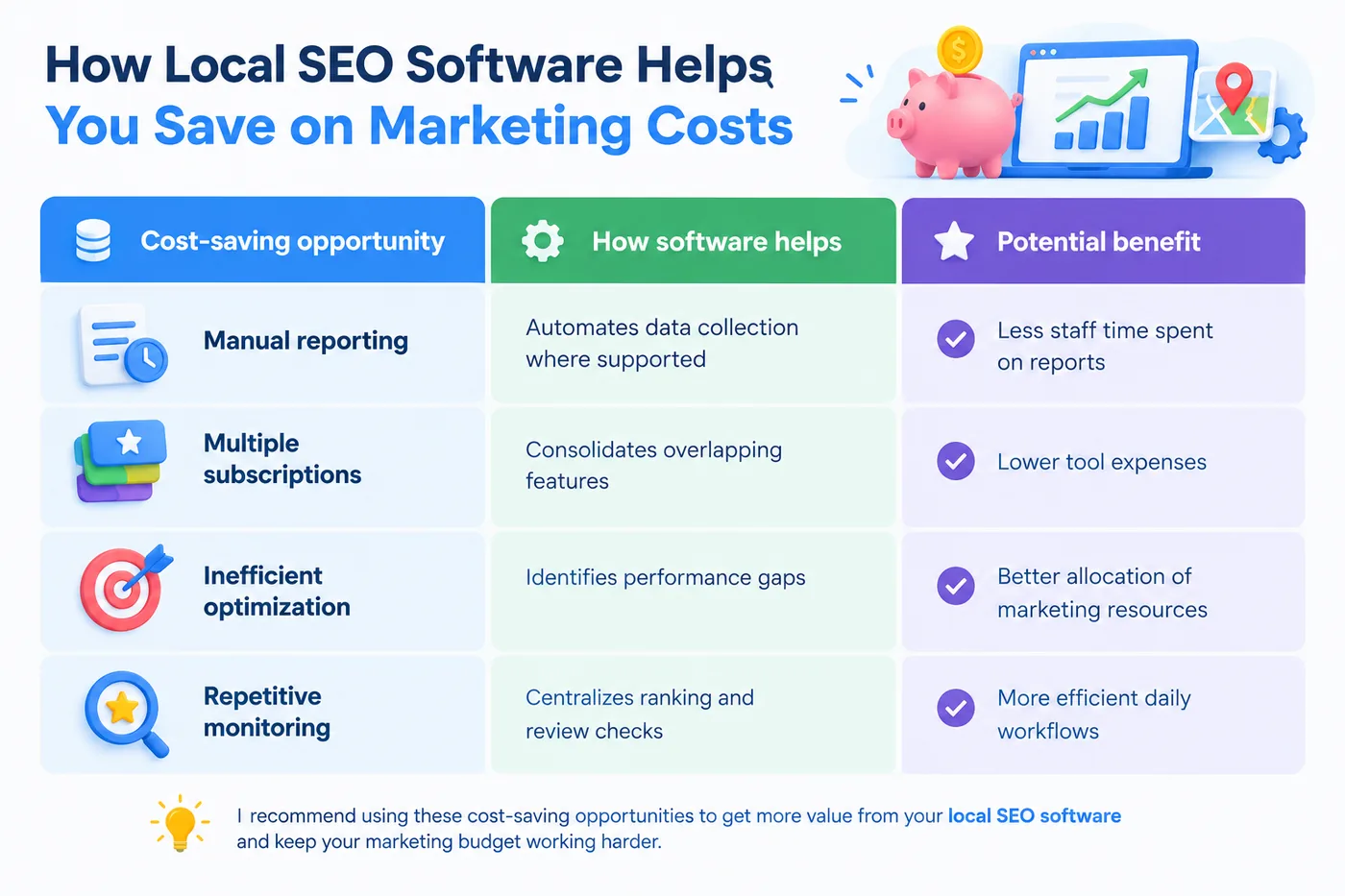
Local SEO software saves time by centralizing Google Business Profile management, review monitoring, rank tracking and reporting, so teams stop repeating manual checks across tools. It cuts costs by reducing labor hours, replacing overlapping subscriptions and showing which locations actually need budget. Estimate its value as labor savings plus avoided tool costs plus added lead value, minus the software cost.
Managing local SEO can take more time and money than many businesses expect. From updating Google Business Profiles and monitoring customer reviews to tracking local rankings and preparing performance reports, these tasks require consistent attention. When handled manually, they can consume valuable working hours and increase marketing expenses, leaving less time for customer service and business growth.
Local SEO software helps simplify these processes by bringing essential tools and performance data into one place. Businesses can automate repetitive activities, identify opportunities to improve local search visibility, and make more informed decisions about where to invest their marketing budget. Instead of relying on scattered tools and time-consuming manual checks, teams can build a more organized and efficient workflow.
Platforms like [Happy Rank](/) help businesses monitor local search performance and manage key SEO activities more efficiently. By choosing the right tools and measuring results consistently, businesses can save time, control operational costs, and strengthen their local online presence.
How Local SEO Software Saves Time on Everyday Marketing Tasks
Managing local SEO involves several recurring tasks, from updating business information to monitoring reviews and checking search rankings. When I look at how businesses handle these activities manually, the biggest challenge is the time spent switching between platforms, collecting data, and repeating the same processes. Local SEO software helps simplify this workload by centralizing essential activities and reducing unnecessary manual effort.
Automate Google Business Profile Management
Keeping a Google Business Profile accurate and up to date is essential for maintaining a reliable local presence. However, managing business details manually can become difficult, particularly for companies operating across multiple locations.
With the right local SEO tools, businesses can simplify profile management, monitor important information, and organize updates more efficiently. Depending on the platform, useful capabilities may include:
- Business information management: Keep business names, addresses, phone numbers, and operating hours consistent.
- Profile optimization: Review business categories, services, descriptions, and photos to identify areas for improvement.
- Multi-location management: Coordinate profile updates across multiple branches from a centralized dashboard.
I recommend reviewing profile information regularly rather than waiting for customers to report outdated details. This approach helps businesses maintain accurate information while reducing avoidable administrative work.
Simplify Review Monitoring and Responses
Customer reviews influence how people evaluate local businesses. However, checking multiple platforms for new feedback and responding individually can consume significant time.
Local SEO automation can make this process more manageable through review monitoring, notifications, and AI-assisted response drafts where supported. Businesses can use these features to identify new reviews, prioritize customer concerns, and prepare timely responses.
For example, a plumbing company receiving reviews across several service areas can use centralized monitoring to identify recurring complaints and respond more consistently.
I find it helpful to establish a simple review management routine:
- Monitor new reviews and identify urgent customer concerns.
- Prepare personalized responses using relevant customer feedback.
- Review each response for accuracy and tone before publishing.
- Track recurring feedback to identify opportunities to improve service.
Automation should support genuine customer communication, not replace it.
Manage Multiple Locations From One Dashboard
Businesses with several branches often face duplicated work when managing each location separately. Local SEO software can reduce this burden by bringing location data, ranking insights, and selected management tasks together.
A restaurant group, for instance, can review the local search performance of different branches without manually compiling separate reports every time.
By reducing repetitive tasks and simplifying coordination, businesses can spend less time managing processes and more time improving their local marketing strategy.
How Local SEO Software Reduces Marketing Costs
Marketing expenses can increase when businesses rely on manual processes, multiple subscriptions, or campaigns that are not guided by reliable performance data. Local SEO software helps businesses manage these challenges by streamlining recurring tasks, improving resource allocation, and making local marketing efforts easier to measure. I believe the real value comes from reducing avoidable work while helping teams focus their budgets on activities that support business growth.
Reduce Manual Labor and Repetitive Work
Tasks such as checking Google Maps rankings, monitoring customer reviews, and preparing SEO reports require regular attention. When employees perform these activities manually, the time involved can increase operational costs.
Using local SEO automation, businesses can simplify repetitive processes and reduce the hours spent gathering information. For example, a marketing team can use automated reporting to review local search performance instead of compiling ranking data from several sources every week.
This allows teams to redirect their time toward more valuable activities, including:
- Improving Google Business Profile optimization.
- Responding to customer feedback and identifying service issues.
- Researching local keywords and competitors.
- Developing marketing campaigns based on performance data.
Replace Disconnected Tools With a Unified Platform
Many businesses use separate subscriptions for local rank tracking, review monitoring, citation management, and SEO reporting. Although individual tools can be useful, overlapping features may increase costs and create unnecessary administrative work.
A suitable local SEO platform can consolidate several activities into one workflow. Before switching, I recommend comparing existing subscriptions with the features available in a unified solution. Consolidation makes financial sense only when the new platform meets your requirements at a reasonable total cost.
Avoid Wasted Spending With Better Local SEO Insights
Without reliable performance data, businesses may spend money improving areas that already perform well while overlooking locations with weaker visibility. Local SEO reporting helps identify these gaps and prioritize improvements.
For example, a plumbing company might discover that its website attracts customers in one service area but struggles to appear in Google Maps searches in another. Instead of distributing its budget equally, the company can focus on improving relevant local pages, business information, and other ranking factors in the weaker area.
I find that managing these tasks through a single, well-organized workflow makes local SEO easier to handle. Instead of spending time on repetitive checks and scattered reports, businesses can focus on improving search visibility, managing customer feedback, and making better marketing decisions.
Make Better Use of Your Marketing Budget
Although software cannot guarantee lower expenses or higher rankings, it can provide the information businesses need to make more informed spending decisions and manage local SEO more efficiently.
Use Local SEO Data to Improve Efficiency and Results
Saving time and reducing expenses is only part of an effective local SEO strategy. Businesses also need reliable data to understand where they appear in local search results and which improvements deserve attention. Local SEO software makes this process easier by organizing performance data, tracking visibility, and helping marketers make informed decisions. I recommend using these insights to prioritize meaningful improvements rather than relying on assumptions about what works.
Track Local Rankings Across Different Neighborhoods
A business may rank well in one neighborhood but struggle to appear in Google Maps results elsewhere. Local rank tracking helps identify these differences and reveals where additional optimization may be necessary.
With geo-grid rank tracking, businesses can evaluate Google Maps rankings across multiple geographic points instead of relying on a single location-based search.
For example, a cleaning company might appear prominently near its office but have limited visibility in surrounding service areas. I would use this information to review local landing pages, business categories, service details, and competitor activity before deciding on the next steps.
Monitor Competitors and Identify Opportunities
Understanding competitor performance helps businesses identify gaps in their local marketing strategy. Local SEO tools can make it easier to compare search visibility, monitor competing businesses, and identify opportunities to improve rankings.
I recommend reviewing:
- Local keyword rankings to understand which searches competitors perform well for.
- Google Business Profile optimization to identify differences in categories, services, and profile completeness.
- Customer reviews to understand common expectations and areas where competitors receive positive feedback.
- Local search visibility to identify neighborhoods where your business has room to improve.
These findings should guide your strategy rather than encourage you to copy competitors without considering your customers' needs.
Measure Calls, Website Clicks, and Customer Actions
Rankings are useful, but they do not tell the complete story. Local SEO reporting helps businesses evaluate customer engagement through measurable actions, including phone calls, website visits, and direction requests, where reliable tracking data is available.
I suggest monitoring these metrics alongside rankings to understand whether improved visibility corresponds with increased customer interest.
| Metric | What it reveals | Recommended action |
|---|---|---|
| Google Maps rankings | Visibility across locations | Investigate weak areas |
| Website clicks | Interest in learning more | Improve relevant landing pages |
| Phone calls | Potential customer inquiries | Review contact information |
| Direction requests | Interest in visiting a location | Keep business details accurate |
Regularly reviewing these metrics helps businesses improve local SEO performance and make smarter marketing decisions.
Turn Reports Into Actionable Decisions
I recommend reviewing reports regularly, identifying significant changes, and prioritizing improvements based on business goals.
By combining local SEO analytics, competitor tracking, and performance reporting, businesses can spend less time gathering information and more time acting on it. The goal is not simply to collect more data, but to use the right insights to improve efficiency, strengthen local visibility, and make marketing investments more accountable.
How to Choose Local SEO Software That Fits Your Budget
Choosing the right local SEO software requires more than comparing subscription prices. Businesses need tools that address their specific challenges, simplify daily workflows, and provide useful performance insights. I recommend evaluating your current marketing process before investing in a new platform. This helps you avoid paying for unnecessary features while ensuring the software supports your local search goals.
Identify Your Biggest Time and Cost Challenges
Start by reviewing how your team currently manages local SEO tasks. Identify activities that consume the most time, create recurring expenses, or lead to inconsistent results.
For example, a small business might spend several hours each week checking Google Maps rankings, monitoring customer reviews, and preparing reports manually. A multi-location company may face additional challenges coordinating business information across branches.
I suggest listing your most time-consuming activities, including:
- Manual local rank tracking and competitor research.
- Google Business Profile management across multiple locations.
- Review monitoring and customer response management.
- Collecting performance data and preparing local SEO reports.
This assessment gives you a practical starting point for identifying which local SEO tools could deliver the greatest operational value.
Compare Features, Pricing, and Scalability
Once you understand your needs, compare platforms based on their capabilities, pricing structure, and ability to support future growth. The cheapest subscription may not be the most cost-effective choice if it lacks essential features or requires additional tools.
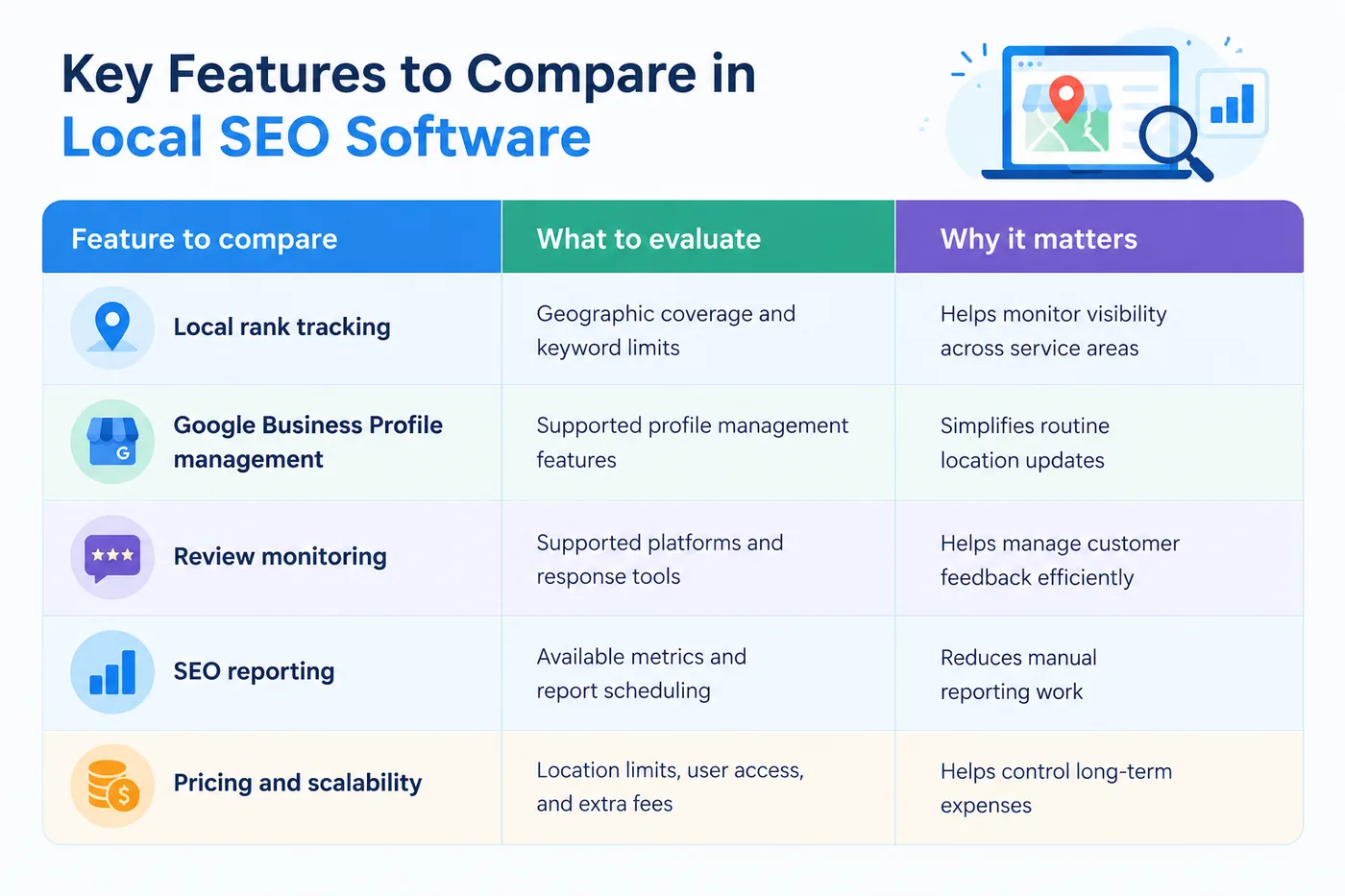
Compare these features against your business needs and budget to choose local SEO software that saves time, simplifies workflows, and supports long-term growth. I also recommend checking onboarding requirements, integrations, support options, and contract terms before committing. Businesses managing multiple locations should confirm that the pricing remains practical as they expand.
Calculate the Potential Return on Investment
The next step is to estimate whether the software's benefits justify its cost. Consider both direct savings and the value of time recovered from repetitive tasks.
Use this simple formula:
Estimated net value = Labor savings + Avoided tool costs + Additional contribution from leads − Software costs
For instance, if automation reduces reporting time, calculate the value of those saved hours using your team's actual labor costs. Add only genuine subscription savings and measurable additional contribution from leads, without counting the same benefit twice.
I recommend tracking these results for several weeks or months and comparing them with your original baseline. Ultimately, the best local SEO platform is one that fits your budget, solves real workflow problems, and provides measurable value without adding unnecessary complexity.
Build a More Cost-Effective Local SEO Workflow
Choosing the right local SEO software is only the first step. To save time and reduce marketing expenses consistently, businesses need a structured workflow that turns data into practical improvements. I recommend focusing on the tasks that have the greatest impact on local visibility, customer engagement, and operational efficiency. A clear process helps teams avoid unnecessary work, track progress, and make better use of their marketing budgets.
Audit, Automate, Measure, and Improve
An effective local SEO workflow starts with understanding current performance and identifying opportunities to work more efficiently. Rather than automating everything immediately, I suggest following four practical steps:
- Audit existing processes: Review how your team manages Google Business Profile optimization, customer reviews, local rankings, and performance reports. Identify repetitive tasks, overlapping subscriptions, and areas where manual work creates delays.
- Automate routine activities: Use suitable local SEO automation features to simplify recurring tasks, such as ranking checks, review monitoring, and report preparation. Keep human oversight for decisions that require accuracy, judgment, or personalized communication.
- Measure performance: Track Google Maps rankings, website clicks, phone calls, direction requests, and other relevant customer actions. Compare results against your baseline to understand whether your efforts are producing meaningful improvements.
- Improve based on insights: Review the data regularly and prioritize issues that affect business goals. For example, if one location has weaker visibility than others, investigate its profile completeness, local competition, and relevant website content before allocating additional resources.
This approach makes local SEO management more organized and helps teams focus on measurable priorities instead of reacting to every ranking fluctuation.
Start Small and Expand What Works
Businesses do not need to automate every marketing activity at once. I recommend starting with one location, a small group of important keywords, or a recurring task that consumes significant staff time.
For example, a local auto repair shop could begin by monitoring local search rankings and reviewing its Google Business Profile performance. After establishing a reliable routine, the business can expand into competitor monitoring, review management, and more detailed local SEO reporting.
Before expanding, evaluate whether the workflow is delivering practical benefits. Ask yourself:
- Are employees spending less time on repetitive SEO tasks?
- Have unnecessary software expenses decreased?
- Can the team identify local visibility problems more quickly?
- Are customer engagement metrics moving in the right direction?
By combining suitable software with regular reviews and consistent optimization, businesses can build a more efficient local marketing strategy.
Ultimately, the goal is not to use the greatest number of tools. It is to establish a sustainable workflow that saves time, controls avoidable costs, and supports long-term local search growth.
Conclusion
Managing local SEO efficiently requires the right tools, a clear strategy, and consistent performance monitoring. Local SEO software helps businesses reduce repetitive tasks, simplify daily workflows, and identify opportunities to use their marketing budgets more effectively. From Google Business Profile management and local rank tracking to review monitoring and performance reporting, these tools make it easier to manage essential activities without unnecessary manual effort.
I recommend evaluating your current processes, identifying time-consuming tasks, and choosing local SEO tools that address your specific business needs. Regularly measuring results also helps you understand which improvements deliver value and where additional attention is needed.
Platforms like [Happy Rank](/) can help businesses monitor local search visibility, track rankings across geographic areas, and make more informed optimization decisions. By combining the right software with consistent execution, businesses can save valuable time, control avoidable marketing expenses, and build a stronger local search presence over time.
Frequently asked questions
How does local SEO software save time?
It brings recurring tasks like profile updates, review monitoring, ranking checks and report preparation into one dashboard, so your team spends less time switching platforms and collecting data by hand.
How can local SEO software reduce marketing costs?
By cutting the hours spent on manual work, replacing separate subscriptions for rank tracking, reviews, citations and reporting when one platform covers them, and showing which locations need investment so budget isn't spread evenly by default.
How do I calculate the ROI of local SEO software?
Estimated net value = labor savings + avoided tool costs + additional contribution from leads − software costs. Value saved hours at your team's actual labor cost and avoid counting the same benefit twice.
Should AI write my review replies automatically?
AI-assisted drafts can speed up replies, but review each one for accuracy and tone before publishing. Automation should support genuine customer communication, not replace it.
Is the cheapest local SEO software the most cost-effective?
Not necessarily. A low price doesn't help if the tool lacks features you need and forces you to buy others. Compare features, pricing as you add locations, integrations, support and contract terms.
How should I start using local SEO software?
Start small with one location, a few important keywords or your most time-consuming task. Once that routine works, expand into competitor monitoring, review management and more detailed reporting.