
Local SEO Software for Businesses That Want More Visibility and Leads
Local SEO software helps businesses get more visibility and leads by tracking how they rank in Google Search and Maps across their service area, keeping Google Business Profile and directory details accurate, monitoring reviews and competitors, and connecting rankings to calls, website clicks and direction requests. Use it to audit, prioritize fixes and measure what drives inquiries.
When people need a nearby service or product, they often turn to Google Search or Google Maps to find the right business. If your business does not appear in those results, you could miss valuable opportunities to connect with potential customers. That is where local SEO software can make a real difference.
Managing local search visibility, tracking local search rankings, keeping business listings accurate, and monitoring customer reviews can quickly become time-consuming when handled manually. The right tools help simplify these tasks, identify areas for improvement, and give you a clearer picture of how your business performs in local searches.
However, better rankings are only part of the goal. You also want more website visits, phone calls, direction requests, and qualified leads. Solutions like [Happy Rank](/) help businesses monitor local search performance and identify opportunities to improve their visibility. With the right local SEO strategy and software, you can make informed decisions that support sustainable business growth.
Understanding Local SEO Software and Its Role in Business Growth
Local customers often search online before deciding which business to contact or visit. If your business is difficult to find in local search results, you may lose potential customers to competitors with stronger visibility. I see local SEO software as a practical way to manage local search performance, identify optimization opportunities, and make better marketing decisions without relying entirely on manual work.
Rather than treating local SEO as a collection of disconnected tasks, businesses can use specialized tools to organize their efforts and measure progress toward meaningful goals.
What Is Local SEO Software?
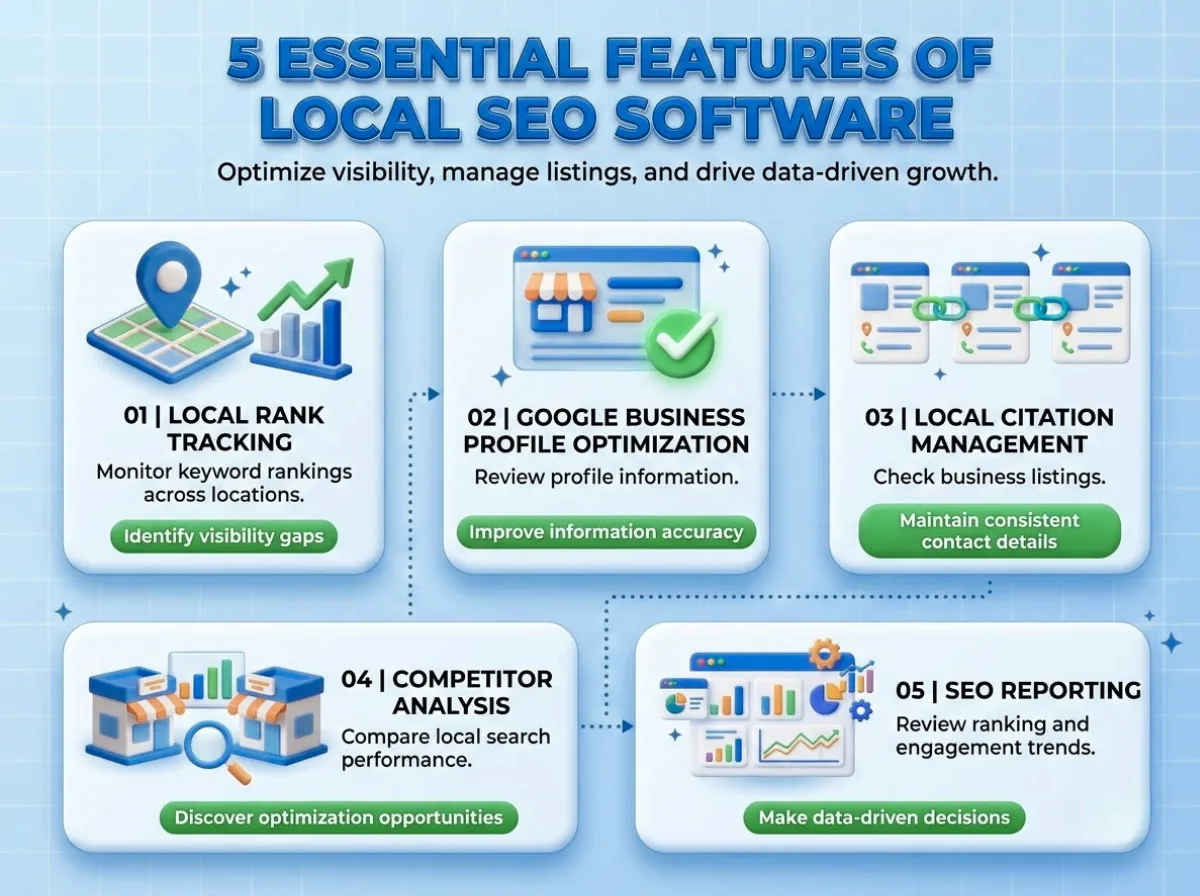
Local SEO software helps businesses improve and monitor their presence in location-based search results. These platforms bring together tools for local rank tracking, Google Business Profile optimization, local citation management, and performance reporting.
Depending on the platform, businesses can use these tools to:
- Track local search rankings: Monitor how a business appears for relevant keywords across different locations.
- Manage business listings: Identify inconsistent business information across online directories.
- Monitor customer reviews: Keep track of customer feedback and identify opportunities to improve reputation management.
- Analyze local SEO performance: Review visibility trends and available engagement metrics to understand what needs attention.
I recommend choosing tools that address your actual business challenges instead of paying for features you may never use.
How Local SEO Software Differs From Traditional SEO Tools
Traditional SEO tools generally focus on website performance, backlinks, technical issues, and organic keyword rankings. While these functions remain valuable, local SEO tools focus more specifically on geographic visibility and customer discovery.
For example, a general SEO platform might show that your website ranks for a service-related keyword. However, local rank tracking can help you understand how your business performs in Google Maps and location-specific searches across your service area.
This distinction matters because local search results can vary depending on the searcher's location and the competitive landscape.
When evaluating local SEO software for businesses, I look for features that help answer practical questions:
- Does my business appear in important local searches?
- Which neighborhoods have weaker Google Maps rankings?
- Are my business details accurate across online directories?
- Are customers finding opportunities to call, visit, or contact my business?
These insights make it easier to prioritize improvements based on actual business needs.
Which Businesses Benefit Most From Local SEO Software?
Almost any business that serves customers in specific geographic areas can benefit from a well-planned local SEO strategy. I would particularly consider these business types:
- Home service businesses: Plumbers, electricians, landscapers, and HVAC contractors can monitor visibility across their service areas.
- Restaurants and retail stores: Local businesses can improve discoverability when customers search for nearby places.
- Professional service providers: Dentists, lawyers, and consultants can strengthen their presence for relevant location-based searches.
- Multi-location businesses: Companies with several branches can monitor performance and maintain consistent business information across locations.
How Local SEO Software Improves Search Visibility
Improving local search visibility requires more than creating a Google Business Profile. You need to understand where your business ranks, whether your information is accurate, and how competitors attract nearby customers. I use local SEO software to organize these activities, identify gaps, and make informed decisions that support stronger local search rankings.
The right local SEO tools can help businesses manage several important areas:
Not every business needs to prioritize the same improvements. Your next steps should depend on your current visibility, target audience, competition, and growth objectives. Once you understand which areas need attention, you can use these insights to build a more focused local SEO strategy.
Track Local Rankings Across Google Search and Maps
Local rank tracking shows how your business performs for relevant search terms in specific locations. Rankings can vary between neighborhoods, even when customers search for the same service.
For example, a plumbing company might rank well near its office but struggle to appear in neighboring communities. Geo-grid rank tracking can help identify these differences across a mapped area.
I recommend monitoring:
- Local keywords, such as “plumber near me” and “emergency plumbing services.”
- Google Maps rankings across important service areas.
- Ranking trends to evaluate performance over time.
These insights help prioritize locations that need attention.
Optimize Your Google Business Profile
Your Google Business Profile helps customers discover essential information about your business. I recommend reviewing your profile regularly to ensure it includes:
- Accurate business hours, address, and phone number.
- Relevant primary and secondary business categories.
- Updated services, descriptions, and photos.
Some local SEO software can help monitor profile details and identify missing information. However, no tool can guarantee higher rankings, since local search visibility depends on several factors.
Manage Local Citations and Monitor Competitors
Local citation management helps businesses identify inconsistent information across online directories. I recommend checking important listings, correcting outdated contact details, and addressing duplicate records.
Meanwhile, local competitor analysis helps you understand how other businesses perform in your target market. Reviewing competitor rankings, profiles, and customer reviews can reveal opportunities to improve your own local SEO strategy.
How Local SEO Software Helps Businesses Generate More Leads
Higher search rankings are valuable, but visibility alone does not guarantee business growth. You also need to turn local searches into meaningful actions, such as phone calls, website visits, appointment requests, and store visits. I recommend using local SEO software to understand how customers discover your business and identify opportunities to improve local lead generation.
By connecting local search visibility with customer engagement data, businesses can make better marketing decisions and focus on attracting people who are more likely to become customers.
| Lead generation factor | What to monitor | How it helps |
|---|---|---|
| Local search visibility | Rankings for relevant local keywords | Identifies opportunities to reach nearby customers |
| Customer engagement | Website clicks and direction requests | Reveals how people interact with your business |
| Phone inquiries | Call activity, where tracking is available | Helps evaluate potential customer interest |
| Online reviews | Ratings and recurring customer feedback | Highlights trust-building opportunities |
| Landing page performance | Relevant traffic and inquiries | Identifies conversion improvements |
Turn Local Search Visibility Into Website Visits and Calls
When your business appears for relevant local searches, potential customers have more opportunities to discover your services. I recommend monitoring website clicks, phone calls, and direction requests where these metrics are available.
For example, an electrician might notice strong visibility for emergency services but relatively few website visits. This could indicate that the business needs clearer service information or a more useful landing page.
Use local SEO analytics to evaluate engagement alongside rankings rather than treating higher positions as the only measure of success.
Use Customer Reviews to Build Trust and Encourage Inquiries
Online reviews influence how customers evaluate local businesses. Recent, relevant feedback can help potential customers understand service quality and decide whether to make contact.
I recommend building a consistent review management strategy that includes:
- Monitoring new reviews across relevant platforms.
- Responding professionally to positive and negative feedback.
- Identifying recurring customer concerns.
- Using genuine feedback to improve products and services.
Although review management can support customer trust, it does not guarantee higher rankings or more leads.
Target High-Intent Local Keywords
Local keyword research helps you identify searches that indicate a customer needs a particular product or service. I prioritize relevant, location-specific phrases that reflect genuine customer intent.
Examples include:
- Plumbing: “emergency plumber near me.”
- Landscaping: “lawn maintenance services in Austin.”
- Restaurants: “family restaurants near me.”
- Auto repair: “brake repair shop in Denver.”
Use these high-intent local keywords naturally in relevant service pages, location pages, and website content.
Improve Conversions With Local SEO Insights
Finally, I recommend reviewing which pages and services generate meaningful inquiries. Local SEO tools can help identify performance gaps, while website analytics can provide additional conversion data.
Essential Features to Look for in Local SEO Software
Choosing the right local SEO software requires more than comparing prices or counting features. I recommend focusing on tools that solve your business's specific challenges, whether you need better local search visibility, more accurate listings, or clearer performance reporting. The right platform should help you manage essential tasks efficiently and turn local SEO data into practical decisions.
Before committing to a tool, evaluate its core features, usability, reporting capabilities, and ability to support your business as it grows.
| Feature | What to Look For | Why It Matters |
|---|---|---|
| Local rank tracking | Location-based rankings and historical data | Reveals visibility gaps |
| Listing management | Business information monitoring and updates | Supports consistent listings |
| Review monitoring | Review alerts and response tools | Helps manage online reputation |
| Analytics and reporting | Rankings, clicks, calls, and available metrics | Supports informed decisions |
| Scalability | Multi-location support and flexible plans | Accommodates business growth |
Evaluate Local Rank Tracking and Geo-Grid Reporting
Reliable local rank tracking helps you understand how your business performs for important keywords across different locations. I look for tools that offer historical ranking data and location-specific reports.
Geo-grid rank tracking is particularly useful when visibility varies across neighborhoods. It helps businesses identify areas where rankings are weaker and prioritize further optimization.
Check Google Business Profile and Listing Management
Your Google Business Profile and online directory listings influence how customers discover and contact your business. I recommend choosing local SEO tools that help monitor business information and identify inconsistencies.
Look for features that support:
- Monitoring business name, address, and phone number.
- Identifying duplicate or outdated listings.
- Reviewing profile information and completeness.
- Managing information across multiple locations, when supported.
These capabilities can reduce manual work and help maintain accurate business details.
Look for Review Monitoring and Reputation Management
Review monitoring helps you stay informed about customer feedback across relevant platforms. I prioritize tools that provide review notifications, centralized monitoring, and response management where available.
Consistent review management helps businesses identify recurring concerns, respond professionally, and understand customer expectations. However, software cannot replace genuine customer service or guarantee positive reviews.
Assess Analytics, Reporting, and Scalability
Strong local SEO analytics help connect search performance with meaningful customer actions. I recommend evaluating whether a platform tracks rankings, website clicks, phone calls, and direction requests, depending on the available integrations.
Before making a decision, consider:
- Ease of use: Can your team understand reports and complete routine tasks?
- Pricing: Are the features worth the ongoing cost?
- Scalability: Can the platform support additional locations?
- Reporting: Can you identify trends and measure progress toward business goals?
How to Use Local SEO Software to Build a Practical Growth Strategy
Investing in local SEO software is only the first step. To improve search visibility and attract potential customers, you need a consistent process for identifying problems, prioritizing improvements, and measuring results. I recommend treating local SEO optimization as an ongoing business activity rather than a one-time project.
A structured approach helps you use local SEO tools effectively, focus on meaningful opportunities, and connect your optimization efforts with measurable business outcomes.
Audit Your Current Local Search Performance
Before making changes, I start with a local SEO audit to understand how a business currently performs in local search results. This establishes a baseline and helps identify the areas that need attention.
I recommend reviewing:
- Local search rankings: Check visibility for relevant keywords across target locations.
- Google Business Profile: Review business categories, operating hours, services, and contact information.
- Local citations: Identify inconsistent business details and outdated directory listings.
- Customer reviews: Evaluate feedback, response practices, and recurring concerns.
- Lead generation metrics: Review available data on website clicks, phone calls, and direction requests.
These findings help you identify weaknesses without spending time on changes that offer little value.
Prioritize Improvements Based on Business Goals
Once the audit is complete, I recommend ranking potential improvements according to their business impact, urgency, and available resources. Not every issue requires immediate attention.
For example, correcting an inaccurate phone number may be more urgent than updating a secondary service page because customers need reliable contact information to reach your business.
Use this simple framework to organize your priorities:
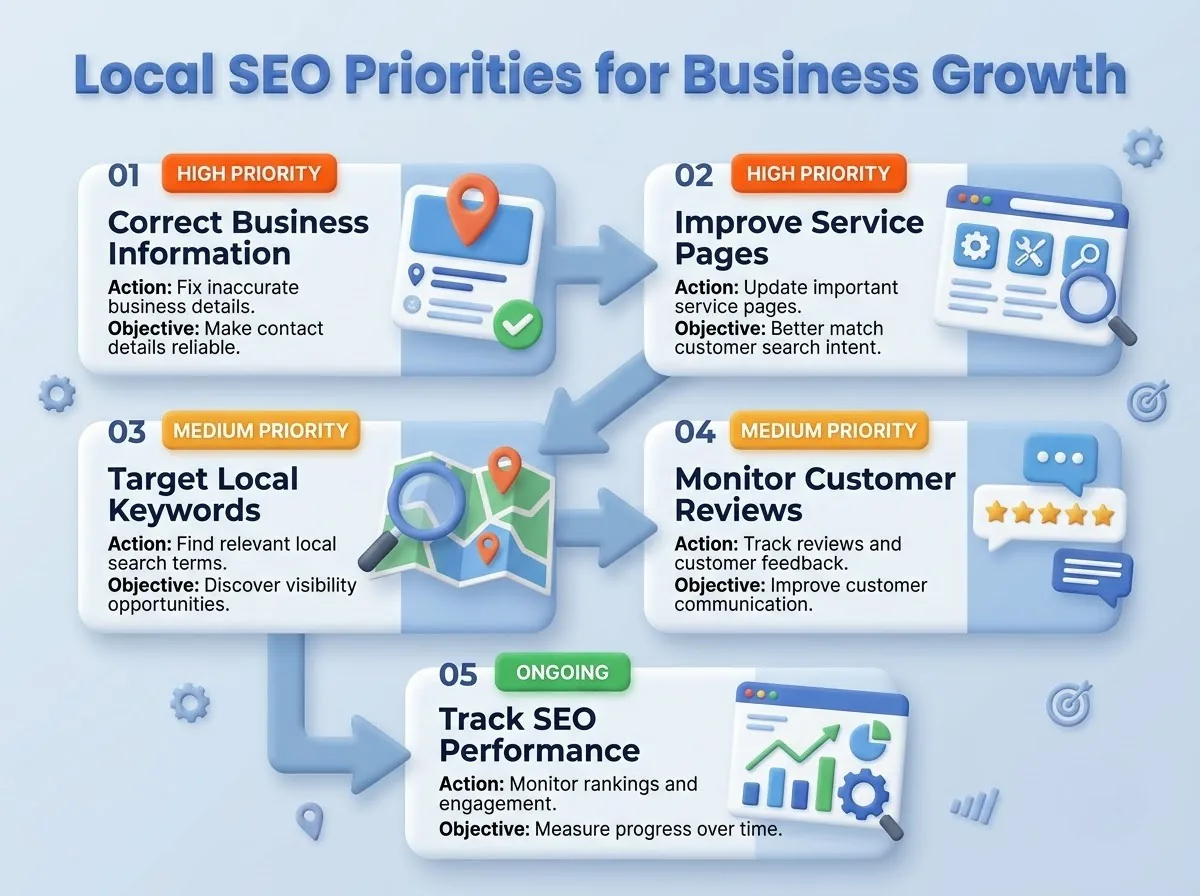
Start with the most important fixes, then refine your local SEO strategy using performance data and changing business needs.
I also recommend setting realistic goals based on your starting performance, competition, and available resources.
Measure Results and Refine Your Approach
Effective local SEO reporting helps you understand whether your actions are producing meaningful improvements. I recommend reviewing performance regularly and comparing results with your initial baseline.
Focus on metrics such as:
- Local keyword rankings across relevant locations.
- Website traffic from local searches.
- Phone calls and direction requests, where tracking is available.
- Qualified leads and customer inquiries.
- Conversion rates on important service pages.
Ultimately, successful local SEO management depends on consistency. By auditing performance, prioritizing improvements, and measuring results, you can build a repeatable workflow that supports stronger visibility and more opportunities to generate leads.
Conclusion
Improving local search visibility takes consistent effort, accurate business information, and a clear understanding of what customers are searching for. The right local SEO software helps simplify these tasks by bringing together local rank tracking, Google Business Profile optimization, citation management, and performance reporting.
I recommend choosing local SEO tools based on your business goals rather than focusing on the number of features alone. Monitor your rankings, review customer feedback, identify opportunities in your target locations, and measure meaningful outcomes such as website visits, phone calls, and qualified leads.
With a platform like [Happy Rank](/), businesses can monitor their local search performance and identify areas that may need improvement. The key is to use these insights consistently and turn them into practical actions. When you combine the right software with a focused local SEO strategy, you can strengthen your online presence and create more opportunities to connect with potential customers.
Frequently asked questions
How is local SEO software different from regular SEO tools?
Traditional SEO tools focus on website performance, backlinks, technical issues and organic rankings. Local SEO tools focus on geographic visibility, such as Google Maps rankings across neighborhoods, listing accuracy and how nearby customers find and contact you.
Which businesses benefit from local SEO software?
Home service businesses like plumbers, electricians, landscapers and HVAC contractors, restaurants and retail stores, professional services such as dentists and lawyers, and multi-location businesses.
How does local SEO software help generate leads?
It connects visibility with customer actions. By tracking rankings alongside website clicks, calls, direction requests and page performance, you can see where visibility isn't turning into inquiries and fix those pages or profiles.
What features should I look for in local SEO software?
Local rank tracking with location-based and historical data, geo-grid reporting, listing management, review monitoring and alerts, analytics on clicks and calls, and multi-location support.
What should a local SEO audit cover?
Rankings for relevant keywords across target locations, your Google Business Profile categories, hours and services, citation consistency, review feedback and response practices, and available lead data like clicks, calls and direction requests.