
How to Get Better Results From Your Local SEO Software
To get better results from local SEO software, set clear goals and a baseline first, then track only keywords and locations you actually serve. Use audits to fix your Google Business Profile, landing pages and citations in priority order, monitor Maps rankings and competitors across your service area, automate routine reports, and compare rankings with calls and leads.
Getting the most out of your local SEO software takes more than checking rankings or reviewing performance reports. You need to understand what the data tells you and turn those insights into actions that improve your local search visibility. Whether you run a plumbing company, restaurant, cleaning business, or marketing agency, the right approach can help you reach more potential customers in your service area.
Effective local SEO optimization involves tracking local keyword rankings, improving your Google Business Profile, maintaining accurate business listings, and monitoring competitors. However, these activities deliver better results when you follow a consistent strategy and measure progress against clear business goals.
Tools such as [Happy Rank](/) can help businesses monitor local search performance, identify optimization opportunities, and understand their Google Maps rankings. Instead of relying on guesswork, you can use these insights to prioritize important tasks and make informed decisions. The key is knowing which metrics matter, which issues to address first, and how to evaluate your progress over time.
Set Clear Goals Before Using Your Local SEO Software
Before I start using local SEO software, I first identify what I want to achieve. Tracking rankings and reviewing dashboards can provide useful information, but these activities are more valuable when they support specific business goals. A clear strategy helps me focus on the metrics that matter, prioritize improvements, and measure whether my local SEO strategy is delivering meaningful results.
Identify the Local SEO Metrics That Matter Most
I recommend choosing performance metrics based on your business objectives rather than tracking every available data point. The right local SEO metrics help you understand how customers discover your business and interact with your online presence.
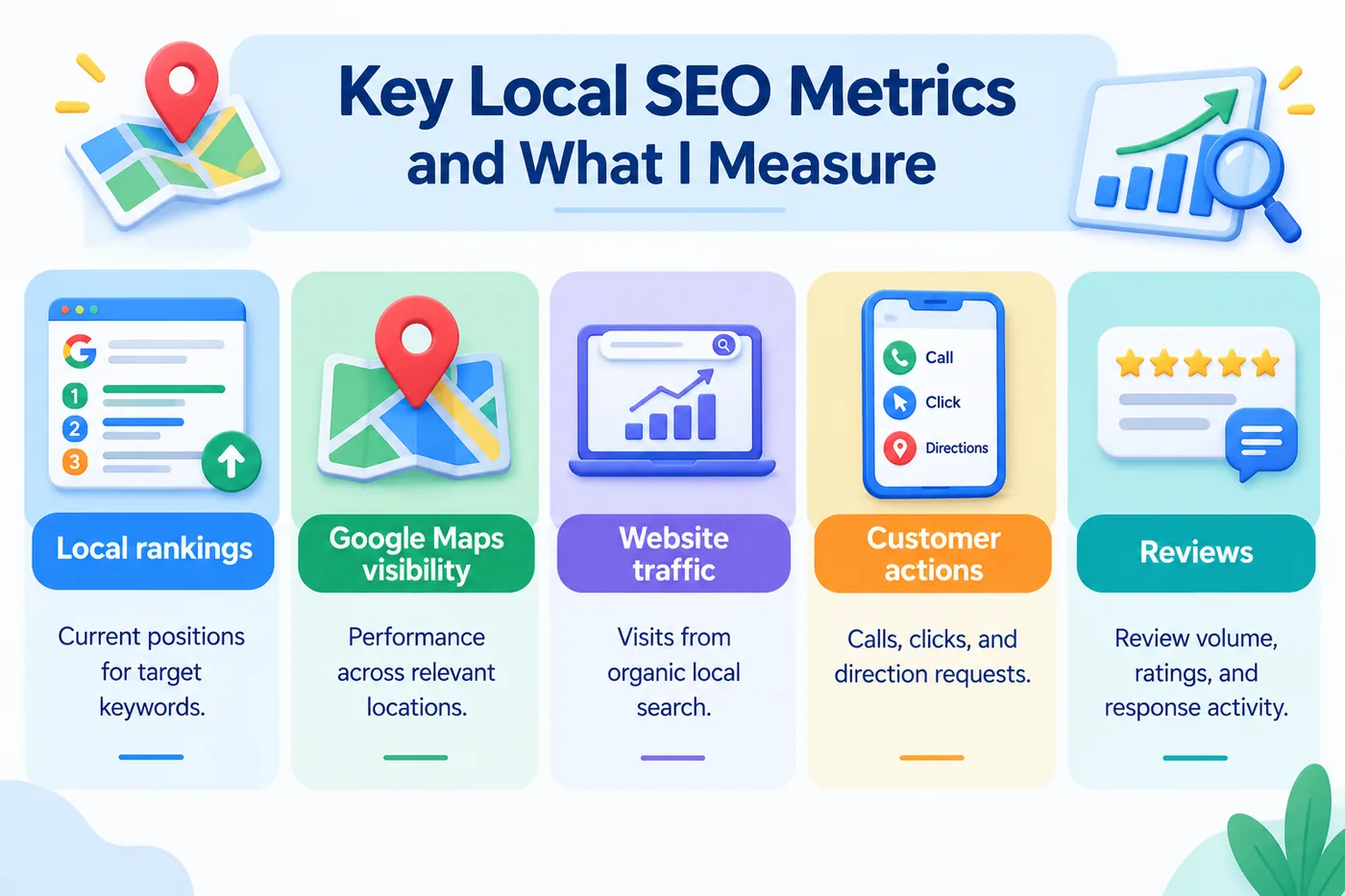
Important metrics to monitor include:
- Local keyword rankings: Track how your business performs for relevant search terms.
- Google Maps visibility: Understand how frequently your business appears in local search results across different areas.
- Website clicks: Measure how many potential customers visit your website from search results.
- Phone calls and direction requests: Identify actions that may indicate strong customer interest.
- Customer reviews: Monitor review volume, ratings, and customer feedback to identify opportunities for improvement.
I also distinguish between visibility metrics and business outcomes. Higher rankings can increase exposure, but calls, website visits, and qualified leads provide additional insight into whether that visibility attracts potential customers.
Focus on the Right Locations and Keywords
Not every keyword or location deserves equal attention. I use local keyword research to identify search terms that match my services, target audience, and service area. For example, a plumbing company might prioritize searches such as "emergency plumber" alongside relevant city-specific terms.
When selecting keywords, I focus on:
- Search intent: Prioritize terms that reflect what potential customers need.
- Location relevance: Track keywords in the cities and neighborhoods the business actually serves.
- Competition: Identify realistic opportunities to improve local search rankings.
- Service relevance: Choose keywords that connect directly to the business's offerings.
This approach keeps local rank tracking focused and makes it easier to identify meaningful opportunities.
Establish a Baseline to Measure Progress
Before making changes, I record current performance so I can compare results over time. My local SEO reporting baseline includes the following:
I then set realistic goals and review these metrics regularly. With a clear baseline, local SEO software becomes more than a tracking tool. It helps me evaluate progress, identify weaknesses, and make data-driven decisions that support long-term local search growth.
Use Local SEO Software to Find and Fix Optimization Issues
I use local SEO software to identify problems that may limit a business's visibility in local search results. Instead of making random changes, I review audit findings, prioritize important issues, and create a clear plan for improvement. This approach helps me strengthen local SEO optimization, maintain accurate business information, and improve the experience potential customers have when they discover a business online.
Audit Your Google Business Profile
I start by reviewing the Google Business Profile to ensure that customers can find accurate and complete information. Even small errors can create confusion or make it harder for customers to contact a business.
I check the following details:
- Business information: Verify the business name, address, phone number, and operating hours.
- Business categories: Confirm that the primary and secondary categories accurately describe the services offered.
- Services and photos: Keep service descriptions and relevant images current.
- Business description: Make sure the description clearly explains what the business offers.
Regular Google Business Profile optimization helps maintain a reliable online presence and gives potential customers the information they need.
Improve Local Landing Pages and On-Page SEO
Next, I review the website to identify opportunities for better local search optimization. My focus is on making each page relevant to the services and locations the business targets.
I prioritize improvements such as:
- Adding relevant local keywords to page titles, headings, and meta descriptions naturally.
- Improving service pages with useful information that answers customer questions.
- Creating location pages when a business genuinely serves multiple areas.
- Strengthening internal links between related service and location pages.
- Ensuring pages are mobile-friendly and load efficiently.
I avoid stuffing keywords into content. Instead, I focus on helpful, location-specific information that matches local search intent.
Check Business Listings and Local Citations
I also use local SEO tools to identify inconsistencies across online business directories. Incorrect contact details can confuse customers, so I check that important listings contain accurate information.
| Audit area | What I check | Recommended action |
|---|---|---|
| Business details | Name, address, and phone number | Correct inconsistent information |
| Online directories | Listing accuracy and completeness | Update important listings |
| Website pages | Missing or outdated content | Improve relevant pages |
| Business profile | Categories, services, and hours | Complete missing details |
Maintaining accurate local citations supports business information consistency across the web.
Turn Audit Findings Into an Action Plan
Finally, I organize the findings by priority rather than attempting to fix everything at once. I address incorrect business information and significant website issues first, followed by content improvements and routine maintenance.
By turning audit results into specific tasks with deadlines, I make local SEO software more actionable. This process helps me track completed work, identify remaining issues, and focus resources on improvements that support stronger local search visibility.
Use Ranking and Competitor Insights to Improve Local Visibility
I use local SEO software to understand where a business appears in local search results and identify opportunities to outperform nearby competitors. Rather than relying on occasional ranking checks, I monitor performance consistently and use the data to refine my local SEO strategy. This helps me focus on relevant keywords, improve visibility in target areas, and understand what may be limiting local search performance.
Track Google Maps Rankings Across Different Locations
I recommend monitoring Google Maps rankings across the areas a business serves. Local results can vary depending on the searcher's location, competition, and relevance to the query. A business may perform well near its address but receive less visibility in surrounding neighborhoods.
Using local rank tracking and geo-grid tracking, I can identify these differences and prioritize locations that need attention. I focus on:
- Tracking important local keywords across relevant service areas.
- Identifying neighborhoods where visibility is consistently weak.
- Comparing ranking trends over time instead of reacting to daily fluctuations.
- Reviewing business profile information and relevant service pages when rankings decline.
These insights help me make more informed decisions about local search optimization.
Analyze Competitors to Discover Ranking Opportunities
Competitor analysis helps me understand how other businesses perform in the same local market. I use local SEO tools to compare their search visibility, website content, business profiles, and customer reviews.
I look for opportunities such as:
- Services competitors highlight that my business has not explained clearly.
- Customer questions that existing website content does not answer.
- Differences in review volume and customer feedback.
- Relevant keywords where competing businesses appear more prominently.
I use these findings to identify gaps, not to copy competitors. The goal is to develop a more useful and relevant online presence.
Find and Target High-Value Local Keywords
I review local keyword research data to identify search terms that align with customer needs and business services. Instead of targeting every available keyword, I prioritize terms with clear relevance and commercial intent.
When conducting local keyword research, I evaluate four key factors to choose the most relevant search terms. First, I consider search intent to understand what customers need and create content that matches their queries. Next, I assess location relevance to prioritize cities and neighborhoods the business actually serves. I also analyze competition to identify realistic opportunities to improve local search rankings. Finally, I evaluate service relevance to ensure each keyword connects directly to the business's core offerings. By considering these factors, I can prioritize valuable keywords, improve targeted service pages, and make my local SEO strategy more effective.
Monitor Reviews and Customer Feedback
I also monitor online reviews to understand customer expectations and identify recurring concerns. Review monitoring helps me spot opportunities to improve communication, respond professionally, and strengthen customer relationships.
I pay attention to review trends, recurring service complaints, and questions that could inform website content. Although reviews alone do not guarantee better rankings, managing customer feedback supports trust and helps me identify practical improvements.
By combining ranking data, competitor analysis, keyword research, and review monitoring, I can turn local SEO insights into focused actions that improve local visibility over time
Build a Consistent Local SEO Workflow and Act on Insights
I get better results from local SEO software when I follow a consistent workflow instead of checking reports only when rankings drop. A structured process helps me turn local SEO data into practical tasks, maintain accurate business information, and track progress without wasting time on low-priority activities. By combining regular monitoring with clear responsibilities, I can make local SEO management more efficient and sustainable.
Create a Repeatable Local SEO Routine
I divide local SEO activities into daily, weekly, and monthly tasks. This keeps important work organized and makes it easier to identify issues before they become larger problems.
| Frequency | Recommended tasks | Main objective |
|---|---|---|
| Daily | Review important customer inquiries and urgent alerts | Address immediate issues |
| Weekly | Monitor rankings, reviews, and listing updates | Maintain local visibility |
| Monthly | Audit performance reports and website content | Identify improvement opportunities |
I adjust this schedule according to business size, competition, and available resources. For example, a business with multiple locations may need more frequent listing checks than a single-location business.
Prioritize Tasks Instead of Acting on Every Alert
Local SEO tools can generate numerous recommendations, but not every issue deserves immediate attention. I prioritize tasks based on their potential impact, urgency, and relevance to business goals.
My priorities generally include:
- Correcting inaccurate Google Business Profile information.
- Fixing important website errors that affect usability or search visibility.
- Improving service pages that target valuable local keywords.
- Addressing inconsistent local citations across important directories.
- Reviewing performance changes that may indicate a significant problem.
This approach helps me focus on meaningful improvements instead of reacting to every notification. I also distinguish between urgent corrections and long-term optimization tasks.
Automate Repetitive Tasks Where Possible
I use local SEO automation to reduce repetitive work and maintain a reliable monitoring process. Depending on the software's available features, automation can support ranking reports, review alerts, listing monitoring, and scheduled performance summaries.
I look for opportunities to automate tasks such as:
- Generating regular local SEO reports.
- Receiving alerts about new customer reviews.
- Monitoring keyword ranking changes.
- Identifying potential listing inconsistencies.
However, I do not rely on automation without oversight. I verify important updates, review unusual results, and make sure customer responses remain appropriate and personalized.
Use Reports to Guide the Next Round of Improvements
Finally, I review reports to understand which actions are producing useful results. I compare performance over time, examine changes in Google Maps rankings, and check whether website traffic and customer actions are improving.
When results fall short, I investigate possible causes before changing the strategy. This continuous process helps me refine priorities, use local SEO software more effectively, and build a workflow based on evidence rather than assumptions.
Measure Results and Refine Your Local SEO Strategy
I believe the real value of local SEO software comes from understanding whether optimization efforts are producing meaningful business results. Improved rankings are encouraging, but they do not automatically translate into more customers. I regularly review local SEO performance metrics to understand how visibility, website engagement, and customer actions change over time. This helps me identify successful strategies, address weaknesses, and make informed decisions about future improvements.
Connect Rankings With Meaningful Business Outcomes
I start by comparing local keyword rankings and Google Maps visibility with the actions potential customers take. This gives me a clearer picture of whether increased exposure is attracting relevant traffic and generating business opportunities.
I focus on several important indicators:
- Website clicks: Determine whether customers are visiting relevant service and location pages.
- Phone calls: Evaluate whether local visibility is generating customer inquiries.
- Direction requests: Understand interest in visiting a physical business location.
- Qualified leads: Assess whether inquiries align with the services the business provides.
- Customer reviews: Monitor feedback and identify opportunities to improve customer experience.
I also consider seasonal changes, marketing campaigns, and other factors that may influence results. This prevents me from attributing every performance change to a single local SEO strategy.
Review Performance and Adjust Your Approach
I recommend reviewing local SEO reports monthly and conducting deeper evaluations periodically. Regular reviews help me identify trends without overreacting to short-term ranking fluctuations.
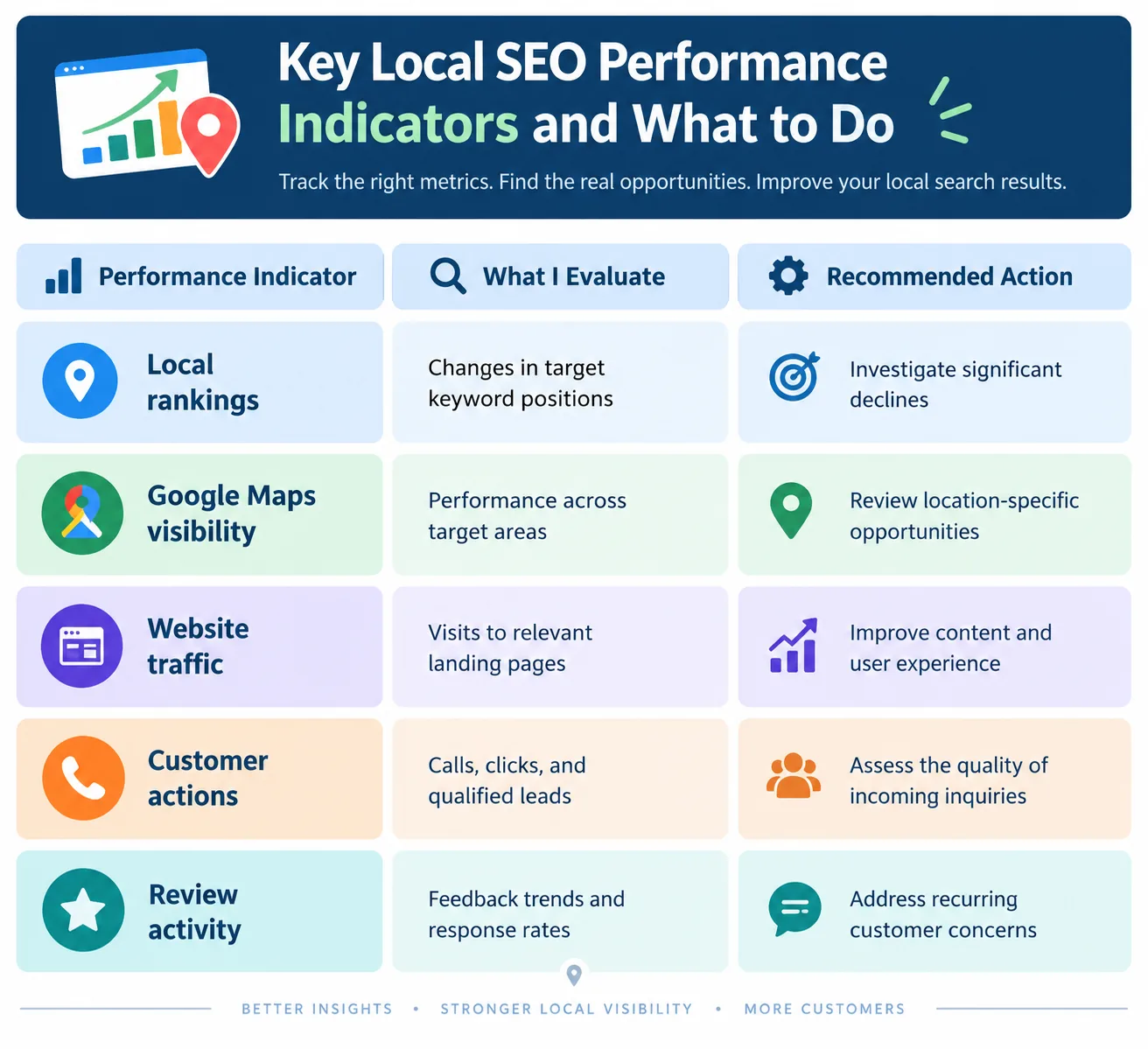
When a metric declines, I investigate possible causes before making changes. For example, weaker rankings may require reviewing competitors, business information, or page relevance rather than immediately rewriting an entire website.
Make Continuous Improvement Part of Your Process
I treat local SEO optimization as an ongoing process rather than a one-time project. Search results, competitors, customer expectations, and business priorities can change, so I regularly revisit my strategy.
To keep improving:
- Reassess keyword priorities as services and customer needs evolve.
- Update outdated business information and website content.
- Review competitors for new opportunities and changes in visibility.
- Measure the impact of completed optimization tasks.
- Use local SEO insights to establish the next set of priorities.
I also give improvements enough time to produce measurable results before concluding. With consistent monitoring and realistic expectations, local SEO software becomes a valuable tool for making data-driven decisions, strengthening local search visibility, and supporting sustainable business growth.
Conclusion
Getting better results from local SEO software requires clear goals, consistent monitoring, and practical action. I focus on improving Google Business Profile optimization, tracking local keyword rankings, analyzing competitors, and measuring customer actions to identify opportunities for growth. By reviewing performance regularly, I can prioritize important tasks and make informed decisions that strengthen local search visibility.
However, tracking data alone is not enough. The real value comes from using local SEO insights to fix problems, improve website content, maintain accurate business listings, and deliver a better customer experience.
Tools like [Happy Rank](/) can simplify local SEO management by helping businesses monitor rankings, identify optimization opportunities, and evaluate progress. I recommend starting with the most important issues, setting realistic goals, and refining your strategy based on results. With consistent effort and the right approach, you can make your local SEO strategy more effective and build a stronger presence in local search results.
.
Frequently asked questions
What should I set up before using local SEO software?
Clear goals, the metrics that match them, and a baseline of current rankings, Maps visibility, website clicks, calls, direction requests and reviews so you can measure progress.
How do I choose which keywords to track?
Prioritize terms that match customer intent, the locations you actually serve, your real services and realistic competition, such as 'emergency plumber' alongside city-specific searches.
Which local SEO issues should I fix first?
Inaccurate Google Business Profile information and significant website errors first, then pages targeting valuable local keywords and inconsistent citations, then routine content improvements.
How often should I review local SEO data?
Check urgent alerts and inquiries daily, rankings, reviews and listing updates weekly, and performance reports and website content monthly, adjusting for your size and competition.
Should I act on every alert from my local SEO tool?
No. Prioritize by impact, urgency and relevance to your goals, investigate the cause of a decline before changing strategy, and avoid reacting to daily ranking fluctuations.