
How Plumbers Can Win More Google Maps Searches
Plumbers can win more Google Maps searches by optimizing their Google Business Profile with accurate primary categories, detailing emergency and repair services, earning high-velocity verified reviews with photos, creating localized service area pages, and tracking geo-grid rank heatmaps to eliminate visibility drop-offs in surrounding suburbs.
When someone searches for a plumber on Google Maps, they usually need help quickly. Whether it is a leaking pipe, a clogged drain, or a broken water heater, customers often contact businesses that appear prominently in local search results. If your plumbing business is difficult to find, you could miss valuable calls and service opportunities, even when you provide excellent work.
The good news is that you can improve your chances of appearing in relevant searches with the right approach tolocal SEO for plumbers. In this guide, we will discuss how to optimize yourGoogle Business Profile, earn genuine customer reviews, target relevant local keywords, and strengthen yourlocal search visibility. We will also cover how to monitorGoogle Maps rankings, evaluate competitors, and measure customer actions to identify areas for improvement. Tools like[Happy Rank](/)can help you track local SEO performance and make informed decisions to attract more nearby customers.
Understand What Helps Plumbers Rank on Google Maps
Before I improve a plumbing business's online presence, I first look at how Google determines which businesses appear in local search results. Understanding these factors helps me build a practicallocal SEO strategy for plumbersinstead of relying on guesswork. While no one can guarantee a specific position, I can improve a business's chances of appearing in relevantGoogle Maps searchesby focusing on accurate information, local relevance, and customer trust.
Learn Google's Three Main Local Ranking Factors
Google primarily considersrelevance,distance, andprominencewhen determining local search results. I use these factors to identify where a plumbing business can make meaningful improvements.
- Relevance:How closely a business's profile matches what someone searches for, such asemergency plumber near meor drain cleaning services.
- Distance:How far the business is from the searcher's location or the location specified in the search.
- Prominence:How well-known a business appears to be, based on factors such as reviews, links, and other information Google can evaluate.
For example, a plumber with a complete profile, relevant service information, and a strong reputation may be better positioned for suitable searches. However, distance still matters, so a business cannot expect to rank equally across every neighborhood.
Understand How Customers Search for Plumbing Services
I also consider the reason behind each search. Plumbing customers often need immediate assistance, but others may be researching a planned repair or installation. Understanding thissearch intenthelps me prioritize the services and keywords that matter most.
| **Search type** | **Example keyword** | **SEO opportunity** |
|---|---|---|
| Emergency service | Emergency plumber near me | Clearly communicate emergency availability |
| Repair service | Leaky pipe repair | Highlight relevant repair services |
| Maintenance | Drain cleaning service | Explain available maintenance options |
| Installation | Water heater installation | Provide detailed service information |
I recommend focusing on search terms that accurately describe the services offered and match the needs of local customers. This approach supportslocal search visibilitywithout stuffing business descriptions with keywords.
Analyze Competing Plumbing Businesses in Your Area
To understand the local competition, I review plumbing businesses that appear for important searches. I look for practical opportunities rather than simply copying their strategies.
My competitor analysis includes:
- ComparingGoogle Business Profilecategories and service information.
- Reviewing customer ratings, feedback, and response patterns.
- Checking website content and relevant local service pages.
- Identifying gaps in service descriptions and customer communication.
These findings help me prioritize improvements based on actual business needs. A focusedGoogle Maps rankingstrategy starts with understanding the local market, recognizing what customers are searching for, and strengthening the factors the business can reasonably influence.
Optimize Your Google Business Profile for More Visibility
A well-maintainedGoogle Business Profileis one of the most important assets for plumbers who want to improve theirGoogle Maps ranking. When customers search for plumbing services nearby, they need accurate information about the business, its services, and how to get in touch. I focus on making the profile complete, relevant, and easy to use so potential customers can quickly decide whether the business meets their needs.
Choose the Right Business Categories and Complete Your Profile
I start by selecting the most accurate primary business category and adding relevant secondary categories when appropriate. These categories help Google understand what the business offers and which searches may be relevant.
I also verify essential business details, including:
- Business name:Use the real-world business name without adding extra keywords.
- Phone number:Provide a current number that customers can use to request service.
- Business hours:Keep regular hours and holiday schedules accurate.
- Website URL:Link to the official website or a relevant service page.
- Business description:Explain the plumbing services, experience, and areas served clearly.
Consistent information supportslocal SEO for plumbersand helps customers avoid confusion when contacting the business.
Add Plumbing Services and Relevant Business Information
Next, I make sure the profile accurately reflects the services the business provides. Specific service information can help potential customers understand whether the plumber handles their particular problem.
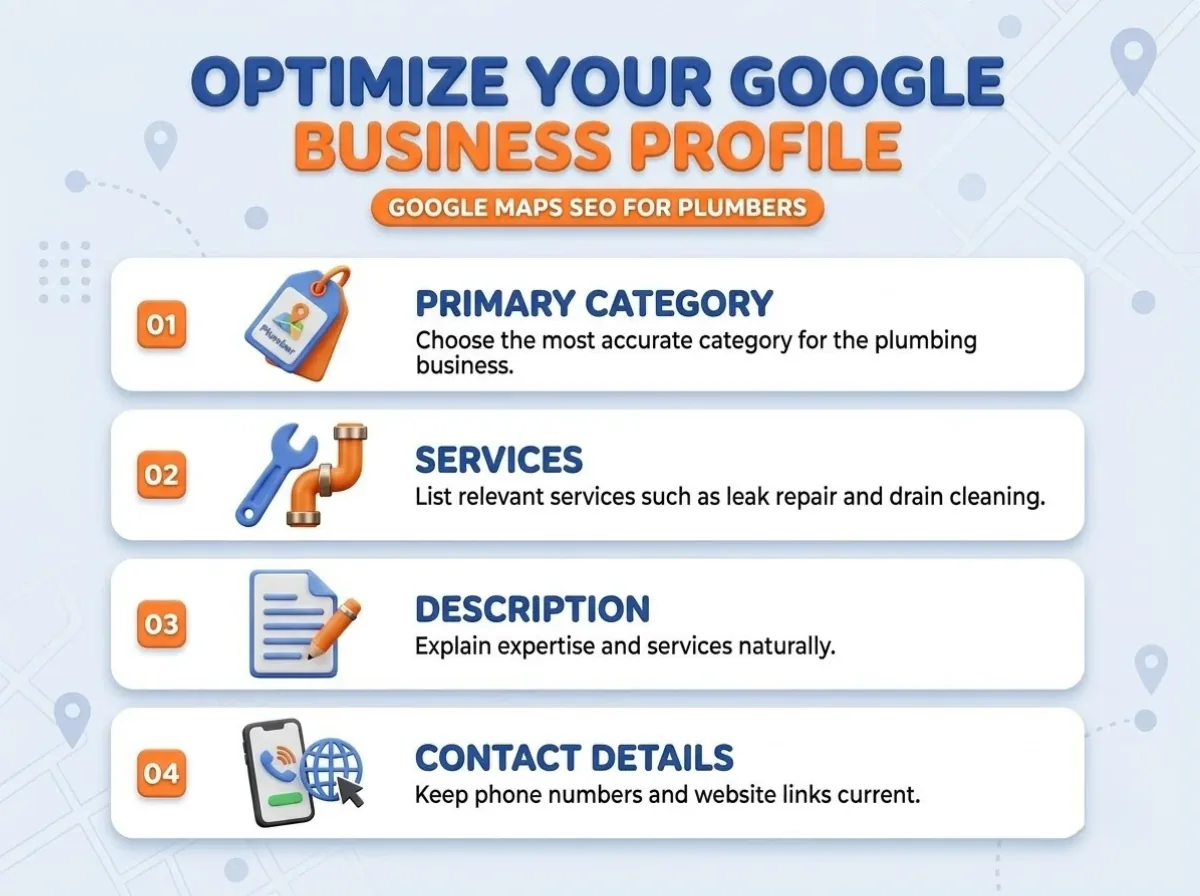
I prioritize services such asemergency plumbing,pipe repair,drain cleaning, andwater heater installationwhen the business actually offers them. I avoid keyword stuffing because clear, accurate information is more useful to customers than repetitive search phrases.
Use Photos, Updates, and Accurate Service Areas
Genuine photos can help customers understand the business and its work before making contact. I recommend uploading relevant images of completed projects, equipment, branded vehicles, and team members where appropriate and with permission.
I also recommend that plumbers:
- Publish useful updates when they have relevant business news or service information.
- Set service areas accurately based on where they genuinely operate.
- Avoid creating fake locations or misleading addresses to influence rankings.
For plumbers who travel to customers rather than serve them at a storefront, the profile should reflect their actual business model and follow Google's eligibility guidelines.
Make It Easy for Customers to Contact You
Finally, I check that customers can take the next step without unnecessary effort. Accurate hours, a working phone number, and a relevant website link make it easier to request an appointment or emergency service.
These improvements support a stronger customer experience and help plumbers make better use of theirGoogle Maps visibility. Although profile optimization cannot guarantee top rankings, it provides a solid foundation for attracting relevant local searches and generating more qualified service inquiries.
Build Customer Reviews and Strengthen Local Reputation
Customer reviews influence how potential customers evaluate a plumbing business before making a call. When people search for aplumber near me, they often compare ratings, read recent feedback, and look for signs of reliable service. I treatonline reputation managementas an important part oflocal SEO for plumbersbecause genuine customer feedback can build trust and support a stronger local presence. Although reviews alone cannot guarantee betterGoogle Maps rankings, a consistent approach to customer satisfaction and feedback can help a business stand out.
Create a Consistent Process for Requesting Reviews
I recommend asking customers for honest feedback after completing a plumbing job. A simple request sent by text message or email makes it convenient for customers to share their experiences without feeling pressured.
To build a reliableGoogle reviews strategy, I focus on these practices:
- Ask customers for feedback after completed services.
- Share a direct link to the business's Google review page.
- Make review requests part of the regular customer follow-up process.
- Encourage honest feedback from all customers, regardless of whether their experience was positive or negative.
- Avoid buying reviews, offering incentives for reviews, or selectively asking only satisfied customers.
For example, after repairing a leaking pipe, a plumber can send a brief follow-up thanking the customer and inviting them to share an honest review. Consistency is more sustainable than trying to collect a large number of reviews in a short period.
Respond to Positive and Negative Reviews Professionally
I also recommend responding to reviews regularly. Thoughtful responses show prospective customers that the business values feedback and takes service quality seriously.
| **Review type** | **Recommended response** |
|---|---|
| Positive feedback | Thank the customer and acknowledge their experience |
| Negative feedback | Respond calmly and offer an appropriate way to discuss the concern privately |
| Specific service feedback | Address the issue professionally without revealing customer information |
| Constructive suggestions | Acknowledge the feedback and consider practical improvements |
When handling negative reviews, I avoid arguments, defensive language, and sharing personal or job-specific details publicly. A professional response can demonstrate accountability, even when the original complaint cannot be fully resolved in a public discussion.
Monitor Review Trends and Customer Feedback
Beyond ratings, I look for recurring themes in customer feedback. Reviews can reveal what customers appreciate and where service delivery needs improvement.
I monitor:
- Review frequency:Whether customers are leaving feedback consistently.
- Customer sentiment:Common comments about punctuality, communication, pricing, and workmanship.
- Average rating:How customer ratings change over time.
- Response activity:Whether the business is addressing feedback promptly.
These insights help me identify service improvements that can strengthen customer relationships and local credibility. Combined with an accurateGoogle Business Profile, relevant service information, and consistentlocal search optimization, a strong review management process helps plumbers build trust and compete more effectively inGoogle Maps searches.
Improve Local Relevance With Website and Citation Optimization
A well-optimized Google Business Profile is important, but I also focus on a plumbing business's website and online listings to strengthen itslocal search visibility. When customers search for aplumber near meor a specific plumbing service, useful website content helps them understand what the business offers and where it operates. A consistent approach tolocal SEO for plumbersconnects the business's profile, website, and directory listings to create a more reliable online presence.
Create Useful Pages for Your Main Plumbing Services
I recommend creating dedicated website pages for the plumbing services that matter most to the business. Instead of describing every service on one general page, I organize information so visitors can quickly find the help they need.
For example, a plumbing website might include pages for:
- Emergency plumbing servicesfor urgent repairs.
- Drain cleaningfor clogged drains and related issues.
- Water heater repair and installationfor residential customers.
- Pipe repair and leak detectionfor common plumbing problems.
Each page should explain the service, answer common customer questions, provide accurate service details, and include a clear way to request assistance. I also use relevantlocal keywordsnaturally in headings, page titles, and descriptions. This supportsGoogle Maps optimizationby helping customers and search engines understand the business's services, although website content alone cannot guarantee better map rankings.
Target Relevant Local Keywords Naturally
I research the phrases customers use when looking for plumbing services in the areas the business genuinely serves. I prioritize search terms that match actual services and customer needs rather than repeating keywords unnecessarily.
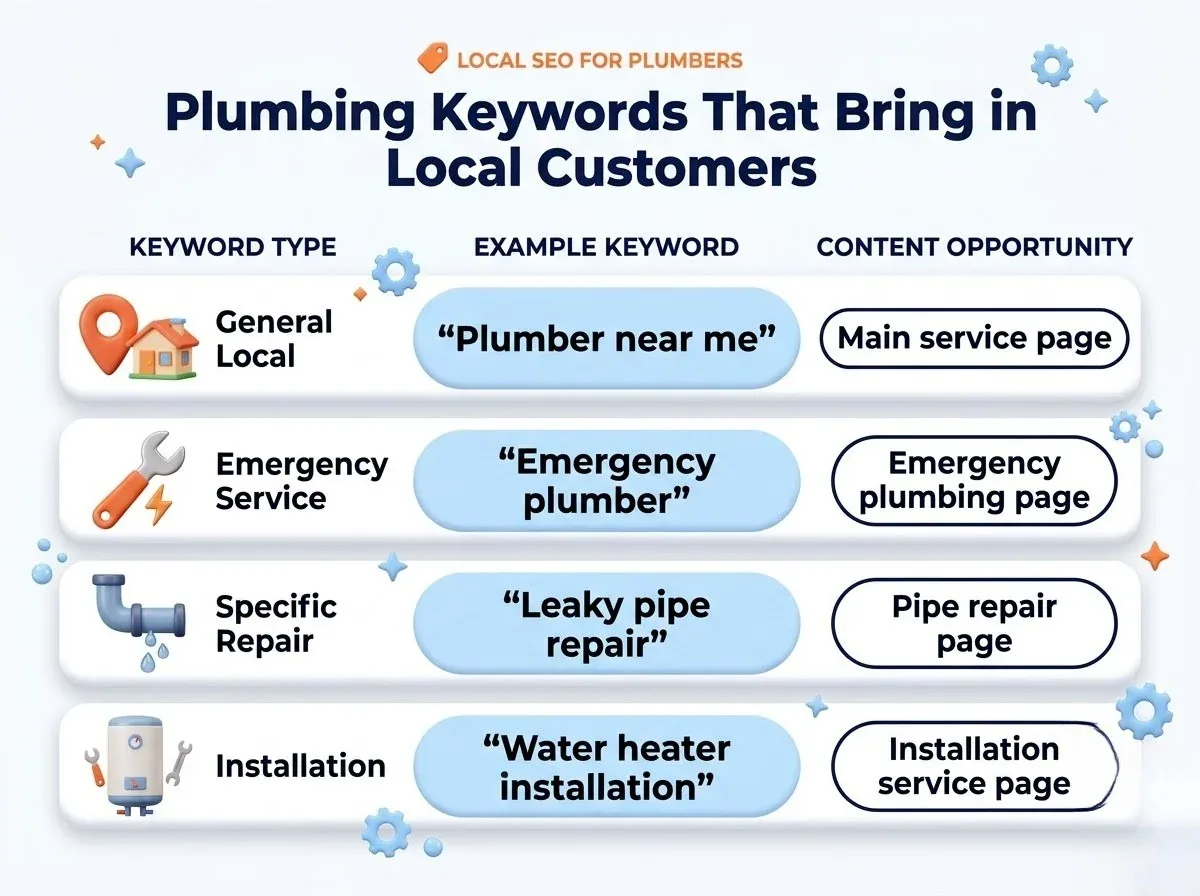
I make sure the content reads naturally and provides useful information instead of forcing every phrase into the same paragraph.
Keep Business Listings and Citations Consistent
I also reviewlocal citations, which are online mentions of a business's details across directories and other websites. Inaccurate information can confuse customers and make it harder for them to contact the right business.
My checklist includes:
- Verify the business name and phone number.
- Keep address information accurate where an address is publicly displayed.
- Correct outdated details on important directories.
- Ensure website contact information matches the business's current details.
Build Local Trust Through Relevant Content and Links
Finally, I recommend publishing helpful plumbing advice, seasonal maintenance tips, and answers to common customer questions. I also look for legitimate opportunities to earn links and mentions from relevant local organizations and community websites.
These efforts strengthenlocal relevance, improve the usefulness of the website, and support a credible online presence. Combined with an optimized profile and genuine reviews, they create a stronger foundation for competing inGoogle Maps searches for plumbers.
Track Google Maps Rankings and Improve Results Over Time
ImprovingGoogle Maps rankingsrequires consistent monitoring and adjustments. I don't rely on a single ranking check to judge whether a plumbing business's local SEO strategy is working. Rankings can vary depending on the searcher's location, competition, and search terms. Instead, I tracklocal search visibility, customer interactions, and website performance to understand where improvements are needed. This approach helps me make informed decisions and focus on activities that support measurable business goals.
Monitor Rankings Across Your Service Area
I recommend tracking how a plumbing business appears across the neighborhoods and communities it actually serves. A plumber may rank well near their primary location but appear less prominently in other areas.
I uselocal rank trackingtools, including geo-grid reports, to compare visibility across different locations. I also monitor relevant searches such asplumber near me,emergency plumber, anddrain cleaning service.
My monitoring process includes:
- Establishing a baseline before making significant changes.
- Checking rankings for priority plumbing services.
- Comparing visibility across relevant locations.
- Reviewing changes over time rather than reacting to daily fluctuations.
This helps me identify areas where a business may need stronger local relevance or more complete service information.
Measure Calls, Website Visits, and Customer Actions
Rankings show where a business appears, but they don't tell the whole story. I also evaluate whether local visibility leads to meaningful customer engagement.
I monitor these key performance indicators to understand how customers interact with a plumbing business:
- Google Maps visibility:Shows how prominently the business appears for relevant local searches.
- Phone calls:Helps me evaluate customer interest in contacting the business.
- Website clicks:Indicates whether searchers want to learn more about available services.
- Direction requests:Can indicate interest in visiting the business location, where applicable.
- Qualified leads:Helps me assess whether visibility is generating potential plumbing jobs.
I compare availableGoogle Business Profile performance metricsover time and consider them alongside website analytics and lead records. This provides a more complete view of local SEO performance.
Use Local SEO Tools to Identify Improvement Opportunities
I uselocal SEO softwareto organize ranking data, review monitoring, business listing checks, and competitor insights. Rather than making changes without evidence, I prioritize issues such as inaccurate listings, declining visibility, or service pages that need improvement.
Build a Repeatable Optimization Routine
I recommend establishing a monthly review process to keepGoogle Maps optimizationon track. My routine includes checking business information, monitoring customer reviews, reviewing local rankings, and evaluating customer actions. I then prioritize the most important improvements and measure their impact over time.
Consistent monitoring helps plumbers adapt to changing competition, strengthen theirlocal SEO strategy, and make better decisions about attracting nearby customers throughGoogle Maps searches.
Conclusion
Winning moreGoogle Maps searchestakes consistent effort, but the right strategy can help plumbers improve local visibility and attract more potential customers. From optimizing yourGoogle Business Profileto collecting genuine customer reviews, creating useful service pages, and maintaining accurate business listings, every step contributes to a stronger online presence. I also recommend trackinglocal SEO performanceregularly to understand which improvements are working and where more attention is needed.
Rather than focusing only on rankings, I look at the bigger picture, including customer calls, website visits, and qualified service inquiries. These insights help plumbers make informed decisions and refine theirlocal SEO strategyover time. Tools likeHappy Rankcan simplifylocal rank tracking, monitor Google Maps visibility, and help identify opportunities to improve performance across service areas.
Start by reviewing your current online presence, identifying the biggest gaps, and addressing them one at a time. With accurate information, a strong reputation, and consistent optimization, your plumbing business can build greater local visibility and connect with more customers searching for reliable plumbing services.
If you run an HVAC business, showing up when local customers search forAC repair near me,furnace installation, oremergency heating servicescan make a real difference to your growth. But having a website alone does not guarantee that people in your service area will find you on Google. You also need a solidlocal SEO strategy for HVAC contractorsto improve yourlocal search rankings, strengthen yourGoogle Maps visibility, and attract customers who are ready to book a service.
The good news is that you do not need to tackle everything at once. With the right approach, you can improve yourGoogle Business Profile optimization, target relevantlocal HVAC keywords, earn genuinecustomer reviews, and make your website more useful to potential clients. Tools like[Happy Rank](/)can also help you monitorHVAC local SEO performanceand track your progress. In this blog, I will explain how to optimize your online presence, build local trust, improve yourHVAC website SEO, and measure the results so you can turn more local searches into valuable service leads.
Optimize Your Google Business Profile for Local Visibility
When I work onlocal SEO for HVAC contractors, I consider the Google Business Profile one of the first places to focus. It helps potential customers discover your business through Google Search and Google Maps when they need AC repair, heating installation, or emergency HVAC services. A well-maintained profile also gives customers essential information before they decide to call or request an estimate.
However, simply creating a profile is not enough. I recommend keeping your business information accurate, highlighting your services, and updating your profile regularly. These steps can strengthen yourHVAC local SEOstrategy and make it easier for nearby customers to understand what your company offers.
Complete Every Important Business Profile Detail
I always recommend reviewing your Google Business Profile to ensure that customers can find the information they need without confusion. Inaccurate or incomplete details can create unnecessary barriers when someone needs urgent heating or cooling assistance.
Focus on these essential details:
- Business name:Use your real business name without adding unnecessary keywords.
- Business category:Choose the most relevant primary category and add appropriate secondary categories when available.
- Phone number and website:Provide a working phone number and link to your official website.
- Business hours:Keep regular hours and holiday schedules accurate.
- Business description:Explain your HVAC services, experience, and service area clearly.
These details supportGoogle Business Profile optimizationand help potential customers make informed decisions.
Add Service Areas, Photos, and HVAC Services
For HVAC companies that travel to customers, I recommend specifying the areas they genuinely serve. If your business operates as a service-area business without a customer-facing storefront, configure the profile accordingly rather than displaying a residential address publicly.
I also suggest listing your core services and adding authentic business photos. This helps customers understand your capabilities before contacting you.
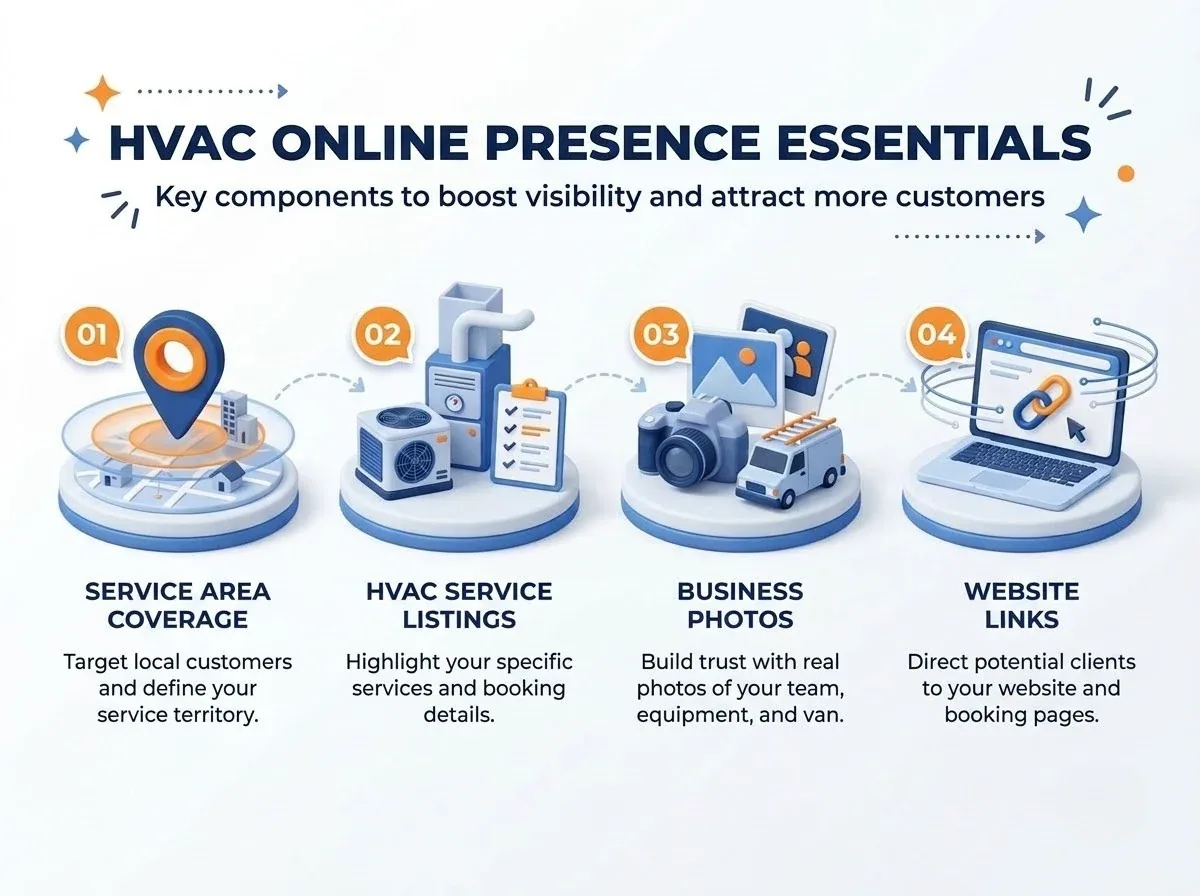
Regularly review your profile details to ensure your service areas, HVAC offerings, and contact information remain accurate and up to date.
Keep Your Profile Active and Updated
I treat profile maintenance as an ongoing part ofHVAC contractor SEO, not a one-time task. Review your information regularly, respond professionally to customer reviews, and share useful updates when appropriate.
I also recommend monitoring available profile performance data to understand how customers discover your business and which actions they take. Although profile activity alone does not guarantee higher rankings, accurate information and a helpful customer experience support a stronger local presence.
By maintaining these details consistently, you can build a more reliable online presence and improve your chances of connecting with customers searching forlocal HVAC services.
Target Local HVAC Keywords and Optimize Your Website
I consider keyword research and website optimization essential parts oflocal SEO for HVAC contractors. When homeowners need an urgent AC repair or a new heating system, they often search for a specific service in their area. Your website should match those searches with relevant content that explains what you offer, where you operate, and how customers can contact you.
I recommend focusing onlocal HVAC keywordsthat reflect actual customer needs rather than trying to rank for broad terms alone. This approach helps you attract relevant visitors and connect your services with people who are more likely to request an estimate or schedule a repair.
Find High-Intent Local HVAC Keywords
I start keyword research by identifying the services customers need and the locations the business serves. I then look for search terms that show clear intent, especially queries related to repairs, installations, and emergency services.
Examples include:
- AC repair near me
- HVAC contractor in Houston
- Emergency furnace repair
- Air conditioning installation in Austin
- HVAC maintenance services
- Heating and cooling companies near me
I usekeyword researchtools, Google Search suggestions, and Google Search Console data to identify relevant opportunities. I also considersearch intent, competition, and service relevance before selecting target keywords.
Create Service Pages for HVAC Solutions
I recommend creating dedicated website pages for your main HVAC services instead of covering every service on one general page. This gives each page a clear purpose and helps visitors find information relevant to their needs.
| **HVAC service** | **Example target keyword** | **Recommended page focus** |
|---|---|---|
| AC repair | AC repair in Houston | Common cooling problems and repair services |
| Heating repair | Furnace repair in Miami | Heating issues and repair options |
| Installation | HVAC installation in Austin | System selection and installation process |
| Maintenance | HVAC maintenance near me | Tune-ups and preventive care |
I include relevant keywords naturally in page titles, headings, body content, and calls to action. Each page should also explain the service, answer common customer questions, and make it easy to request an estimate.
Build Useful Location Pages and Improve On-Page SEO
For businesses serving multiple communities, I recommend creating location pages when each page can provide genuinely useful, location-specific information. Avoid publishing near-identical pages that only replace one city name with another.
I also review theseHVAC website SEOelements:
- Title tags and meta descriptionsthat clearly describe the page.
- H1 and H2 headingsthat organize content around customer needs.
- Internal linksconnecting service pages, location pages, and helpful articles.
- Image alt textthat accurately describes relevant images.
- Mobile usability and page speedto make the website easier to use.
By combining targeted keywords with useful content and sound on-page optimization, I can help an HVAC business build a stronger foundation forlocal search rankingsand attract more relevant service inquiries.
Build Local Trust With Reviews and Business Citations
When I work onlocal SEO for HVAC contractors, I focus on building trust alongside improving search visibility. Homeowners often compare several HVAC companies before choosing one, especially when they need expensive repairs, a new air conditioning system, or emergency heating services. Genuinecustomer reviewsand consistent business information help potential customers evaluate your company and feel more confident about contacting you.
A strong reputation also supports your broaderHVAC local SEO strategyby improving your online credibility and helping customers find accurate business details across the web.
Encourage More Genuine Customer Reviews
I recommend making review requests a regular part of your customer follow-up process. After completing an HVAC repair, installation, or maintenance visit, invite customers to share honest feedback about their experience.
Here are a few practical ways to encourage reviews:
- Ask at the right time:Send a polite review request after the service is completed.
- Make reviewing easy:Share your direct Google review link through email or text.
- Train your team:Encourage technicians to explain how customers can leave feedback without pressuring them.
- Request reviews consistently:Build review collection into your normal customer service workflow.
I advise HVAC businesses to follow Google's review policies. Never buy reviews, offer incentives in exchange for reviews, or selectively ask only satisfied customers to leave feedback. AuthenticGoogle reviews for HVAC companiesprovide more credible social proof than artificially inflated ratings.
Respond to Reviews and Manage Customer Feedback
I consider review responses an important part ofonline reputation management. A professional response shows that your business takes customer experiences seriously and is willing to address concerns.
| **Review type** | **Recommended response** | **Business benefit** |
|---|---|---|
| Positive review | Thank the customer for their feedback | Reinforces customer relationships |
| Negative review | Acknowledge the concern and offer an appropriate next step | Demonstrates accountability |
| Service-related feedback | Identify recurring issues and improve processes | Supports better service quality |
I recommend responding promptly, remaining professional, and avoiding the disclosure of private customer information. I also review feedback for recurring concerns about technician punctuality, repair quality, communication, and pricing.
Keep Local Business Citations Consistent
Accuratelocal business citationshelp customers find reliable information about your HVAC company across relevant online directories. I recommend checking your business name, address, and phone number across trusted platforms and correcting outdated or duplicate listings.
Prioritize these actions:
- Maintain consistentNAP information(name, address, and phone number).
- Update listings on relevant local directories and industry websites.
- Correct old phone numbers, addresses, and business hours.
- Remove or resolve duplicate listings where possible.
Consistent citations do not guarantee higher rankings, but they reduce customer confusion and support a trustworthy online presence. Combined with genuine reviews and responsive customer service, these efforts strengthenHVAC contractor SEOand help potential customers choose your business with greater confidence.
Strengthen Local Authority With Content and Backlinks
I consider helpful content and relevant backlinks important parts oflocal SEO for HVAC contractors. While optimizing your Google Business Profile and website helps customers discover your business, useful information and credible industry connections can strengthen your online presence over time.
I recommend creating content that answers real customer questions and building relationships with reputable local organizations. These efforts can supportHVAC SEO, demonstrate your expertise, and help potential customers feel more confident about choosing your heating and cooling services.
Publish Helpful HVAC Content That Answers Local Questions
I focus on content that solves common problems homeowners face throughout the year. For example, customers may search for help when their air conditioner stops cooling during summer or their furnace struggles to heat their home in winter.
I recommend publishing useful articles on topics such as:
- Seasonal HVAC maintenance:Explain how routine inspections can help identify potential system problems.
- AC troubleshooting:Cover common cooling issues and explain when professional repairs are necessary.
- Heating system maintenance:Share practical advice about furnace inspections and safe operation.
- Energy-efficient HVAC systems:Explain equipment options and factors that influence energy consumption.
- HVAC replacement costs:Discuss the factors that affect installation estimates.
I also incorporate relevantlocal HVAC keywordsnaturally into titles, headings, and content. Where appropriate, I include information about local weather conditions and seasonal service demand. Internal links from these articles to relevant service pages help readers discover the services they need.
Earn Relevant Local Backlinks
Alocal backlinkis a link from another website to your HVAC business website. I prioritize relevant, trustworthy links rather than pursuing large numbers of low-quality links.
Consider these opportunities:
- Build relationships with local builders, property managers, and complementary home service businesses.
- Participate in community events or sponsor relevant local initiatives.
- Contribute useful HVAC advice to local publications or industry websites.
- Join legitimate local business associations that maintain member directories.
| **Backlink opportunity** | **Example** | **Potential value** |
|---|---|---|
| Local partnerships | Builders and property managers | Relevant referral traffic |
| Community involvement | Local event sponsorships | Community awareness |
| Industry publications | HVAC maintenance advice | Demonstrated expertise |
| Business associations | Legitimate member directories | Local relevance |
I avoid buying links intended to manipulate rankings or participating in excessive link exchanges. Relevant backlinks can supportHVAC website SEO, but results depend on overall quality and context.
Demonstrate Experience and Local Expertise
I recommend showing potential customers evidence of your practical experience. Publish authentic project examples, explain the problems your technicians solved, and share customer testimonials with permission.
You can also highlight:
- RelevantHVAC licenses and certifications
- Technician training and professional qualifications
- Real project photos and service case studies
- Clear explanations of your repair and installation process
By combining useful content, credible backlinks, and verifiable expertise, I can help an HVAC business build stronger local authority. These activities complementlocal SEO for HVAC companiesand give customers more reasons to trust your services before making contact.
Measure Local SEO Performance and Improve Results
I believe that successfullocal SEO for HVAC contractorsrequires more than optimizing a website and waiting for rankings to improve. You need to measure performance regularly, understand how customers discover your business, and identify which activities generate meaningful inquiries. Tracking the right metrics helps you make informed decisions instead of relying on assumptions.
I recommend reviewing yourHVAC local SEO performanceconsistently and using the findings to refine your strategy. The goal is not simply to appear higher in search results, but to connect with more local customers who need your heating and cooling services.
Track Local Rankings, Google Maps Visibility, and Website Traffic
I start by monitoring how an HVAC business performs for relevant service and location-based searches. Rankings can vary by search location, so I recommend evaluating visibility across the communities your business serves rather than relying on a single search.
I use tools such as Google Search Console, Google Analytics, and Google Business Profile performance reports to understand search visibility and website engagement.
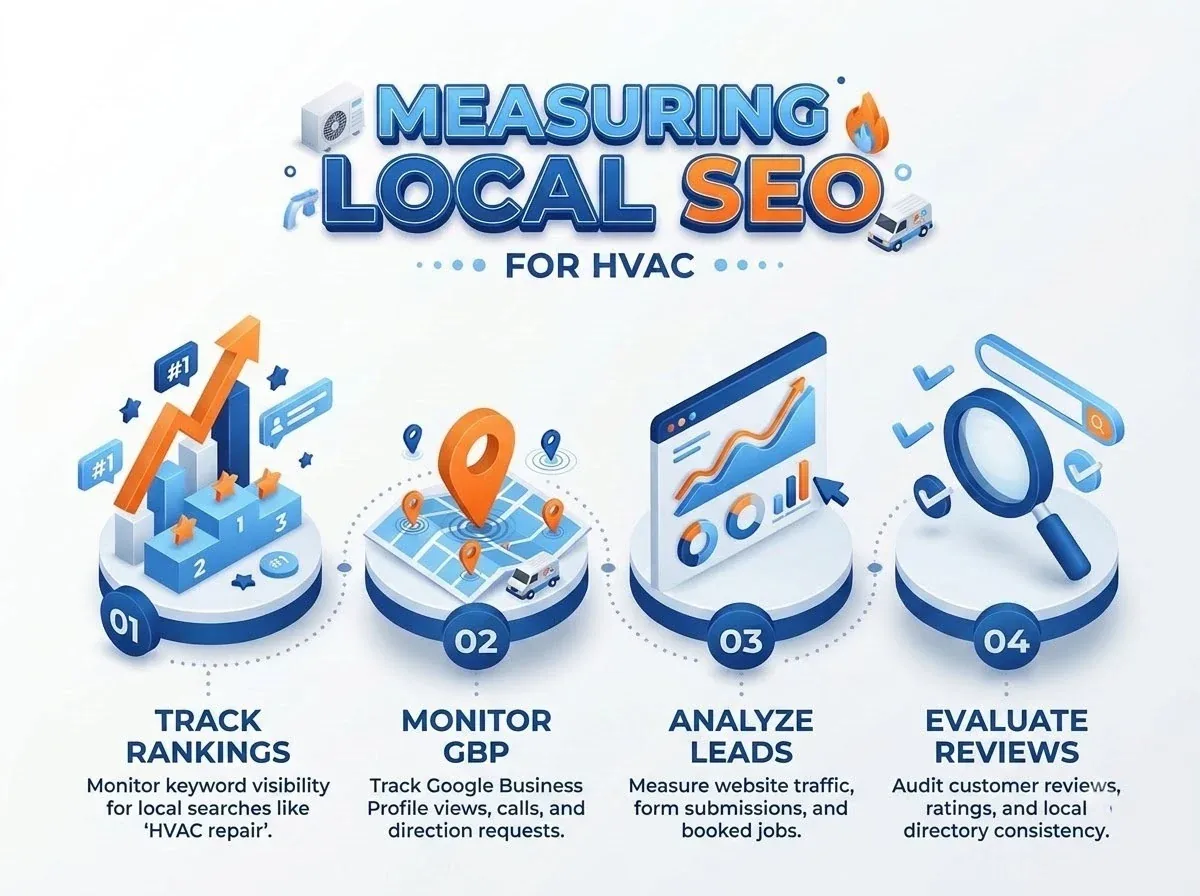
I also monitorHVAC local search rankingsover time to identify patterns and opportunities for improvement.
Measure Leads, Calls, and Customer Actions
Higher rankings are useful, but I place greater emphasis on whether SEO attracts potential customers. I recommend tracking the actions visitors take after discovering your business online.
Important metrics include:
- Phone calls:Measure inquiries from potential customers seeking repairs or installations.
- Contact form submissions:Track requests for estimates and service appointments.
- Conversion rate:Evaluate how effectively website visits turn into inquiries.
- Qualified leads:Identify inquiries that match your services and service areas.
I use analytics and appropriate call-tracking methods to understand which pages and channels contribute to customer inquiries. Accurate tracking helps distinguish website activity from actual business opportunities.
Identify Gaps and Refine Your Strategy
I review performance data regularly to determine what needs attention. If a service page attracts traffic but generates few inquiries, I examine its content, contact options, and relevance to customer intent.
My ongoingHVAC contractor SEOchecklist includes:
- Updating underperforming service pages with useful information.
- Improving internal links between related pages.
- Correcting inaccurate business details and addressing customer feedback.
- Expanding content for relevant services and locations.
- Reviewing lead quality and conversion trends.
I avoid making major changes based on short-term fluctuations alone. By measuring results consistently and prioritizing improvements that support business goals, HVAC contractors can build a more effectivelocal SEO strategyand create better opportunities for sustainable growth.
Conclusion
Ranking higher on Google takes consistent effort, but the rightlocal SEO strategy for HVAC contractorscan help you reach more customers in your service areas. From optimizing your Google Business Profile and targeting relevantlocal HVAC keywordsto earning genuine customer reviews and building local authority, every step contributes to a stronger online presence. I also recommend trackinglocal search rankings, website traffic, phone calls, and qualified leads to understand what is working and where improvements are needed.
You do not have to make every change at once. Start by addressing the most important gaps in your online presence, then review your progress and refine your approach over time. Tools like[Happy Rank](/)can help you monitorlocal search visibility, track rankings across service areas, and identify opportunities to improve your local SEO performance. Ultimately, the goal is not just to appear on Google, but to make it easier for nearby customers to find your HVAC business, trust your services, and contact you when they need professional heating or cooling assistance.
When people want to find a place to eat, they often turn to Google Search or Google Maps and look for options nearby. Searches like “restaurants near me,” “best brunch in my area,” or “family-friendly restaurants” help customers discover places that match their needs. If your restaurant does not appear in these results, you could miss opportunities to attract nearby diners. This is wherelocal search visibilitybecomes important.
Strongrestaurant local SEOhelps your business appear in relevantlocal search results, making it easier for potential customers to find your menu, check opening hours, read reviews, and get directions. An accurateGoogle Business Profile, positive customer experiences, and relevant website content can all support your online presence.
However, appearing in search results is only the first step. You also need to understand how customers discover your restaurant and which improvements can increase engagement. Tools like Happy Rank can help businesses monitorlocal rankings, evaluateGoogle Maps visibility, and identify opportunities to improve their local search performance. With a consistent strategy, restaurants can strengthen their online presence and make it easier for nearby customers to choose them.
How Local Search Visibility Helps Restaurants Get Discovered
When I evaluate a restaurant’s online presence, I start by looking at how easily customers can find it through Google Search and Google Maps.Local search visibility for restaurantsmatters because customers often search for dining options close to their homes, workplaces, or current locations. Appearing in relevantlocal search resultsgives restaurants an opportunity to connect with people who are already looking for a place to eat.
However, visibility depends on more than simply having a website. Restaurants need accurate business information, relevant content, and a well-maintainedGoogle Business Profileto help customers discover and evaluate their options.
How Customers Find Restaurants Through Local Searches
Customers use specific search terms to find restaurants that match their location, budget, cuisine preferences, and dining needs. I recommend understanding these searches before deciding whichlocal SEO keywordsto target.
Common examples include:
- Restaurants near me:Helps customers discover nearby dining options based on their location.
- Best Italian restaurant in Chicago:Connects cuisine preferences with a specific geographic area.
- Family-friendly restaurants nearby:Targets customers looking for a suitable dining experience.
- Late-night food near me:Helps people find restaurants that meet their immediate needs.
Google considers factors such as relevance, distance, and prominence when determining local search results. While a restaurant cannot control every ranking factor, I focus on improving its business information, local relevance, and online reputation to strengthen its chances of appearing for relevant searches.
The Role of Google Business Profile in Restaurant Visibility
A completeGoogle Business Profilehelps customers find essential information directly in Google Search and Maps. I consider it a fundamental part ofrestaurant local SEObecause customers often use these listings to decide whether a restaurant meets their needs.
| **Profile element** | **Why it matters** |
|---|---|
| Business category | Helps Google understand the restaurant's primary offering |
| Address and hours | Helps customers confirm location and availability |
| Menu and website links | Makes it easier to explore food options and prices |
| Photos | Gives customers a visual impression of the food and atmosphere |
| Customer reviews | Helps potential diners evaluate customer experiences |
I recommend reviewing these details regularly, especially when seasonal hours, menus, or contact information change.
Why Accurate Restaurant Information Matters
Inaccurate information can create unnecessary friction. A customer who finds incorrect opening hours or an outdated menu may choose another restaurant instead.
To maintain reliablelocal business listings, I prioritize these actions:
- Keep the restaurant's name, address, phone number, and hours accurate.
- Update menus, reservation links, and dining options when changes occur.
- Check important online directories for outdated or inconsistent information.
- Monitor customer feedback and correct recurring information gaps.
By maintaining accurate details and relevant online content, restaurants can improve the customer discovery experience and build a stronger foundation forlocal search visibility.
How Local Visibility Influences Restaurant Traffic and Revenue
Stronglocal search visibility for restaurantscan help businesses connect with nearby customers who are actively deciding where to eat. When I evaluate a restaurant'slocal SEO strategy, I look beyond search rankings and consider how online discovery can lead to meaningful customer actions, including website visits, phone calls, reservations, and walk-in traffic. Although higher visibility does not guarantee increased revenue, it creates more opportunities to attract potential diners.
Turning Online Searches Into Restaurant Visits
I focus on the connection betweenlocal search rankingsand customer behavior. When a restaurant appears in relevant Google Search or Google Maps results, customers can quickly review its location, menu, operating hours, and ratings before deciding whether to visit.
Several customer actions can indicate that local visibility is generating interest:
- Direction requests:Show that customers may be considering an in-person visit.
- Phone calls:Help customers ask about availability, menu options, or reservations.
- Website visits:Allow potential diners to explore menus, pricing, and dining experiences.
- Reservation activity:Helps restaurants understand whether online discovery leads to bookings.
I recommend tracking these actions alongside search performance to understand whetherrestaurant local SEOis supporting business objectives.
Reaching Customers at the Right Moment
One advantage oflocal search optimizationis the opportunity to reach customers when they have a specific dining need. Someone searching for a nearby lunch spot may have different expectations from someone planning a special dinner.
I recommend targeting relevantlocal SEO keywordsthat reflect the restaurant's actual offerings, location, and customer intent. For example:
- Cuisine-based keywords:Such as “Mexican restaurant in Austin.”
- Meal-based keywords:Such as “weekend brunch near downtown.”
- Service-based keywords:Such as “takeout restaurant near me.”
- Experience-based keywords:Such as “outdoor dining in Denver.”
I also ensure that relevant website pages provide useful information matching these searches. This helps customers find suitable options without relying on broad, unrelated keywords.
Building Awareness in the Local Community
Consistentlocal search visibilitycan help restaurants reach nearby residents, office workers, tourists, and visitors who may not know the business exists. I recommend combining an accurateGoogle Business Profile, useful website content, and genuine customer reviews to strengthen local discovery.
Restaurants can also build awareness by participating in community events, sharing relevant local updates, and maintaining accurate listings on reputable directories.
Understanding the Limits of Local Search Visibility
I treat visibility as one part of restaurant growth, not a guarantee of sales. Food quality, pricing, service, competition, and customer experience all influence whether someone chooses to visit.
By measuring these indicators together, I can identify whichlocal SEO effortsdeserve further attention and where improvements may help convert online discovery into real customer visits.
How Reviews and Restaurant Information Shape Local Visibility
When I assesslocal search visibility for restaurants, I pay close attention to customer reviews and the quality of business information available online. These elements help potential diners evaluate a restaurant before visiting. Accurate details, useful photos, and genuine customer feedback can strengthen trust and support a restaurant'slocal SEO strategy. Although reviews and profile updates do not guarantee higher rankings, they can influence how customers perceive a business and whether they choose to visit.
Why Online Reviews Matter for Restaurant Discovery
I consideronline restaurant reviewsan important part of local search performance because customers often compare ratings and feedback before choosing where to eat. Reviews provide insights into food quality, service, cleanliness, atmosphere, and overall customer satisfaction.
To encourage meaningful feedback, I recommend that restaurants:
- Ask customers to share honest reviews after their dining experience.
- Make it easy for customers to find the restaurant's review page.
- Avoid buying reviews or offering prohibited incentives for positive feedback.
- Monitor recurring comments to identify opportunities to improve service.
Consistent attention tocustomer reviewscan help restaurants understand customer expectations and strengthen their online reputation. A steady flow of genuine feedback also gives potential diners more information when comparing local options.
Responding to Positive and Negative Reviews
I recommend responding to reviews professionally and consistently. Thoughtful responses demonstrate that a restaurant values customer feedback and takes service quality seriously.
For positive reviews, a brief and personalized thank-you can help maintain a positive relationship. For negative reviews, I suggest acknowledging the concern, responding respectfully, and offering an appropriate way to resolve the issue.
When managingrestaurant reputation online, I focus on three priorities:
- Respond promptly without becoming defensive.
- Address specific concerns rather than relying on generic replies.
- Use recurring feedback to identify operational improvements.
These practices can improve customer confidence and contribute to a better dining experience.
Using Restaurant Photos, Menus, and Business Details
Accurate information helps customers make informed decisions. I recommend maintaining a completeGoogle Business Profilewith current menus, operating hours, contact details, and high-quality photos.
| **Information** | **Benefit for customers** |
|---|---|
| Food photography | Shows menu items and presentation |
| Interior photos | Helps customers understand the dining atmosphere |
| Updated menu | Clarifies available dishes and prices |
| Operating hours | Helps customers plan their visit |
| Reservation links | Makes booking more convenient |
Maintaining Consistent Local Business Listings
I also checklocal business citationsacross relevant directories and restaurant platforms. The restaurant's name, address, and phone number should remain accurate and consistent wherever customers find them.
Outdated listings can create confusion and reduce customer confidence. By reviewing directory information, correcting errors, and updating business details regularly, restaurants can strengthen theirlocal search visibilityand provide a more reliable discovery experience.
How Restaurants Can Improve Local Search Visibility
Improvinglocal search visibilityfor restaurants requires a consistent approach to business listings, website content, keyword targeting, and performance tracking. When I develop arestaurant local SEO strategy, I prioritize actions that help search engines understand the business and make it easier for potential customers to find relevant information. Rather than focusing on rankings alone, I aim to build a reliable online presence that supports customer discovery and restaurant growth.
Optimize the Google Business Profile
I start withGoogle Business Profile optimizationbecause the profile helps customers discover essential restaurant information through Google Search and Maps. I recommend completing all relevant fields and reviewing them regularly.
Key actions include:
- Choose accurate primary and secondary business categories.
- Update opening hours, contact details, and location information.
- Add current menus, quality food photos, and reservation links where available.
- Keep holiday hours and temporary closures updated.
- Monitor and respond to customer reviews professionally.
A complete profile gives potential diners useful information when comparing local dining options.
Target Relevant Local SEO Keywords
I researchlocal SEO keywords for restaurantsbased on cuisine, location, dining preferences, and customer intent. The goal is to match website content with the searches potential customers actually make.
For example, a restaurant might target phrases such as“sushi restaurant in Seattle,” “brunch near downtown,”or“family-friendly Italian restaurant.”
I recommend using relevant keywords naturally in page titles, headings, menu pages, and location-specific content. Avoiding keyword stuffing helps maintain readable, useful content for customers.
Improve the Restaurant Website for Local Searches
A restaurant website should make essential information easy to find, especially on mobile devices. I focus onrestaurant website SEOimprovements that reduce friction and support customer decisions.
- Create clear menu and location pages.
- Display the restaurant's address, phone number, and hours prominently.
- Provide working reservation and online ordering links where applicable.
- Improve mobile usability and page-loading speed.
- Use relevantlocal business schema markupwhen appropriate to help search engines interpret business information.
Strengthen Local Citations and Community Relevance
I recommend maintaining accuratelocal business citationson relevant directories, restaurant platforms, and community websites. Consistent business details help customers find reliable information across different sources.
Restaurants can also build local relevance by participating in community events, collaborating with nearby businesses, and publishing useful content about genuine local activities.
Monitor Local Rankings and Customer Actions
I use performance data to identify whichlocal SEO effortsneed improvement. Tracking several metrics provides a more complete picture than rankings alone.
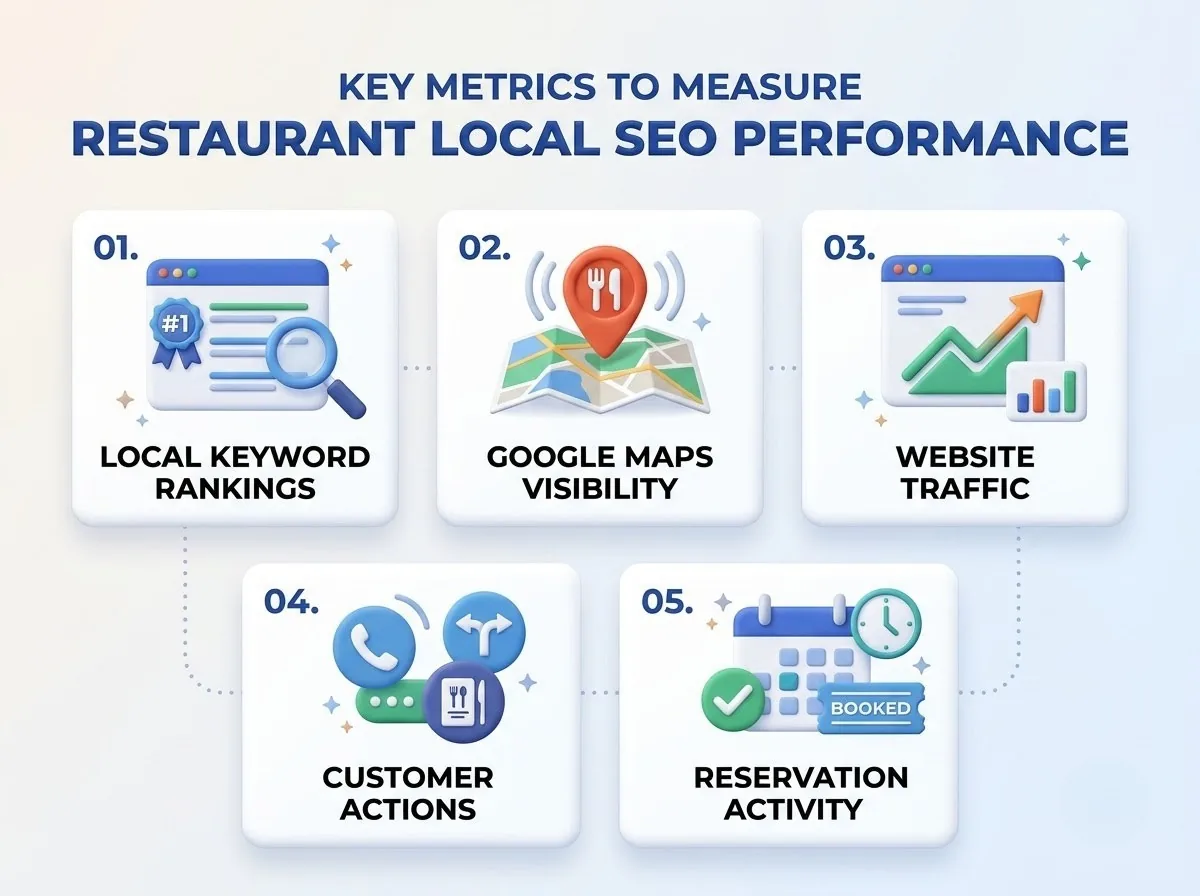
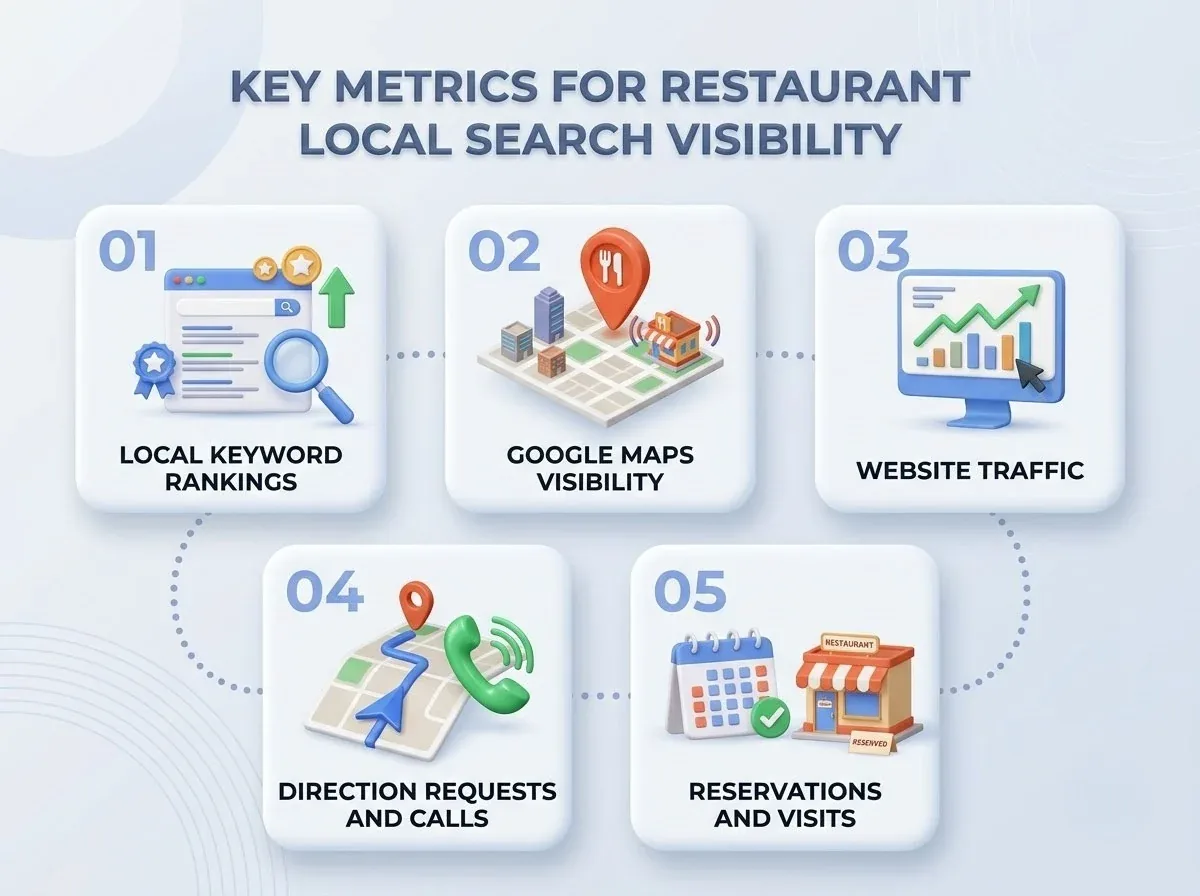
Tracking these metrics regularly helps restaurants identify local SEO opportunities, understand customer behavior, and improve their overall local search visibility.
How Restaurants Can Measure and Maintain Local Search Visibility
Maintaininglocal search visibility for restaurantsrequires regular monitoring, consistent updates, and informed decisions. I recommend treatingrestaurant local SEOas an ongoing process rather than a one-time task. Search rankings, customer behavior, and local competition can change over time, so restaurants need to evaluate their performance and identify areas for improvement. By tracking relevant metrics, restaurant owners can understand how customers discover their business and which optimization efforts deserve more attention.
Track the Metrics That Matter
I focus on metrics that connectlocal search performancewith customer interest and business goals. Rankings help measure visibility, while customer actions provide additional insight into whether people are engaging with the restaurant online.
The following metrics help me evaluate performance:
- Local keyword rankings:Show how a restaurant performs for relevant location-based searches.
- Google Maps visibility:Helps assess how easily customers can discover the restaurant through map results.
- Organic website traffic:Reveals visits generated through unpaid search results.
- Customer actions:Include calls, direction requests, and menu views where tracking is available.
- Reservation activity:Helps measure booking interest when reliable tracking data is available.
I use tools such as Google Search Console, Google Business Profile performance data, and local SEO platforms like Happy Rank to monitor relevant indicators. Reviewing these metrics together provides a more useful picture than relying on a single ranking position.
Identify Local SEO Opportunities and Gaps
When I reviewlocal SEO performance, I look for issues that may prevent a restaurant from reaching its intended audience. A restaurant might rank well for its brand name but remain less visible for important cuisine-related or location-based searches.
I recommend checking for the following opportunities:
- Keyword gaps:Identify relevant restaurant searches where visibility could improve.
- Incomplete business information:Correct missing or outdated profile details.
- Weak website content:Improve pages that do not adequately address customer needs.
- Competitive differences:Review competitors' categories, content, reviews, and available business information.
These checks help prioritize improvements based on relevance and potential customer value.
Maintain a Consistent Optimization Routine
I recommend establishing a regular schedule for maintainingrestaurant online visibility. Small, consistent improvements can help prevent outdated information and reveal changing customer needs.
To maintain a reliablelocal SEO strategy, I recommend these recurring tasks:
- Weekly:Monitor new reviews and respond to customer feedback.
- Monthly:Review search performance, website traffic, and customer actions.
- Quarterly:Evaluate keyword opportunities and competitor visibility.
- As needed:Update menus, business hours, photos, and contact information.
I also recommend documenting significant changes so their effects can be evaluated over time. By combining regular monitoring with accurate business information and useful website content, restaurants can strengthen theirlocal search visibilityand make better decisions about their long-termlocal SEO strategy.
Conclusion: Make Local Search Visibility Work for Your Restaurant
Stronglocal search visibility for restaurantshelps potential customers discover dining options, compare menus, read reviews, and decide where to eat. By maintaining an accurateGoogle Business Profile, targeting relevantlocal SEO keywords, encouraging genuine customer reviews, and improving website content, restaurant owners can build a stronger online presence and reach more nearby diners.
I recommend treatingrestaurant local SEOas an ongoing process. Regularly monitoringlocal rankings,Google Maps visibility, website traffic, and customer actions helps identify opportunities to improve performance. Tools like Happy Rank can support this process by helping restaurants track local search performance and understand where further optimization may be needed.
Ultimately, visibility is only one part of restaurant growth. Accurate information, quality food, excellent service, and a positive dining experience help turn online discovery into lasting customer relationships. By combining consistent local SEO efforts with a customer-focused approach, restaurants can improve their chances of attracting new diners and encouraging repeat visits.
Frequently asked questions
How can plumbers rank #1 on Google Maps?
Optimize your Google Business Profile with 'Plumber' as the primary category, define specific service areas, add all plumbing repair and installation services, earn consistent positive customer reviews, and build location-specific service pages.
What are Google's top ranking factors for plumbing searches?
Google ranks plumbers based on relevance (profile accuracy, services listed), distance (proximity to the homeowner in need), and prominence (review volume, customer ratings, citations, and local backlinks).
Should plumbers list 24/7 emergency hours on Google Maps?
Only if your business genuinely answers calls and dispatches plumbers around the clock. Setting 24/7 hours when unavailable frustrates customers and leads to negative reviews.
How do customer reviews impact plumber Google Maps rankings?
Reviews provide trust and keyword relevance. Reviews that mention specific services like 'water heater repair' or 'emergency leak fix' help your profile rank for those specific long-tail queries.
How can I track my plumbing company's Google Maps ranking across town?
Use geo-grid tracking with Happy Rank to visualize your local pack rank at GPS points across all served zip codes and neighborhoods, uncovering ranking gaps where competitors dominate.