
How Local SEO Software Helps Businesses Win More Local Customers
Local SEO software helps businesses win more local customers by tracking geo-grid rankings across neighborhoods, monitoring competitors, managing Google Business Profile information, streamlining review responses, and connecting visibility to calls, website visits, and direction requests for smarter optimization decisions every day.
Ever wondered why your business can show up in local search one day and disappear from the map the next? Or why a competitor keeps appearing in front of customers searching in nearby neighborhoods? Local SEO is highly location-dependent, which makes tracking and improving your visibility more complicated than simply checking where you rank for a keyword.
That is where local SEO software can make a real difference. Instead of manually monitoring local rankings, Google Maps, Google Business Profile, competitors, reviews, and customer actions, you can bring these activities into one organized workflow. In this guide, we will look at how local SEO software helps businesses uncover local visibility gaps, monitor local competitors, improve their Google Business Profile, manage reviews, track geo-grid rankings, and connect search visibility with actions such as calls, website visits, and direction requests.
We will also look at what to consider when choosing a platform and how tools like Happy Rank can help turn local search data into practical optimization decisions. By the end, you will have a clearer idea of how to use local SEO software not just to track rankings, but to create more opportunities to win local customers.
What Is Local SEO Software and Why Do Businesses Need It?
When I work through a local SEO strategy, one thing becomes clear pretty quickly: the difficult part is rarely finding one ranking position. The real challenge is understanding the bigger picture. A business may rank well in one neighborhood, struggle in another, have strong reviews but weak profile engagement, or see competitors appear ahead for important searches.
That is where local SEO software becomes useful. Instead of checking every signal separately, businesses can use one platform to monitor local search rankings, Google Maps, competitors, reviews, and customer activity. The result is a much clearer view of what is happening across their local market.
What Does Local SEO Software Actually Do?
At its simplest, local SEO software brings multiple local optimization tasks into one workflow. Depending on the platform, it can help businesses monitor and manage areas such as:
- Local rank tracking for important keywords and locations
- Geo-grid tracking to understand rankings across different geographic points
- Google Business Profile monitoring and management
- Local competitor tracking to see which businesses are gaining visibility
- Review management for monitoring and responding to customer feedback
- Local SEO analytics to measure visibility and customer actions
- Reporting that makes ranking and performance changes easier to understand
I find this especially useful when working with businesses that serve several neighborhoods or operate multiple locations. Instead of jumping between spreadsheets, Google searches, review platforms, and analytics reports, the important information can be brought together in one place.
Why Manual Local SEO Management Becomes Difficult
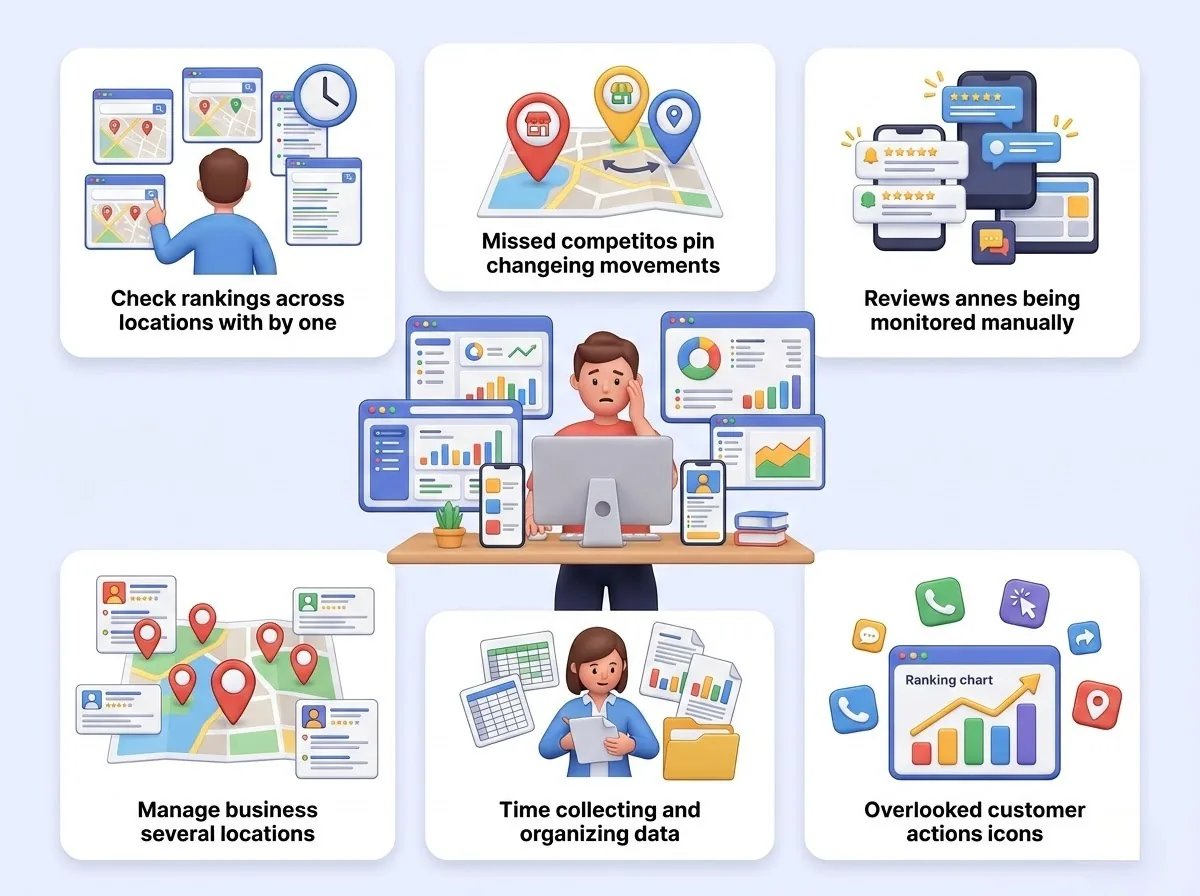
Manual tracking can work when you are monitoring a very small business with only a handful of keywords. But as the campaign grows, the process quickly becomes time-consuming.
For example, manually checking Google Maps rankings can give you a useful snapshot, but it does not necessarily show how your business performs across an entire service area. The same business can have different visibility depending on where the searcher is located.
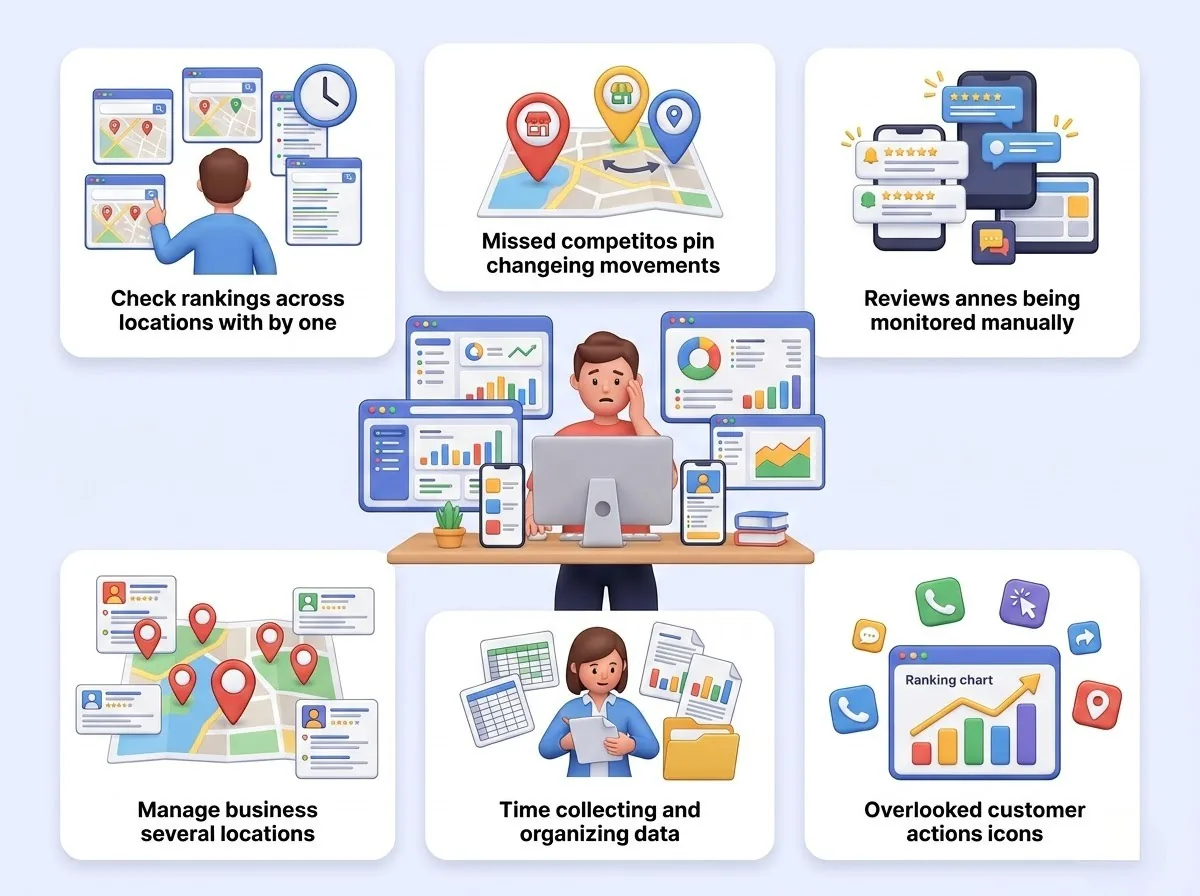
Here are some common challenges with a manual approach:
- Single-location checks hide how visibility changes across neighborhoods and service areas
- Manual Maps and review checks become time-consuming as keywords and locations grow
- Scattered spreadsheets and screenshots make trends and competitor shifts hard to spot
- Seeing your business from your own office creates a false sense of confidence about citywide visibility
I have also found that manual checks can create a false sense of confidence. Seeing your business in the Local Pack from your own office does not mean every nearby customer sees the same result.
From Ranking Data to Customer Opportunities
The real value of local SEO software is not simply collecting more data. It is making that data useful.
A good platform should help answer practical questions:
- Where is my business visible?
- Which neighborhoods need attention?
- Which local competitors are outranking me?
- Which keywords are improving or declining?
- Are customers calling, visiting my website, or requesting directions?
- Which local SEO activities deserve attention next?
That shift matters because local SEO is ultimately about more than rankings. It is about building local visibility that creates opportunities for real customer interactions.
Once businesses can see where those opportunities exist, they can make more informed optimization decisions instead of relying on occasional manual searches.
How Local SEO Software Improves Local Search Visibility
When I look at local SEO performance, I never rely on a single ranking position. A business might appear prominently when someone searches from its storefront but rank much lower a few miles away. That is why understanding local search visibility requires more than typing a keyword into Google and checking the result.
With the right local SEO software, businesses can see how their visibility changes across locations, identify weak areas, and monitor whether their optimization efforts are actually making a difference.
See Rankings Across Different Geographic Areas
One of the biggest advantages of local rank tracking is that it shows how rankings can vary depending on the searcher's location. This matters particularly for businesses serving multiple neighborhoods or a wider service area.
For example, I might find a business ranking in the Local Pack when searching close to its address, but that same business may have much weaker visibility several neighborhoods away. A single ranking check would hide that difference.
This is where geo-grid rank tracking becomes useful. Instead of checking one location, a geo-grid can measure rankings across multiple points and help businesses visualize their Google Maps rankings.
Businesses can use this information to understand:
- Where they have strong local visibility
- Which neighborhoods have weaker rankings
- How far their visibility extends
- Where competitors appear more prominently
- Whether rankings are improving across the service area
That geographic context makes ranking data much more actionable.
Find Local Ranking Gaps
Once you can see rankings across different locations, the next question is simple: Where are the opportunities?
I like to think of these as local ranking gaps. They are areas where a business could potentially improve its visibility but currently has limited presence.
A software platform can help uncover gaps such as:
| Ranking Gap | What It May Tell You |
|---|---|
| Strong rankings near the business, weak rankings farther away | Geographic visibility may be limited |
| One service ranks well, another does not | Certain service keywords need attention |
| Competitor consistently outranks you | There may be a competitive gap |
| Rankings decline across several locations | Recent optimization or market changes may need investigation |
The important point is not to treat every low ranking as a problem that needs immediate fixing. Instead, I use these insights to determine which gaps are most relevant to the business and its customers.
Track Ranking Changes Over Time
Local SEO is not a one-time project. Rankings can change as competitors optimize their profiles, customer reviews change, search behavior shifts, or Google updates its local search systems.
That makes local SEO analytics and historical tracking particularly valuable.
Rather than asking, Where do we rank today? I prefer asking:
- Are our local rankings improving?
- Which locations are gaining visibility?
- Where have we lost ground?
- Did a recent optimization lead to measurable improvement?
- Are competitors moving ahead?
Historical data helps put individual ranking changes into context. A small daily fluctuation may not matter, but a consistent decline across several locations deserves attention.
Ultimately, better local search visibility comes from knowing where you stand and where improvement is possible. With that information in hand, businesses can move from simply monitoring rankings to making smarter local SEO decisions.
How Local SEO Software Helps Businesses Understand Competitors and Customers
Ranking higher is useful, but I never look at rankings in isolation. When reviewing a local SEO campaign, I also want to know who is winning local searches, where competitors are stronger, and what customers do after they discover a business. That combination gives a much more realistic picture of local search performance.
This is where local SEO software can turn scattered information into competitive and customer insights that businesses can actually use.
Identify the Competitors Winning Local Searches
Your competitors are not necessarily the businesses you consider competitors offline. In local search, the businesses appearing above you for important keywords are the ones competing for that customer's attention.
With local competitor tracking, businesses can identify:
- Which competitors consistently appear in the Local Pack
- Which businesses outrank them for important keywords
- Where competitors have stronger Google Maps visibility
- Which geographic areas competitors dominate
- How competitive positions change over time
I have found this particularly useful when a business assumes it has one main competitor, only to discover that different neighborhoods have completely different search competitors.
| Competitive Insight | Why It Matters |
|---|---|
| Competitor ranks above you | Shows where visibility is being lost |
| Competitor appears across more locations | Indicates broader geographic reach |
| Competitor gains rankings over time | Signals changing market competition |
| Competitor dominates specific keywords | Reveals potential content or service gaps |
The goal is not to copy competitors. Instead, their performance can help you identify local SEO opportunities that might otherwise remain hidden.
Understand What Customers Do After Finding Your Business
Getting visibility is only the first step. The more important question is what happens next.
A customer might find your Google Business Profile, visit your website, call your business, or request directions. These actions tell you much more about the commercial value of your local visibility.
When reviewing performance, I like to look beyond ranking positions and consider signals such as:
- Phone calls
- Website clicks
- Direction requests
- Profile interactions
- Lead activity
- Customer engagement
For example, if rankings improve significantly but customer actions remain flat, I would not automatically consider the campaign a success. It may be worth reviewing the profile information, services, reviews, offers, or website experience.
Turn Local Search Data Into Better Decisions
This is where the different data points start working together.
Instead of treating each metric separately, businesses can use local SEO analytics to identify patterns and prioritize their next actions.
| What You See | Possible Next Action |
|---|---|
| Low rankings in a valuable neighborhood | Investigate local visibility opportunities |
| Strong rankings but few website clicks | Review profile messaging and website experience |
| Strong visibility and increasing calls | Identify what is driving customer interest |
| Competitor dominates a service keyword | Analyze the competitive gap |
| Rankings improve across multiple locations | Continue and scale successful optimization |
I have always found that the best local SEO decisions come from asking, What does this data tell me to do next? rather than simply collecting another report.
When competitor intelligence and customer behavior are viewed alongside local rankings, businesses can make more informed decisions and focus their resources where they have the greatest potential impact. That turns local SEO software from a tracking tool into a practical decision-making system.
How Local SEO Software Helps Manage Your Google Business Presence
When I review a business's local search visibility, I often start with its Google Business Profile because it is one of the first places potential customers interact with a business. A profile with outdated information, unanswered reviews, or neglected content can create friction even when the business has strong local rankings.
This is where local SEO software can make everyday Google Business Profile management easier. Instead of treating profile optimization as an occasional task, businesses can manage important local signals more consistently.
Keep Your Google Business Profile Information Accurate
Customers need reliable information when they find a business through Google Maps or local search. If important details are incorrect or outdated, a potential customer may simply move on to another option.
Depending on the business and its locations, important profile information can include:
- Business name and contact information
- Address and service areas
- Business categories
- Services offered
- Opening hours
- Website information
- Multiple business locations
I have seen how small inconsistencies can create unnecessary confusion. If a customer searches for a service and finds outdated hours or incomplete information, even a strong ranking may not translate into a visit or call.
For businesses managing several locations, centralized local SEO management can also reduce repetitive work and make it easier to maintain consistent information.
Manage Reviews More Efficiently
Reviews influence how customers evaluate a business before deciding whether to call, visit, or request more information. They also provide valuable feedback about what customers appreciate or where they experience problems.
Instead of checking reviews manually across different locations, businesses can use review management tools to monitor activity and organize responses.
A useful review workflow can help businesses:
- Monitor new customer reviews
- Identify reviews that need a response
- Respond consistently and professionally
- Reduce delays in replying
- Spot recurring customer feedback
- Understand common customer concerns
I particularly like using customer feedback as more than a reputation metric. If several customers mention the same service, staff experience, or recurring issue, that feedback can highlight an operational or marketing opportunity.
Keep Local Profiles Active With Posts and Q&A
A complete Google Business Profile is not just about basic business information. Businesses can also use features such as Google Posts and Q&A to provide useful information to potential customers.
Depending on the business, this might include:
- New service announcements
- Offers and promotions
- Seasonal updates
- Helpful customer information
- Frequently asked questions
- Important business announcements
The key is relevance. I would rather see a business publish fewer useful updates than fill its profile with repetitive content that offers little value.
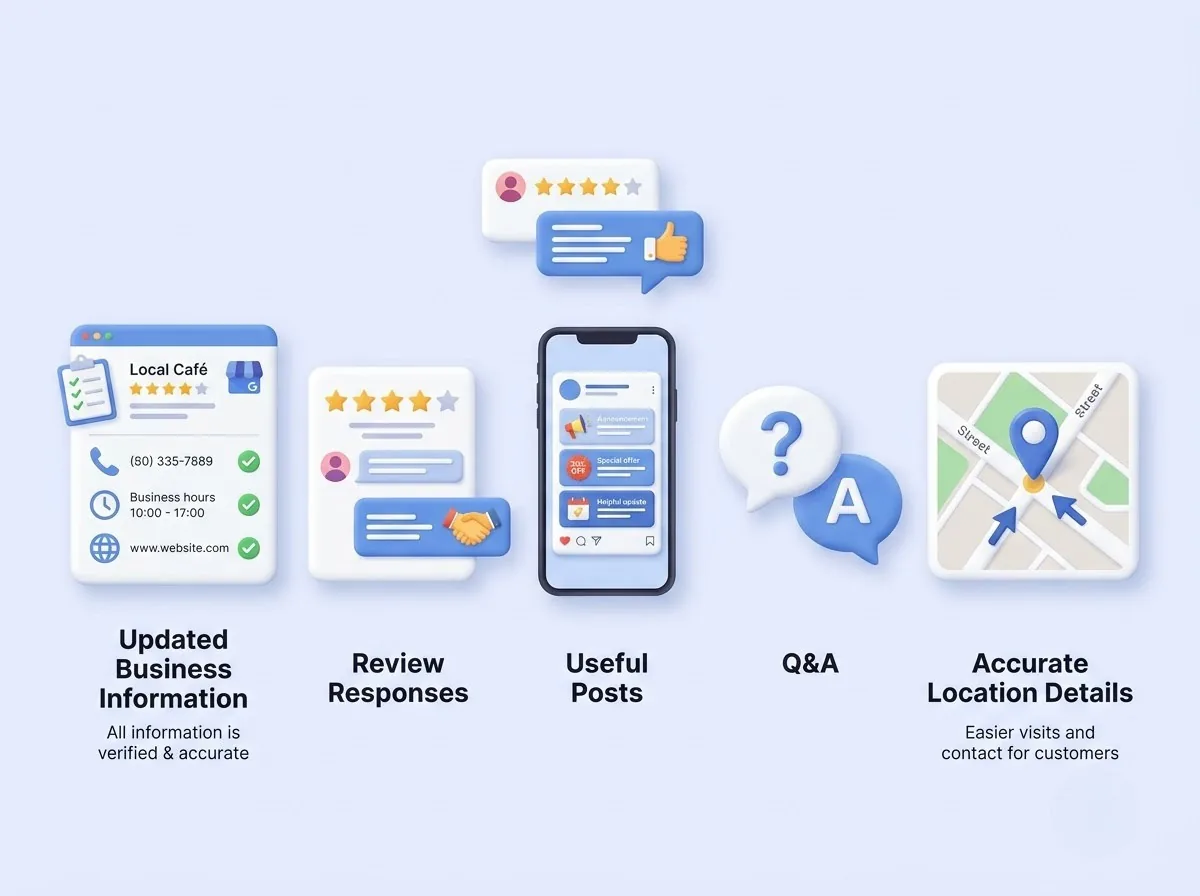
Ultimately, effective Google Business Profile management is about reducing friction for customers. When businesses combine accurate information, active review management, and useful profile content with their local SEO strategy, they create a stronger experience for people who discover them through local search.
What to Look for in Local SEO Software
Choosing local SEO software can feel overwhelming because many platforms promise better rankings, more visibility, and easier reporting. In my experience, though, the best choice is not necessarily the platform with the longest feature list. It is the one that helps you understand what is happening in local search and, more importantly, what you should do next.
Before choosing a platform, I recommend looking at a few capabilities that directly support local search visibility, optimization, and customer growth.
Accurate Local Rank and Geo-Grid Tracking
Start with local rank tracking that reflects how customers actually search from different locations. A single ranking position rarely tells the full story, especially for businesses serving multiple neighborhoods.
Look for features such as:
- Geo-grid rank tracking
- Google Maps ranking data
- Local Pack monitoring
- Multiple keyword tracking
- Geographic visibility reports
- Historical ranking data
I find geo-grid tracking particularly valuable because it can reveal areas where a business performs well and locations where competitors have stronger visibility.
Google Business Profile Management
Your software should also make Google Business Profile management easier. If you are managing several locations, switching between profiles and manually checking each one can quickly become inefficient.
Look for tools that help you monitor or manage:
- Business information
- Multiple locations
- Profile activity
- Google Posts
- Q&A
- Customer reviews
The goal is not simply convenience. Keeping local business information accurate helps create a smoother experience for customers who discover you through Google Maps or local search.
Competitor and Review Monitoring
I also recommend looking for software that combines local competitor tracking with review management. These two areas can reveal important information about your position in the market.
Competitor monitoring can help answer:
- Who is ranking above us?
- Where are they more visible?
- Which locations are competitive?
- Are their rankings changing?
Meanwhile, review monitoring can help businesses stay aware of customer feedback and respond more consistently.
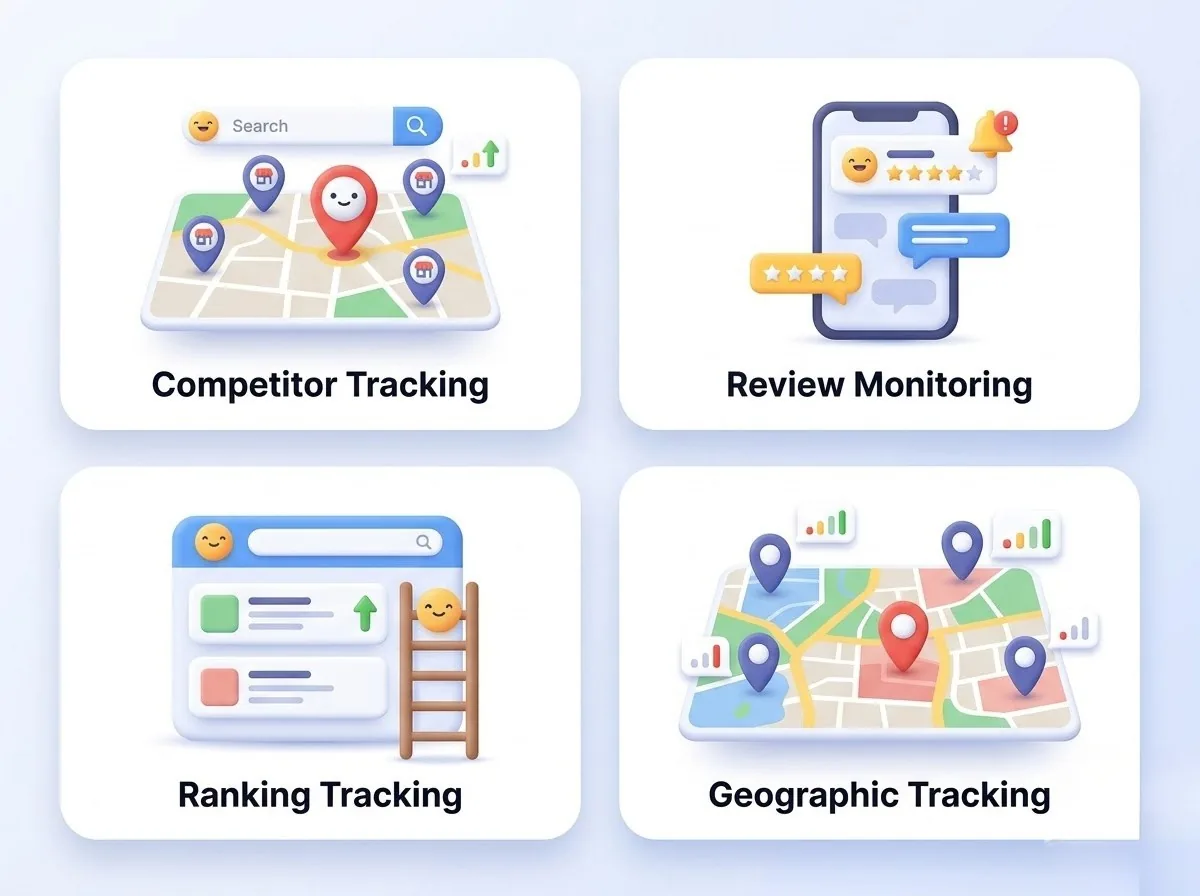
A good local SEO software platform brings several important insights together, making it easier to understand what is happening across your local search presence. By combining competitor tracking, review monitoring, ranking tracking, and geographic tracking, businesses can see where they are performing well, where competitors are gaining ground, and where customers are sharing valuable feedback. This broader view helps turn local SEO data into clearer priorities and more informed optimization decisions.
Customer Action and Conversion Analytics
Ranking improvements are useful, but I always want to know what happens after someone finds the business. That is why local SEO analytics should go beyond keyword positions.
Look for reporting around:
- Phone calls
- Website clicks
- Direction requests
- Profile interactions
- Lead activity
- Ranking trends
For example, if rankings improve but calls and website visits do not, that tells me there may be another part of the customer journey worth investigating.
Reporting That Helps You Take Action
Finally, prioritize reporting that makes information understandable. A good local SEO reporting system should help answer four simple questions:
- What changed?
- Where did it change?
- Why does it matter?
- What should we do next?
I have found that the most useful reports are not necessarily the longest ones. They are the ones that turn local SEO data into clear priorities.
Ultimately, the right software should help you connect local rankings, competitors, Google Business Profile activity, reviews, and customer actions. When these insights work together, local SEO becomes easier to manage, measure, and improve consistently.
Conclusion
Winning more local customers starts with knowing where your business stands in local search and what is influencing your local visibility. In this guide, we explored how local SEO software can help businesses track local rankings, uncover geographic gaps, monitor local competitors, manage their Google Business Profile, stay on top of reviews, and connect search visibility with customer actions such as calls, website visits, and direction requests.
The bigger takeaway? Local SEO is not just about chasing higher rankings. It is about using reliable local SEO analytics to understand what is working, identify where opportunities exist, and make smarter optimization decisions.
Frequently asked questions
What is local SEO software?
Local SEO software brings local rank tracking, geo-grid tracking, Google Business Profile management, competitor tracking, review management, and local analytics into one workflow. Instead of checking each signal separately, businesses get a clearer view of visibility across their local market.
How does geo-grid tracking help win more local customers?
Geo-grid tracking measures rankings across multiple geographic points instead of one location. It shows where visibility is strong, which neighborhoods are weak, how far reach extends, and where competitors appear more prominently, so businesses can prioritize valuable areas.
How does local SEO software help with local competitors?
It identifies which businesses consistently appear in the Local Pack, which competitors outrank you for important keywords, where they have stronger Maps visibility, and how positions change over time. Those insights reveal competitive gaps and content or service opportunities.
How does local SEO software help manage Google Business Profile and reviews?
It helps keep business information accurate across locations, monitor new reviews, identify replies needed, respond consistently, spot recurring feedback, and keep profiles active with useful posts and Q&A. Accurate profiles and active review management reduce friction for customers discovering you in search.
What should I look for when choosing local SEO software?
Look for accurate local rank and geo-grid tracking, Google Business Profile management, competitor and review monitoring, customer-action analytics for calls, website clicks and direction requests, and reporting that explains what changed, where, why it matters, and what to do next.