
How Local SEO Software Simplifies Local Search Marketing
Local SEO software simplifies local search marketing by bringing rank tracking, Google Business Profile monitoring, listing management, review monitoring, competitor analysis and reporting into one place. Geo-grid tracking shows how rankings change across your service area. Software saves time and surfaces problems, but accurate information, useful content and consistent optimization still drive results.
Ever feel like your local marketing tasks are multiplying faster than your customer list? One minute, you’re checking rankings, and the next, you’re updating business listings, tracking reviews, and trying to figure out why a competitor keeps showing up ahead of you on Google Maps. That’s where local SEO software can make a real difference. Effective local search marketing is about more than getting your business to appear in search results. It involves improving local search visibility, managing your Google Business Profile, tracking location-based keywords, and understanding what brings customers through your door. Handling everything manually can quickly turn into a time-consuming puzzle. Tools like Happy Rank help businesses organize their local SEO activities, monitor rankings, and gain insights into their local search performance. Instead of juggling endless spreadsheets and scattered tasks, you can spend more time making informed decisions. With the right approach, local SEO becomes less of a headache and more of a practical way to connect with nearby customers.
Understanding the Challenges of Local Search Marketing
Local marketing sounds simple enough: help nearby customers find your business when they need your products or services. But getting noticed in local search results takes more than adding your city name to a few website pages. Businesses must manage listings, monitor rankings, understand competitors, and keep their online information accurate. Without an organized process, these tasks can quickly become overwhelming.
Why Local Search Visibility Matters for Small Businesses
Imagine someone searching for a plumber, coffee shop, or landscaping company nearby. They will likely check Google Search or Google Maps, compare available options, and choose a business that appears trustworthy and relevant. Strong local search visibility helps your business become part of that decision-making process. Effective local SEO helps businesses connect with customers who are actively searching for nearby products and services. It can support several important outcomes:
- Google Maps visibility: Improve your chances of appearing when customers search for relevant local services.
- Local keyword rankings: Understand how your website performs for searches related to your services and service areas.
- Website traffic: Attract visitors who are looking for solutions your business provides.
- Customer inquiries: Create more opportunities for phone calls, direction requests, bookings, and quote requests.
For businesses serving specific neighborhoods or cities, visibility can vary from one location to another. Monitoring these differences helps you understand where your marketing is working and where improvements may be needed.
Common Problems With Managing Local SEO Manually
Managing local search marketing manually can feel like trying to solve a puzzle with half the pieces scattered across different tools. You might check rankings in one place, update business information somewhere else, and maintain a spreadsheet to track competitors. Before long, keeping everything organized becomes a job of its own. Some common challenges include:
- Manual rank tracking: Checking search positions repeatedly takes time, especially when targeting several keywords or locations.
- Business listing management: Keeping business names, addresses, phone numbers, hours, and categories accurate across directories requires regular attention.
- Review monitoring: Following customer feedback across different platforms can become difficult as review activity increases.
- Local competitor analysis: Understanding competing businesses requires more than occasionally searching Google and checking who appears first.
- Performance reporting: Collecting data from multiple sources makes it harder to evaluate progress consistently.
These challenges can affect small businesses and marketing agencies alike. When information is spread across disconnected tools, important updates may be missed, and decisions can end up relying on incomplete data.
Why Traditional Marketing Workflows Become Difficult to Manage
The real problem with manual local search marketing is not always the amount of work. It is the difficulty of connecting individual tasks into a consistent process. Updating a listing, improving a landing page, and monitoring rankings may seem like separate activities, but each contributes to your overall local search performance. Without a clear workflow, businesses may struggle to answer practical questions: Without a clear workflow, managing local search marketing can quickly become complicated. Businesses may struggle to identify which tasks need immediate attention, where their online presence is falling behind, and whether their efforts are delivering results. Asking the right questions can help you identify gaps in your local SEO strategy and focus on the improvements that matter most.
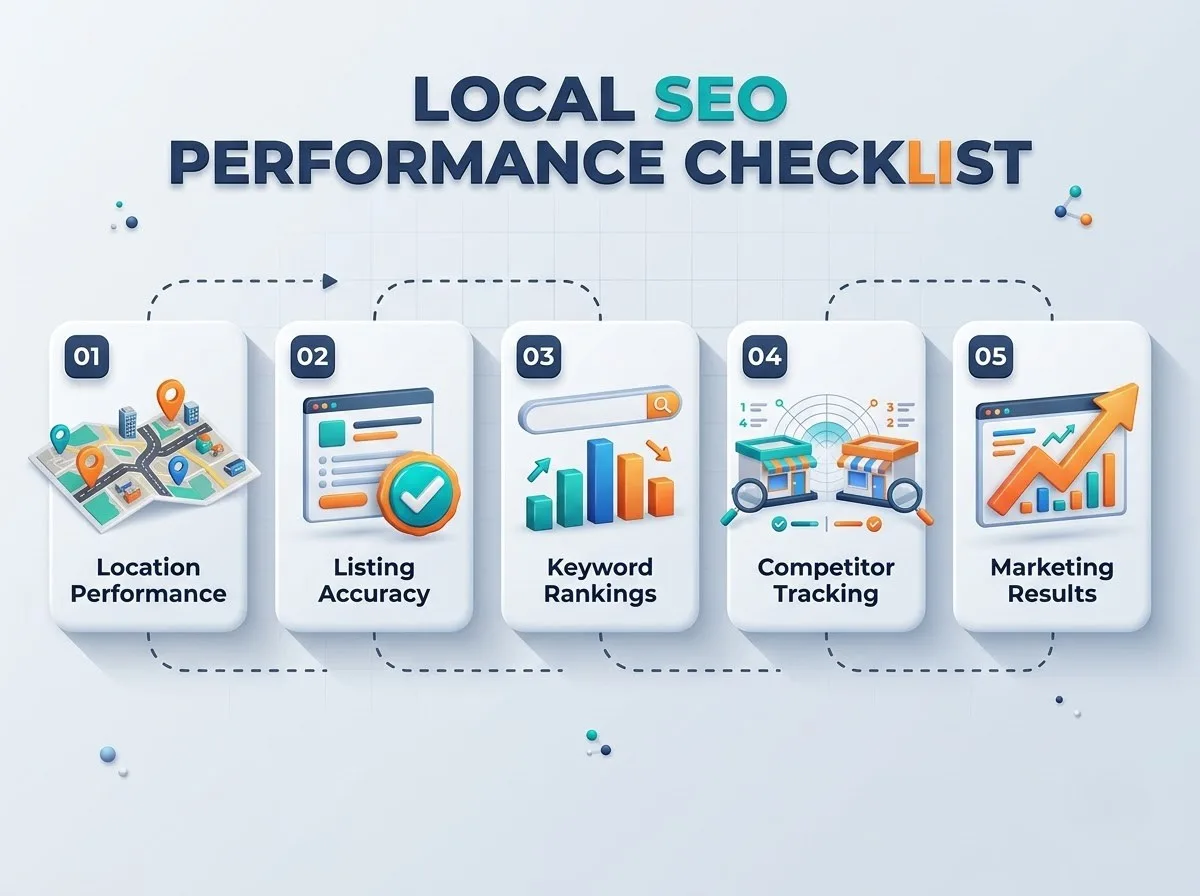
Local SEO performance checklist
A centralized platform such as Happy Rank can help businesses organize local SEO activities and monitor relevant performance information in one place, depending on the features available in their plan. Having a clearer view of ongoing tasks and results makes it easier to identify priorities and maintain a consistent optimization routine. The goal is not to automate every decision. It is to spend less time collecting scattered information and more time using it to improve your marketing. When local SEO tasks become easier to manage, businesses can focus on what matters most: reaching nearby customers and building a stronger presence in local search results.
How Local SEO Software Automates Everyday Marketing Tasks
Managing local search marketing gets easier when you no longer have to handle every task manually. From checking keyword rankings to monitoring business listings, local SEO software helps organize repetitive activities and gives businesses a clearer picture of their online presence. Instead of spending hours switching between platforms, you can focus on making improvements that help customers find your business.
Simplifying Local Keyword Research and Rank Tracking
Choosing the right keywords is essential for reaching people searching for your services. Local keyword research helps identify search terms that include specific services, cities, or neighborhoods. For example, a landscaping company might target phrases such as "lawn care services" or "landscapers near me." With local rank tracking, businesses can monitor how their important keywords perform over time. Depending on the software, they may also compare rankings across different service areas. This helps businesses:
- Identify keywords with strong local relevance.
- Monitor changes in local search rankings.
- Discover locations where visibility needs improvement.
- Evaluate whether optimization efforts are producing progress.
Rather than checking rankings randomly, businesses can use consistent tracking to make better-informed decisions.
Managing Google Business Profile and Business Listings
Accurate business information makes it easier for potential customers to contact you or visit your location. However, keeping details consistent across multiple platforms can become tedious. Google Business Profile optimization helps businesses maintain important information, including business hours, categories, contact details, and services. Local SEO tools may also help identify listing inconsistencies and organize updates across supported directories. For example, if a business changes its phone number, outdated details on online directories could confuse customers. Regular local listing management helps reduce these inconsistencies and supports a more reliable online presence.
Monitoring Reviews and Customer Feedback
Customer reviews influence how people evaluate local businesses. Monitoring feedback helps you understand what customers appreciate and where your service might need attention. Online review monitoring brings customer feedback into a more manageable workflow when supported by the platform. Businesses can look for recurring comments, identify common concerns, and respond thoughtfully to customer experiences. Useful review management practices include:
- Checking new reviews regularly.
- Responding professionally to positive and negative feedback.
- Identifying recurring service issues.
- Monitoring changes in review volume and ratings.
These activities help support online reputation management while showing customers that their feedback matters.
Reducing Repetitive Tasks Through Centralized Workflows
Switching between spreadsheets, listing platforms, and reporting tools wastes valuable time. A centralized local SEO dashboard can bring supported tasks and performance data together, making daily marketing activities easier to organize. Platforms such as Happy Rank can help businesses monitor local search performance and manage relevant SEO activities according to available features. This gives teams a more structured way to review progress and identify priorities. Ultimately, automation works best when it reduces repetitive work without replacing human judgment. With a more organized workflow, businesses can spend less time managing scattered tasks and more time improving their local search visibility.
Improving Local Rankings With Better Data and Insights
Guesswork can make local SEO feel like throwing darts in the dark. You might update your website, add new keywords, or improve your business listing without knowing whether those changes are helping. Local SEO software makes this process more organized by helping businesses monitor performance, identify opportunities, and make decisions based on useful data.
Tracking Local Rankings Across Different Areas
Did you know your business can appear prominently in one neighborhood but struggle to gain visibility just a few miles away? Local search rankings often vary depending on the searcher's location, competition, and search context. Tools with geo-grid rank tracking help businesses examine ranking patterns across multiple points within a service area. For example, a plumbing company might rank well near its office but appear less frequently in surrounding neighborhoods. These insights can help businesses:
- Identify areas with weaker local search visibility.
- Understand how rankings vary across service locations.
- Prioritize relevant location-based keywords.
- Evaluate changes in visibility over time.
This information helps businesses develop more focused optimization strategies instead of assuming that one ranking reflects performance everywhere.
Analyzing Local Competitors
Your competitors can reveal useful opportunities, provided you look beyond who ranks first. Local competitor analysis helps businesses understand how other companies appear in search results and where their own online presence may need improvement. Depending on the tool, you can examine competitor keyword visibility, business listing information, review activity, and other available SEO signals. For example, if competing businesses have more complete service pages or consistently earn customer reviews, you can identify areas worth improving in your own strategy. The goal is to learn from the local market, not simply copy another business.
Identifying and Fixing Local SEO Problems
Small issues can create unnecessary obstacles in your local SEO strategy. Missing business information, inconsistent listings, outdated website content, and poorly optimized service pages may limit your ability to reach relevant customers. A local SEO audit helps uncover these issues so you can address them systematically. Start by checking:
- Whether your business information is accurate and consistent.
- Whether important service pages target relevant local keywords.
- Whether your Google Business Profile is complete and up to date.
- Whether your website has technical or on-page SEO issues.
Prioritizing these improvements helps you use your time and resources more effectively.
Turning SEO Reports Into Actionable Decisions
Collecting data is useful only when you know what to do with it. Local SEO reporting helps businesses track trends in rankings, website traffic, and customer actions such as calls or inquiries when those metrics are available. Tools such as Happy Rank can support local performance monitoring through their available reporting and tracking features. By reviewing results regularly, businesses can identify what needs attention, refine their local search marketing strategy, and make more informed decisions about their next steps.
How Local SEO Software Supports a More Effective Marketing Strategy
Getting better rankings is great, but what happens after your business becomes more visible? The real goal of local search marketing is to connect with the right customers and turn that visibility into meaningful business results. Local SEO software helps you organize your efforts, measure progress, and build a strategy around what the data tells you.
Connecting Local SEO Activities With Business Goals
It is easy to get caught up in rankings and forget what they are supposed to achieve. While local keyword rankings and Google Maps visibility are important, businesses should also consider whether their marketing attracts potential customers. Start by connecting your SEO activities to specific business goals, such as:
- Increasing relevant website traffic from local searches.
- Generating more phone calls and quote requests.
- Improving visibility in important service areas.
- Encouraging more customers to visit a physical location.
- Attracting inquiries for high-priority services.
Tracking these outcomes alongside search performance gives you a more complete picture of your local SEO strategy. Rankings show where you appear, while customer actions help you understand whether that visibility is bringing potential business opportunities.
Creating a Consistent Local SEO Workflow
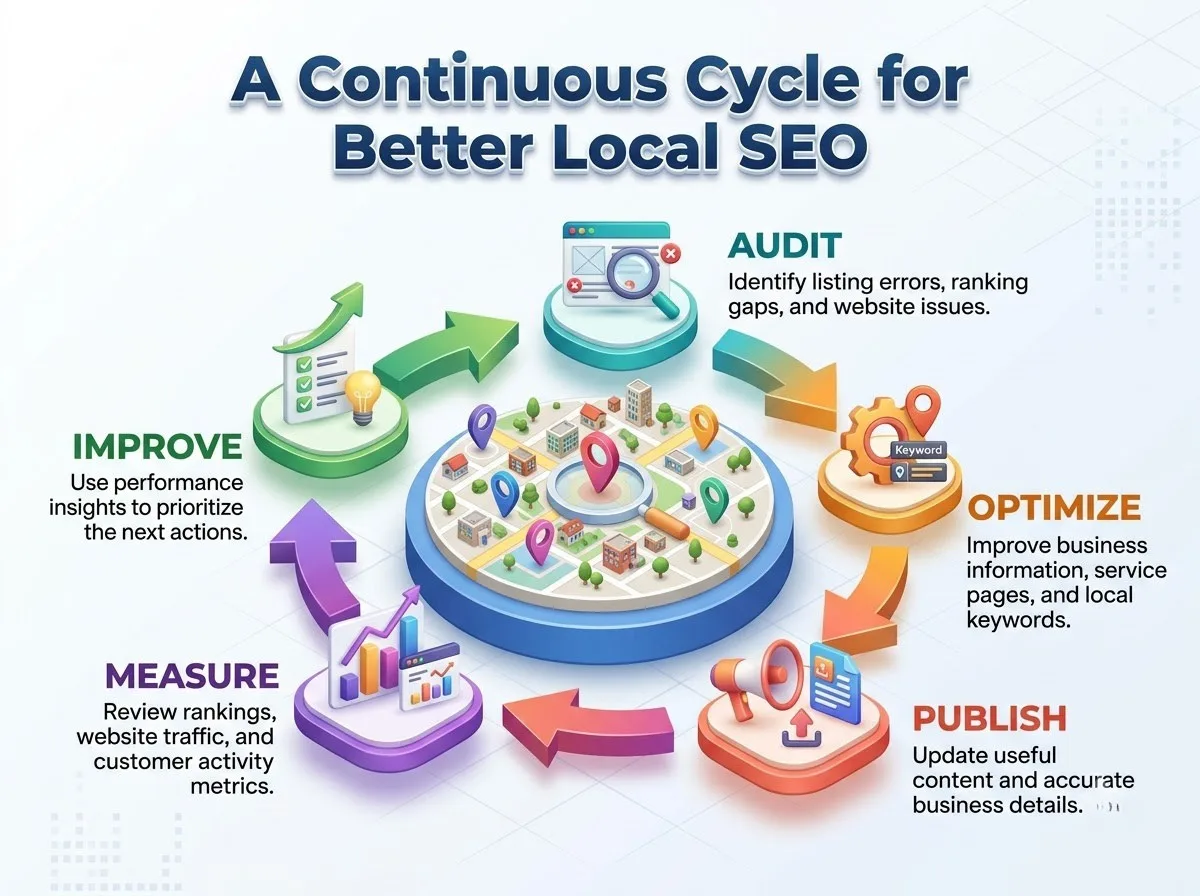
Local SEO works best when optimization becomes a regular habit rather than an occasional project. A structured workflow helps businesses keep important tasks moving without losing sight of their priorities. A practical approach follows five stages: A structured workflow makes local SEO marketing easier to manage and improve over time. Instead of handling tasks randomly, businesses can follow a consistent process to identify problems, optimize their online presence, publish accurate information, and track performance. Each stage builds on the previous one, helping you make data-driven decisions and focus on the improvements that can strengthen your local search visibility.
Local SEO infographic design steps
Using local SEO tools to organize these activities can make the process easier to repeat. Platforms such as Happy Rank can help businesses monitor relevant local SEO activities according to their available features.
Managing Multiple Locations More Efficiently
Managing one business location is challenging enough. Add several branches or service areas, and keeping track of everything becomes considerably more complicated. Multi-location SEO requires accurate information and a tailored approach for each location. A centralized platform can help teams organize location-level performance, compare rankings, and identify which branches need additional attention. For example, a restaurant chain may perform well in one city but struggle to appear in searches around a newer branch. Reviewing each location separately helps the team identify gaps instead of applying the same strategy everywhere.
Making Better Use of Time and Marketing Resources
The biggest benefit of an organized local search marketing strategy is the ability to focus on tasks that matter most. By reducing repetitive work and making performance data easier to review, local SEO software helps teams prioritize their time. However, software alone will not guarantee higher rankings. Accurate information, useful website content, positive customer experiences, and consistent optimization remain essential. When your workflow is organized and your decisions are backed by data, local SEO becomes easier to manage and more closely aligned with your business goals.
Choosing the Right Local SEO Software for Your Business
Not every business needs an expensive marketing platform packed with features it will never use. The right local SEO software should solve your current challenges, fit your workflow, and help you improve local search visibility without adding unnecessary complexity. Before choosing a tool, focus on the features that support your business goals.
Essential Features to Look For
A useful platform should make everyday local SEO management easier while providing insights you can turn into action. Consider these essential features when comparing options:
- Local rank tracking: Monitor keyword positions and understand how visibility changes across relevant locations.
- Google Business Profile monitoring: Review important business information and identify opportunities to improve your profile.
- Local SEO audits: Find listing inconsistencies, website optimization issues, and other potential problems.
- Competitor analysis: Understand competing businesses and identify gaps in your local marketing strategy.
- Review monitoring: Keep track of customer feedback and identify recurring concerns.
- Geo-grid rank tracking: Examine local ranking patterns across different areas, where supported.
- Performance reporting: Review available metrics to understand progress and prioritize future improvements.
You do not necessarily need every feature on day one. Choose tools based on the tasks that currently consume the most time or create the biggest obstacles.
Evaluating Ease of Use, Scalability, and Reporting
A platform may offer impressive capabilities, but those features are only valuable if your team can use them effectively. Look for an intuitive interface, clear reports, and workflows that match your daily marketing activities. Consider these questions before making a decision:
- Can you understand the reports without extensive technical knowledge?
- Does the software support the number of locations you manage?
- Can you track the keywords and service areas that matter to your business?
- Are the available features included in your chosen pricing plan?
- Does the platform provide the support and integrations you need?
Also, consider the potential local SEO ROI. Compare the subscription cost with the time saved, the quality of insights provided, and the business opportunities your improved marketing may generate. Remember that software cannot guarantee rankings or revenue.
How to Get Started With Local SEO Software
You do not need to overhaul your entire marketing process overnight. Start with a few practical steps and build from there.
- Establish a baseline: Record your current rankings, business listing status, and available performance metrics.
- Fix the basics: Correct inaccurate business information and address obvious optimization issues.
- Set priorities: Choose relevant local keywords and identify the locations that need attention.
- Monitor progress: Review performance regularly and look for meaningful changes.
- Refine your strategy: Use the information available to adjust your priorities and measure results.
Happy Rank is an option to explore if you want to organize your local SEO workflow and monitor local search performance. Review its available features and pricing to determine whether it fits your business requirements. Ultimately, the best tool is one that makes your marketing process clearer, more consistent, and easier to manage. Start with your biggest challenges, choose features that address them, and expand your approach as your business grows.
Conclusion
Local search marketing does not have to feel like a never-ending checklist of rankings, listings, reviews, and reports. With the right local SEO software, businesses can simplify routine tasks, monitor local search rankings, identify optimization opportunities, and make more informed marketing decisions. The key is to focus on what actually helps your business grow. Keep your Google Business Profile accurate, track relevant local keywords, monitor competitors, and use performance insights to improve your strategy. Remember, better local search visibility takes consistent effort, useful content, and a positive customer experience. Software makes the process more manageable, but your ongoing decisions make the difference. If you want to bring more structure to your local SEO strategy, explore how Happy Rank fits your needs and helps you monitor your local search performance. Start by identifying the tasks that consume the most time, then build a workflow that makes them easier to manage. After all, local SEO should help you spend less time chasing data and more time connecting with the customers who matter most.
Frequently asked questions
What does local SEO software do?
It organizes repetitive local SEO tasks: tracking keyword rankings across locations, monitoring your Google Business Profile and listings, following reviews, analyzing competitors and reporting on performance in one dashboard.
Why is managing local SEO manually difficult?
The work is spread across rank checks, directory updates, review platforms, competitor research and spreadsheets. When information sits in disconnected tools, updates get missed and decisions rely on incomplete data.
What features should I look for in local SEO software?
Local rank tracking, Google Business Profile monitoring, local SEO audits, competitor analysis, review monitoring, geo-grid rank tracking and clear performance reporting. Start with the features that solve your most time-consuming tasks.
Can local SEO software guarantee higher rankings?
No. It saves time and shows where to improve, but rankings still depend on accurate business information, useful website content, positive customer experiences and consistent optimization.
How do I get started with local SEO software?
Record a baseline of your rankings and listing status, fix inaccurate business information, choose priority keywords and locations, review progress regularly, and adjust your priorities based on the results.